
Points:
Time spent:
IP address:
Canary word: Present
Possible AI signals:
Original Text:
Are you sure you want to delete this comment? This cannot be undone.
Mark this comment as a review? Points will be awarded to the poster.
Your comment was posted, but it wasn’t long enough to count as a review. Reviews need about four complete sentences (at least 250 characters). Try writing another review that explains your thoughts in more detail — the author will appreciate it, and you’ll earn points for it.
141,249 Literary Works • 674,329 Reviews



this is probably my april madness submission, so give me all you've got
xoxoxo
Hey Spark,
Have been wanting to review, but wasn't quite sure where to start! This is such an impactful and heartfelt poem - I really love and appreciate it in its current state.
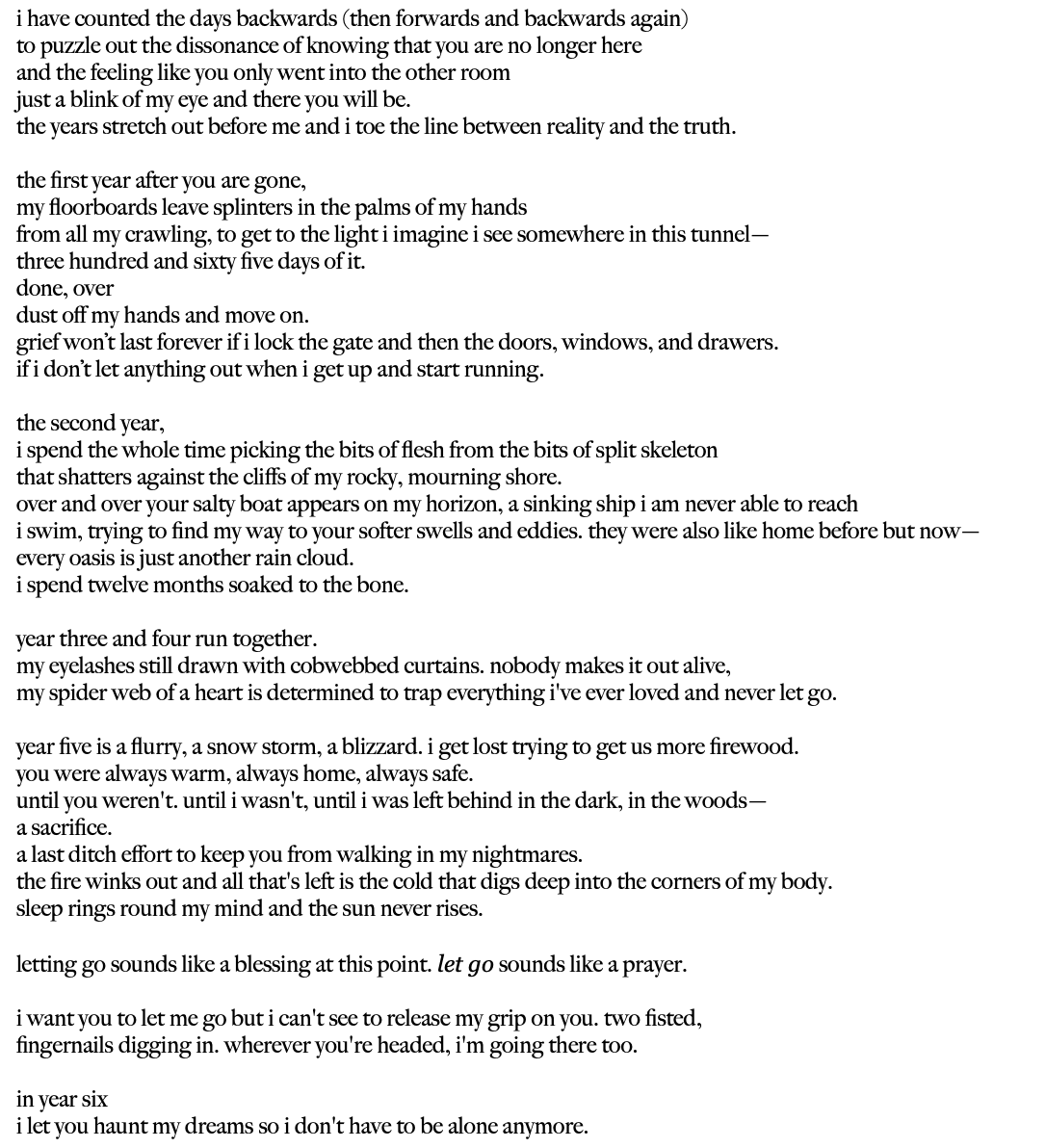
I think the overall arch of the piece is very easy to follow - the speaker is processing through grief over a loss of someone they loved. I think the "loss" could be interpreted as a person leaving, but the context especially in the "year five" and "year six" sections I think point more towards the speaker grieving a loss of someone who has passed.
I really commend you for how concrete you made something that can feel kind of intangible - every stanza not only has concrete metaphor and description and vivid imagery but those images also are dynamic and active - that really makes for an engaging poem. I think one of the risks about writing about a big "feeling" is that the poem can sometimes read as if it's all just in the speaker's head and not feel very lived / real - but this poem certainly does come across as lived and is very engaging to read.
As I read, something I sort of wondered at first was if the poem may be a little bit of a commentary on the seven stages of grief - especially with the numbering, the note about going forward and then going backwards (line 1) I think if that was something you did intentionally or unintentionally it makes it especially bitter / heartbreaking that the poem leaves off at number 6 - because the seventh stage of grief is "acceptance & hope" - meaning if they sort of line up, that the speaker hasn't made it to that stage yet. I can see some other connections in your writing, but I'm not sure if that is over-interpretting.
Some comments on your specific lines in here -
In stanza one - you give an excellent description of the tension in death between closeness and farness. The final line in this stanza "i toe the line between reality in truth" is a great set-up for the rest of the poem because as a reader it makes me a little cautious to trust the speaker and almost expecting them to not be completely rooted in reality for the rest of the poem. You also very clearly establish your conflict - though I do wonder if it may be helpful to be even more direct that the grief / absence the speaker is facing is that of someone who has died.
In stanza two "year one" - the image of splinters from floorboards in palms is really unnerving, but fits very well. The light in the tunnel has the potential to seem "cliche" but I think the way you've described it comes across as very sincere, it makes me wonder a bit if the implication is the speaker wanted to follow the death that their loved one did "follow the light" or if they were looking for some sign of life / resurrection but could not find it. I really love how you broke up & phrased the lines "grief won't last forever ... and start running" - it's a great example of polysyndeton actually that the way there's a double "and" actually makes it feel like the speaker is trying to convince themselves, or becoming more earnest with the expansions of their first statement. I do think you could get even more dramatic in that line though. Like the transition from gate - door locking is reasonable, the transition between door - window, also reasonable, drawers is more wild / frantic feeling, but could it get even smaller and more absurd to bring home the point even more of this image of closing down and locking everything in. Could even maybe use a bodily image there like "closing down gates, and doors, windows, and drawers, and my fingers around these letters, and my lungs around this air. " etc. Not sure! but just a thought! Because I like the technique, but think you could get away with taking it up another notch.
In stanza three - "the second year" - the second line is very grisly, sort of fitting the pattern from the second stanza of beginning with a shocking image to root the rest of the stanza - I follow the sea metaphor pretty well except the rain cloud I found a little difficult to link up in my mind; and also that felt a little more loose and airy than the more gritty grounded / drowning imagery in the rest of that stanza. I do like the looseness of all of your lines and stanza lengths - I think that is very fitting and works well for a poem like this; it felt organic and yet organized because of the numbering.
In stanza four - "three and four" - I really like the double meaning of the "no one makes it out alive" implying that the speaker has maybe become guarded of people they are connected to, but also of themselves - that maybe they have become dead inside or not able to live fully out and about anymore. This was one of the only ones of the "main" / middle stanzas that didn't have some natural imagery attached outside of the cobwebs, and makes it feel a little different than the others. You're even sort of going with natural elements of wood, water, [cobwebs], snow/fire - it feels a little un-evenish for this one not to have a similar image. But that's also super nit-picky! I think it'd be interesting if that one could incorporate like stone or air or something that would be a natural echo to the other images you have so far.
In stanza five - "year five" - this one's first four lines are the most complicated in the poem so far - but I think they are fairly clear to follow and really portray that feeling of being lost and being "without". I thought describing the fire as "winking out" was a little bit of an odd choice of words - as that seems so peaceful compared to what I would have expected. I like the subtle end rhymes / echoes between wood / woods, sacrifice / rises.
In the conclusion aspect - the italicized "let go" - I think the italics was fine there - but I did wonder if that font might be a touch larger that the rest of the text in that line? Might just be that font looking a little off to me there. I do like how at first I expected the "let go" to be in the direction of the speaker to the subject, but instead it's flipped from the subject to the speaker - showing how active / prominent they really still are. I like that the description of the fingernails / grip makes me think back to stanza two with the palms - and makes me almost want more hand imagery throughout. The final lines also echo the lack of sleep theme from stanza five - and I think that's another potential theme that could be expounded on a bit more in the poem.
The concluding line isn't what's expected I think from the set-up, and I even read it as a little bit of closure - like the speaker struggled so much from the loss, but once they accepted it a bit more, and even accepted the presence of grief and the person's memory in their life again - allowing themselves to be haunted, it seems like maybe they have some closure / feeling of not being alone anymore. The interesting aspect is no where in the poem did it really seem like they were truly alone (outside of stanza 1) because the subject is so present in the rest of the poem. So it's an interesting conclusion, but for me hits a good final note that I interpret somewhat positively.
Overall my absolute favorite lines were all of stanza two, and then also in stanza three that images of a body continuing to be swept to shore is very haunting but also fitting for this all.
I think a lot of readers will be able to resonate with the drawn out and multiple-toned emotion that you describe as part of the grief of the speaker. The poem is both personal and relatable. And there's a lot of depth and interesting imagery here that makes me want to read it through multiple times.
I enjoyed reading this a lot, and really don't have anything to say in terms of "big suggestions" - but just enjoyed the read and being able to enter the world of this poem for a moment.
Lastly, I'm really sorry for your loss - assuming this poem comes from a personal experience of grief - and hoping writing this maybe gave you some good processing too. <3 As your poem very much shows - even losses that are "old," sometimes run very deep.
Thanks again for sharing! Please let me know if you wanted feedback on some aspect I didn't get to.
alliyah
Grief is no laughing matter and you showed grief in a tangible and expressible manner that many would find easy to understand. I have lost someone, a blood relative, and I feel the sting. However, I was not close to that said relative despite loving them. This poem shows that you may have lost someone really really close to you. In your poem, I could sense your loss and your pain and your struggle in staying afloat in a sea of emotion, sadness, and pure grief.
Your descriptions of grief are painful and tangible. Even those who have not peeled such things will drown at the weight of your words. For the first paragraph, you talk about counting the days forwards and backwards and forward once more. It is an accurate description, because I have seen someone who has dealt with grief. They kept recounting their memories with that person, every single object, event, or word reminding them of that person. And it does feel like a blink of an eye. Death comes to all and it's a painful thing because time is temporary. Nowadays, time runs faster than ever before so the gravity of the pain is even more heavy. In your second paragraph, you talk about your first year of grief. Crawling is a vivid way to describe the way you are desperately trying to find hope or happiness in this situation. Personally, the third paragraph is the most gripping for me. Describing the situation as a sinking ship you can’t reach shows that you are feeling horrible for an event you cannot control. It’s a sinking and paradoxical emotion of seeing something horrible happen in front of your eyes and not being able to do anything about it. The last few paragraphs show that the person is still dealing with memories of the person. In the end, they’ve learned to deal with the grief, albeit still missing the person terribly.
Overall, this poem is beautiful, gripping, riveting, and simply poignant. I want to applaud you for being able to capture such a complex subject within a few paragraphs. And I really hope you're okay.
This is alpacaboss, signing off.
P.S. I just wanted to appreciate your poem and your courage to speak out about this experience. I pray that you’re okay