
Points:
Time spent:
IP address:
Canary word: Present
Possible AI signals:
Original Text:
Are you sure you want to delete this comment? This cannot be undone.
Mark this comment as a review? Points will be awarded to the poster.
Your comment was posted, but it wasn’t long enough to count as a review. Reviews need about four complete sentences (at least 250 characters). Try writing another review that explains your thoughts in more detail — the author will appreciate it, and you’ll earn points for it.
141,381 Literary Works • 674,386 Reviews



Hi Lim! Big fan of this poem so I thought I'd leave a little comment!
I still think this is a really incredible poem and I love the subtle continuity between themes as well as the moments of contrast.
The narrator keeps describing things that seem on their surface so ordinary!! (like spider webs)! but are described in a new way that is just really layered and interesting.
I think my favorite segment is the part about the folded fairy wings -> the speaker is so nonchalantly callous that it's a little shocking and makes me wonder if the fairy is the spider or the speaker themselves or just what it's a symbol of.
Overall there's a ton of complexity and different ways you could interpret a poem like this, but I think the moments of continuity steer the reader into concrete directions of meaning like *look closely, * things are not as they appear, *there's a continuity or thread of connection between us all, & and maybe that thread has to do with the repetition of life.
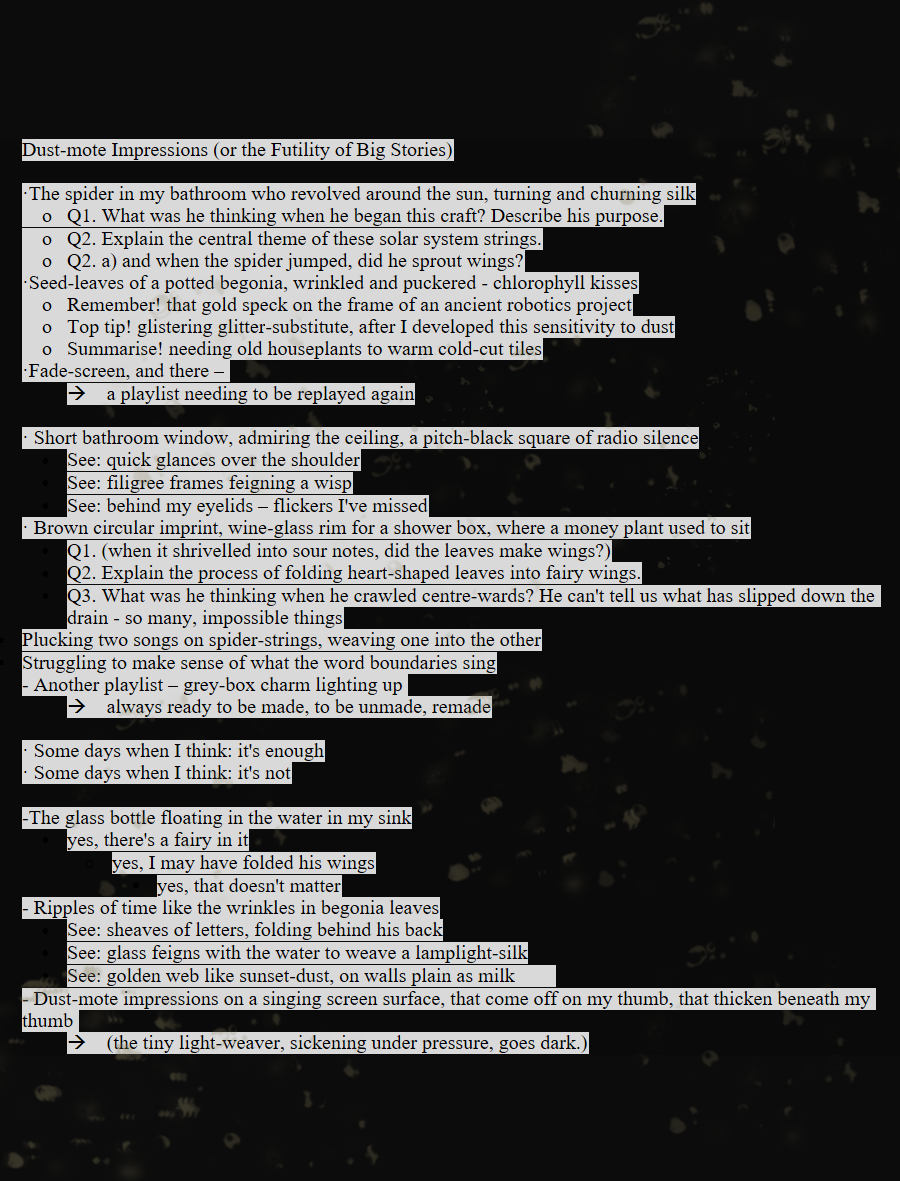
Such a neat usage of the list poem genre too! (I'd also love to hear a bit about your formatting process for this - it looks like newspaper cut-outs, and almost like a reverse black-out poem, which is a really interesting effect too).
Not gonna lie, when I clicked on this poem I wasn't expecting this at all.
And then when I started reading I thought this was some cringe essay plan or something and I was just about to click off. But then- incredible act- the first rhyme.
"explain the central theme of these solar system strings ?
and when the spider jumped, did he sprout wings ?"
That line was just mesmerising. And it totally made me jump right back in the poem.
Sooooooo
wow
What can I say ? This poem (?) is incredible. There's just so much style and so much uniqueness in it,
I'm not quite sure but it felt like a movie script at times, as in when you describe actions. And that line just have so many possibilities. But I'm pretty sure you meant the spider died.
there's also something that could've worked better is to use a particle phrasal verb. Let me explain this Chinese word to you. Basically, at the end of a sentence, to produce a fading effect that lasts upon the reader, authors use this technique. As "faded away" or "trailed off".. In your last line, you end with "goes dark", and since this line, from what I understood, is about the spider dying, saying something like "dissolved away" or something of that style, it would give to the reader a sense of impending doom. It's not a must, but if you're looking to polish this writing, that would certainly help.
Thanks for the review, stygianmoon! That's a lovely suggestion there - I hadn't known about this technique before, so thanks so much for sharing. I'm pleased to hear the poem surprised you, as that was part of my intention writing this. Thanks again for sharing your thoughts <3
Hi! I adore the structure of this poem! I've seen very few artistic poems on this site, and this one is really fantastic and creative. I am a big fan of unconventially formatted poems as well, so I love the fact that this follows no rhyme or syllable scheme and rather just says what it wants to.
This poem so clearly paints little vignettes of each story you tell, and leaves it to the reader's interpretation to decide what each vignette means to them. I think this is very touching and creative, and I love the details and how clearly you describe things. I was never bored in this poem.
Fantastic job!!
Thanks for the review! I did write it hoping to create some kind of cohesion without rhyme/syllable schemes, so I'm glad it worked for you as a series of vignettes. Thanks again for your lovely comments