
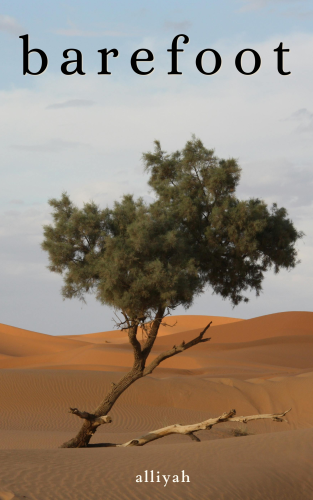
i make my own Horeb in the middle of my grief / and demand fire, for this water is too bitter to drink ("marah" (מָרָה) all the way through); i lament for everything the river drowned. / He cups my head gentle against His chest and lets me weep. i want to know His name as soon as He calls my own like Moses (מֹשֶׁה) / "daughter, daughter" the repetition draws me out; like honey-clotting, tide-pulling, shepherd-staff-straining to pull a lamb that's fallen into a pit. / i am His, and i know not who He is, but His name is woven (papyrus reeds for a basket) into-through-and-against the name of my father, and his father, and his father all the way to Abraham.
and Hagar whispers, "this is my (your) God too" / "El Roi, El Roi". i let Him name me what He wants to. ash smudged on feet; well-water in my glass.
Points:
Time spent:
IP address:
Canary word: Present
Possible AI signals:
Original Text:
Are you sure you want to delete this comment? This cannot be undone.
Mark this comment as a review? Points will be awarded to the poster.
Your comment was posted, but it wasn’t long enough to count as a review. Reviews need about four complete sentences (at least 250 characters). Try writing another review that explains your thoughts in more detail — the author will appreciate it, and you’ll earn points for it.
141,368 Literary Works • 674,383 Reviews




I wrote this poem much inspired by candyhearts style for the Imitate Me hashtag challenge, and liked the poem so much I thought I'd post.
I'm a big believer that poetry can be interpreted faithfully without knowing the author's intention, so please feel free to interpret the poem's meaning however best suits you. Would love to know your interpretation for how the poem is striking you.
*** Scripture Reference Notes ***
Spoiler
A reader who isn't familiar with some of the above scriptural references within the poem may benefit from reading these passages that the poem references:
Genesis 16 - Hagar meets God in the Desert, names God,
Ruth 1 - Naomi's Sons Die, renames herself,
Exodus 2 - the naming of Moses, Drawn out of the Water Twice,
Exodus 3 - Moses meets God at Horeb, is given God's name,
Exodus 14 - the Israelites Drawn out of the Water,
Exodus 15-22 - the Israelites meeting God in the Bitter Desert,
John 4 - The Shepherd Meets the Woman at the Well,
Mt. Horeb References in the Bible.
Hebrew notes:
Horeb (חֹרֵב) - Desert (also refers to Mt. Horeb / Mt. Sinai)
Marah (מָרָה) - Bitter (can also refer to the name)
Moses (מֹשֶׁה) - To Draw Out (can also refer to the name)
El Roi (אֵל רֳאִי) - The God Who Sees (name of God given by Hagar)
*** Interpretive Intent ***
Spoiler
To me, personally the poem is a reflection on my experience with grief and faith. Grief re-writes our self-knowing in faith, and maybe more difficult... grief re-writes our God-knowing too. God's response to our bitterness, is not far-off or un-knowing, but it draws us in and draws us out. He weaves himself into-through-and-against loss, close enough to see and hold us, and ultimately draws us out to save us; a fountain in a desert place.
Hello! I wrote a review for this and conveniently forgot to submit it.
Loving the midrashic vibe here - to me, I get a sense that the narrator is refusing to passively retell these stories, and instead is inhabiting them and allowing several biblical figures and places to speak across one another.
Great sense of force/determination here!
I really like the blending of Horeb and Marah here as well. They belong to different moments, but I think the poem draws them together through need: fire is demanded because the water cannot be drunk. That collapsing of geography makes a lot of sense to me, even across stories. Grief does not necessarily unfold chronologically or tidily, and the poem’s landscape behaves similarly - every place of suffering and encounter seems to exist at once, fittingly. That is such a beautiful way to reimagine grief!
I like the inclusion of the Hebrew, too, because naming is so central throughout the poem. The original language names feel physical here, as though the narrator is trying to reach beneath translation and touch the oldest available form of these stories.
Also loving the slash format! It makes me think that the poem is continuously moving forward while carrying several thoughts at once, which fits the overwhelming quality of grief. It reads as though the narrator has too much to say to stop for a traditional line break. I also like that it creates a sense of movement WITHOUT fully separating them, since you cannot necessarily have one without the other.
Gorgeous!
The papyrus parenthetical is so clever to me because it returns to Moses’ basket while describing a name as "woven." There’s also an interesting reversal here. Moses is placed in a woven basket to survive the river; the narrator finds God’s name woven into a lineage that may itself serve as a kind of vessel through grief. Very thought-provoking!
At the same time, the phrase "my father, and his father, and his father all the way to Abraham" introduces a strongly patriarchal genealogy - I think the later arrival of Hagar is very essential because she interrupts, or perhaps expands, that lineage. Especially in grief, it is nice to recognize that God also belongs to the abandoned and overlooked, like Hagar (or really any woman in these texts).
I also really enjoyed the ending:
I like how the progression moves from demanding a sign, to being held, to hearing "daughter," to accepting whatever name God gives. That is such a satisfying transformation without being overly triumphant, as you can't "erase" what has happened prior. Once again, I think that is a solid way to view grief/the past.
All the best!
Belated, but this was such a very thoughtful and detailed review - thank you! Very appreciative! Love that you found it midrash-like as well! Thanks for your thoughtful analysis! <3
Alliyah!
You have so much packed in here, so I'm going to touch on a few things.
On a more surface level:
-after "bitter to drink" it took me a few reads to get the rhythm down to read it smoothly. If that is your intention, then you're good! If not, maybe look at if there's another way to punctuate to make it clearer?
-"daughter/daughter" section just feels like it's missing a syllable or has one too many, and I can't tell if it's how I'm reading it or if the unsettled feeling is intentional.
-on the other hand, I absolutely love everything from "woven" to "Abraham" - it reads beautifully and feels like enjambed lines without actually being such
On a content level: I am impressed at how seamlessly you've woven so many references into one, and as a reader I definitely appreciated your reference notes. It's definitely a case of context making a difference in how you as the writer were thinking, and it helped in my reading. I know there's mixed opinions on hearing anything from an author vs. something standing on its own. In this case I think a good portion would stand on its own, but you get more depth with your notes.
<3
Mesh! Thank you so much for the thoughtful review! <333
> "bitter to drink" -> yes, you're definitely right that something is a little awk there to follow -> I think the italics, plus the quotes, plus the Hebrew, plus the parenthesis kind of is too jolting, I think if I format it a little differently I can hopefully get that smoothed out. I liked putting both marah and מָרָה because the first I think points a reader to when the Israelites were complaining for water in the desert (which fits with the poem's imagery themes quite nicely) but the Hebrew is a reminder that it is also the name Naomi chooses for herself "Mara" after her sons die which resonates a bit more directly for me. Will have to consider how to incorporate the English + Hebrew a bit more smoothly in both the spots you mentioned - as I'm definitely going for a play on words with the 3 names.
Thanks for the comments on the notes too, I love that YWS has that "sticky comment" option now so that one doesn't have to add author notes right in the poem itself so readers can kind of opt in or opt out to read as desired.
<3
Good morning, dear writer! Today, we chickens, for our longest dream of clearing the Green Room and dethroning the Golden Goose
to finally sit on it ourselves, bring to you-The Chicken Sandwich Template
Top Bun: First impressions
I've never seen a poem like this before. The setup and everything is very unfamiliar to me.
Slightly Wilted Lettuce: Critiques
To be honest I don't really have many. I just feel like the capitalization is a bit random? I don't know though.
Crispy Chicken: Favorite details
I liked this line
Because it conveys a need for things that are impossible to obtain.
Ketchup: Suggestions for improvement
I don't really have any
Bottom Bun: Closing thoughts
Overall I think the poem was really great and this review was... not
We hope this was helpful! Farewell now, we've got a Review Day to win!!
Bok bok bok buGAWK!!
Chickens
--With best intentions, Yuuki
xxxxx
Hello there alliyah! Currently writing this at midnight because you know what they say, when inspiration strikes, inspiration strikes! 😊😊
I saw this spiritual piece of poetry and knew I definitely had to read it eeeeek! ;D
LOVED:
- the title ahhhh (*sighs in delight*). In fact, I was just reading a really good Christian book ("The Elements" by A Priest of the Oriental Orthodox Church) that mentioned how humility comes from the Latin word humus, for earth. And in the book, the main character had just lost a very close Christian friend of his and was walking barefoot around her tombstone to try to better connect with her, even in grief, as she had mentioned how one must "become earth" to get closer to God. Anyways, sorry for the little rant, but let's just say "barefoot" sounds so deep, and vulnerable, and I really love all the connections it has with spiritual topics!
- Your use of Hebrew! I didn't know what language it was at first, but now that I do, it was such a meaningful choice, as I'm pretty sure all the books you referenced from the Old Testament were first written in it! And I truly have a love for languages, like how each one is deep in its own way, so I think you repeating certain words in Hebrew, maybe to emphasize them, was very meaningful!
- The imagery <333! Especially of the speaker lying on Christ's chest and being allowed to simply cry. It's very vulnerable, but also beautiful and comforting, how our Creator is always there for us through the highs and lows.
- The reference to Horeb, which I didn't know was the same as Mount Sinai, so I learned another new thing today! But I love how it seems like even though the speaker is going through a tough period of grief, it is still a way to connect to God. Like how Horeb means "desert," suggesting a desolate place thirsting for water, and the One at the place, God, provides you with it! I feel like it's a paradox in a sense, because the place of God's presence is named a "desert," but I really liked that!
- The structure of your poem is also interesting. You separated the lines with slashes instead of line breaks (I know, I know, stating the obvious 😅), and I honestly feel this structure does fit the poem's vibe a bit better, since the speaker is in an emotionally rocky time, and the words all being clumped into what seems like a paragraph--but still with the slashes!--emulates that well!
- Finally, I really liked how you listed & linked all the references at the bottom of the page. I have some spiritual poetry that I have not published, but this work has definitely inspired me to do it, and now I can use your strategy of the spoilers in the comments to help others understand the depth behind the references, as well as words in a different language!
I honestly don't have any advice to give on improvements, (I love writing poetry but suck at reviewing it haha), although I do wonder why there was a sudden line break towards the end? Was it to help emphasize the final lines?
Anyways, overall, beautiful job with all the imagery and explaining all the references! <3
Such a thoughtful review @youngdreamer, thank you so much for sharing your reflections and reactions. Very helpful and appreciated!
I may have to check out that book you mentioned -> Re: "barefoot" as a sign of vulnerability -> you're spot on, I was directly referring to Moses encountering the Burning Bush at Horeb there, but also thinking a bit of Jesus washing the disciples' feet. It's a vulnerable place to speak, and yet in the vulnerability of life, there we often meet God most intimately.
Your question Re: the stanza break at the end, I think it was just to emphasize the last part being like a sigh of resolution. At the beginning the speaker longs for fire (God's presence) and sweeter / non-bitter water. In the end they receive what they had longed for but maybe not how they expected -> ash on feet, well-water in their cup. God sees and provides (as He did for Hagar).
Thank you again for all your very thoughtful comments! Hope to read more of your poetry soon too!