
Published October 2, 2016




Points:
Time spent:
IP address:
Canary word: Present
Possible AI signals:
Original Text:
Are you sure you want to delete this comment? This cannot be undone.
Mark this comment as a review? Points will be awarded to the poster.
Your comment was posted, but it wasn’t long enough to count as a review. Reviews need about four complete sentences (at least 250 characters). Try writing another review that explains your thoughts in more detail — the author will appreciate it, and you’ll earn points for it.
141,404 Literary Works • 674,390 Reviews



It's a lighthouse isn't it? Before I read this, it looked like some kind of tower or skyscraper, midway I thought for sure a clock tower, by the end a lighthouse, but man. What a journey this one, whew!
So, I'm no stranger to experiments and heavy structures, no stranger to big projects and big ambitions, I'm a big fan of abstract metaphysical pieces (I'm looking at my copy of Prufrock on my desk, lol) so all of this to say big, ambitious setpieces excite me, though I am far from the mainstream audience, what this means is I am not going to be able to get out ALL of what I want to say in one review, so let's chat this one up!
But some quick things: it really reads to me like a big, epic metaphysical journey even though I kind of cheated having known the insights behind this piece through my chats with you. The title as well alludes to the idea of recycling cliches, and some of them I recognized where they were recycled from, but I don't think I would have understood the recycling premise on my own without previous knowledge of it.
It is actually super subtle bordering obscure. I know there are places where it seems obvious like at the end: "I recycle old metaphors", and near the middle " the documentary about recycling", etc. But the confusion lies in how these set pieces connect, I can elaborate more specifically in chat/pm. Though here comes the eternal struggle and frustration of communication and stringing words, lol!
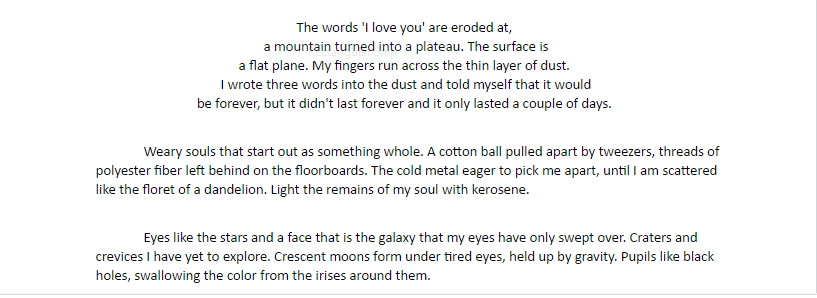
Part of what happens is we're never sure of what we're looking at, for example, we begin with a conflict of eroded i love yous paired with a metaphor of a mountain turn into a plateau, that is plenty grounded and I love the image of the fingers drawing in the dust, it personalizes this. We drift from there to cotton balls, and being picked apart and the hard and heavy emotional pain in tones, ending with this arsonist "lighting of my soul", from there, we are in stars and space.
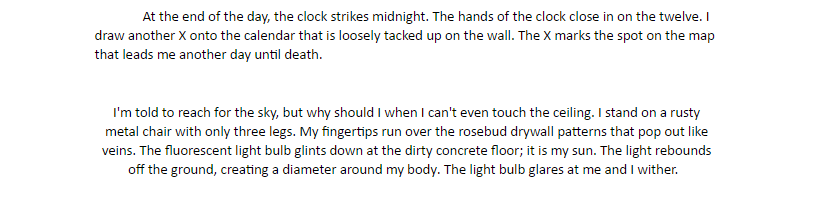
There is a lot of quick movement between these set pieces and we're only allowed a small snippet, so it doesn't give us much time to settle in and make the connections. But for the set pieces themselves, there were lots of beautiful gem, I enjoyed the cotton image, I thought that was new and intriguing and informative too of that emotional moment, cotton is just so very delicate and its threads messy and I picture in my head old cotton gins and the seeds and the picking of it being so very painful, so it was a visceral inage for me. I liked too the rosebud drywall coming alive as well, that reminded me of some Poe-esque imagery.
Your writing is overall beautiful and rich, and I think the challenge of translating something dense with meaning like this is going to inevitably lead to obfuscation, a lot of poets, myself including go through this obstacle, so hit me up at any point I am more than happy to take a closer look!
Above all though, keep up the writing. You have an eye for this.
Still! Chat me up!
~ As always, Audy
Thanks for the review!
Hey, I'm here to review.

All right. Before I start to analyze each stanza (if there is one) and lines, I would like to give off my first impression after seeing this poem. Seeing, not reading, because in my phone I saw the shape of this poem first, not the first line. I assumed it was a shape poem, and if so, it failed to show me the shape on which it was based. Not to mention, if this was a shape poem, the shape was too big that I would prefer to see it rather than reading the entire content. My suggestion is to leave entirely the experimental formatting you're using, or the attempt of making a shape poem, and focus on word choice, the flow from one line to another line, and the connection between stanzas.
First stanza (the mountain-like one).
Simple and to the point. I like it. It talks about the short period of the persona loving someone else, and the imagery is effective to deliver that. However, does this hook me to read further? Well, maybe. I have enough of the phrase 'I love you', no matter how it is delivered. They just indicate this is going to be a romantic/dramatic poem, and, well, I expect diversity. Instead of talking about love between two individuals, why not talk about love towards nature? Or even, stray cat you find on the street? Love is such a wide concept that can be explored and delivered creatively.
After that, I have to be honest with you. I can't read this. I can't continue. I blame myself for being an ESL (English as Second Language), and therefore those imagery you have do not click into my mind like they would if they're presented in my mother language. They're too much for my miniscule brain. I don't understand why it should be like that. I think selecting a few metaphors and expanding on them is a good way to make it that your poem is widely understandable by the non-ESL and ESL speakers, plus, the message cane be delivered more powerful, more poignant.
And so, I am very, very sorry. Usually, if I can't finish a poem, I'll leave it like that and not review it, but I think this one deserves an exception. This is my opinion as an ESL who prefers understandable poetry with few metaphors and much expanding, so perhaps it's not as constructive as it should be. However, I'm glad I've told you what I feel after reading the first stanza and attempting to understand everything that follows it, and perhaps it would give you an idea on how to compose your next poem.
Thanks for the review, 300 points coming your way! :3
Thank you for trying to read this and all ^^
I believe that in your determination to produce a certain form of poetry, to make something so specific, that you allowed yourself to glance past all of the leaks in the pipes, all the execution errors, all the terminal hiccups.
Through a few reads, I've given note that any part that did not undergo specific and intentional, surgical formatting edits for the sake of flow and presentation were riddled with redundancies, repeated phrasing, weak images, repeated phrasing, unneeded JUNK that just slowed down a piece that is already so so slow because of its sheer length.
So that's an overview. The experimental areas are actually quite nice, and as experiments I can appreciate them; however, you desperately need to salvage the remainder and remember in the future that the entirety of a work deserves equal attention to detail. And I understand the overwhelming nature of it all--adjusting comfort zones is weird and hard and hardly done by the fearful. So take some pride that you're brave--and that your experiments warranted some merit.
Oddly enough, my favorite segment of the entire piece is the recycling stanza. It carries a sentiment that actually speaks to me, and I appreciate that. Thank you for that.
Your phrasing still lacks dynamics and it's a disappointment, but there's plenty of time to make that happen. I can go digging for more source material if you'd like examples to learn from. @Morrigan will back me up when I say that you ultimately can't push out anything until you've communed with your poetic god and drank in. It's nearly biblical.
Generally, there's a lot here that, if not experimental, I would advise to be scrapped and burned, but really I think you just need to slow the heck down and check if you're leaving blood on the carpet.
No one will believe it's salsa.
Ty
A few questions for the review because there were some things I didn't quite understand or some things that I wanted to ask:
1) What is communing with my poetic god, I was thinking that it meant don't write poetry until you're sure.
2) Slowing the heck down as in, not writing as much poetry or not posting as often, or checking for edits, because I honestly can't tell sometimes where I'm getting better or worse with where I'm going.
3) I can never tell if I'm getting better or worse, I always think I'm taking a step up, but I always feel like I'm getting proved wrong by that. This was more experimental, and I thought I was doing better than I was before, but I can't always tell anymore.
300 points coming your way.
1. Communing with your poetic god is reading their work. Immersing yourself in their words and, through the process of your life, your brain, your thoughts, your own poetry will be more easily formed. It doesn't mean to stop writing. Just read some good ol' poetry.
2. Slow down as in edit edit edit. Nothing you see from me is a first edition unless it goes on my wall. I even have folks who come before and edit before I release for critiques. But don't slow down writing unless it's burning you out.
3. You will get better through the process of writing, getting feedback, editing, reading, editing, applying feedback, reading, and writing more. Trust me.
My editing must suck at the moment, because I edited the crap out of this. I think my problem is, is that I do it all at once, all the editing at least, and I don't think about it on as high of a critical standpoint as I'd like, and I think that's my problem with it.
Thanks.
Hey Kaos! Geoff/Ravi here to review... or shall I say... gush?
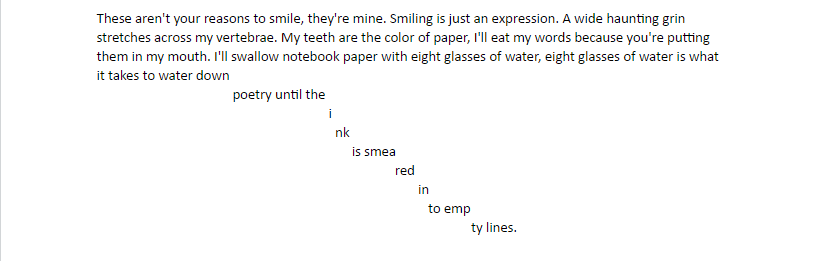
I love this piece so much. After I write this I'm going to go scour the rest of your pieces for more tangled gold. I can't explain it but I just love the way the words feel. The only minor issues I have are with the flow of the poem, not sure if its intentionally choppy or not, and a couple word choices. (the grin across my vertebrae part because vertebrae are in the spine so it doesn't really make sense?) but like overall I loved the piece so I don't know. I loved the way the words tasted, does that make sense? Like if you read it aloud it sounds so great! Oh my goodness!
I'm in awe now because this piece is so good! I can't write poetry to save my life so this is that much more impressive. Keep up the amazing work!
-Geoff <3
Thank you so much!
Alright, alright, I'll try to review a poem of yours. I don't think I've ever reviewed a poem on here before (unless I did with an alt, before), so I'm sorry if I suck at it.
Here goes, I guess?
This feels... wrong. I don't know poetry but it seems kinda – not repetitive or redundant but y'know? The “and” is what particularly throws it off, I think. Maybe you could switch it up a bit or use some different punctuation and toss out the “and”?
I like the third stanza, with all the space allusions and such. Especially “pupils like black holes, swallowing the color from the irises around them.”
These two sentences feel backwards, as if the clock has already struck midnight by the first sentence, but then you backtrack to just before, when the hands “close in on the twelve”. I'm not sure if switching them around or anything like that would affect the rest of the poem, or if this was some intentional poetry process, but--
Okay. “I draw another X onto the calendar that is loosely tacked up on the wall.” feels... loose. With “onto” and “that is” the sentence just feels sorta spread out. Granted, it's your way of writing, so whatever you feel works best, but that's how it feels to me.
As for the second sentence — “The X marks the spot on the map that leads me another day until death.” is that missing a word there, or is there a typo, or am I just not being able to read correctly right now?
I like the effect of the first “staircase” of words about ink smearing and stuff. That's neat. Though, up until this point, each stanza feels like it belongs to a different topic or was torn from some other poem, and it just doesn't really make sense as a whole; some individual stanzas don't even make sense to me on their own.
Is that just because I don't know poetry?
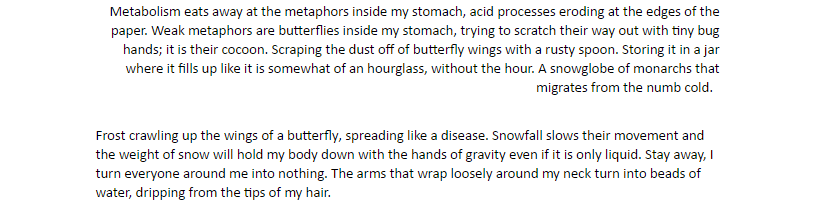
The two stanzas about butterflies, right after the ink smearing staircase, read kind of robotically, or emotionlessly to me? I'm not sure how to explain it or what I could give as an example, but the sentences feel too long and mildly drudging and the description of whatever is going on in them sounds distant and disconnected...
The striked-out line/s sound like a rap, haha. It kinda breaks the poem more than the constantly shifting topic did, but since it's striked-out I assume it's immune to that rule, like it's a background voice or indirectly-connected thought of the narrator, perhaps?
I liked the last stanzas, and the ending of the entire thing with the “black sails” bit. That read nicely and was a sort of satisfying ending to the confusing jumble of everything else (not to say it's bad, I just don't understand poetry).
All-in-all, I've heard you're good at poetry, and, I think, that you're improving? Honestly, myself, I can't really tell; I don't know what's good poetry and what's bad poetry. It's all confusing to me.
Sorry that this probably didn't help any and/or wasted your time.Keep writing, bruv.
- Ttah
Thanks for the review! It did indeed help!