
Points:
Time spent:
IP address:
Canary word: Present
Possible AI signals:
Original Text:
Are you sure you want to delete this comment? This cannot be undone.
Mark this comment as a review? Points will be awarded to the poster.
Your comment was posted, but it wasn’t long enough to count as a review. Reviews need about four complete sentences (at least 250 characters). Try writing another review that explains your thoughts in more detail — the author will appreciate it, and you’ll earn points for it.
141,411 Literary Works • 674,390 Reviews





Thanks for sharing these thoughts on the grayness as opposed to the black or whiteness of things which we encounter and are forced to evaluate. The reality is, of course, that whether we like it or not, not everything is clearcut black or white.
This becomes even clearer when we delve a little into ethics where moral judgments are constantly demanded. In that area of philosophy, we find ourselves constantly confronted with a bewildering array of circumstances that stubbornly refuse to be niched into either white or black. Instead, they straddle the gray area. Let me provide an example.
In the Novel, Les Miserables, the protagonist is arrested for stealing bread for his starving family. Was he indeed wrong in stealing bread. Or was it more righteous to let his family starve in order not to steal the bread? Both are wrong and one would assume that stealing the bread was justified. But he is thrown in prison for it because stealing is a crime which deprives others of things that are rightfully theres.
Then you have a pregnant woman faced with a choice between losing her own life by carrying a baby to term or aborting it. Neither choice is either black nor white.
Do we sacrifice ourselves in an unhappy marriage for the sake of providing the kids with a loving father figure? Or do we seek divorce because we are unhappy?
Do we tell a dying person that he is dying because he has a right to know, or do we spare him the pain of that knowledge so that he can have peace for the short duration of his life.
Do we tell a person prone to heart attacks that his son has just been killed? Or do we lie to him in order to prevent his possible death?
When exactly is a priest under moral obligation to divulge a confession to a victimized party or a possible future victim of marital infidelity?
These situations create what is called a dilemma where both choices seem to be of equal merit and we are pulled in both directions at once and we hesitate. So a world were everything s readily recognizable as either right or wrong with no in betweens simply doesn't exist.
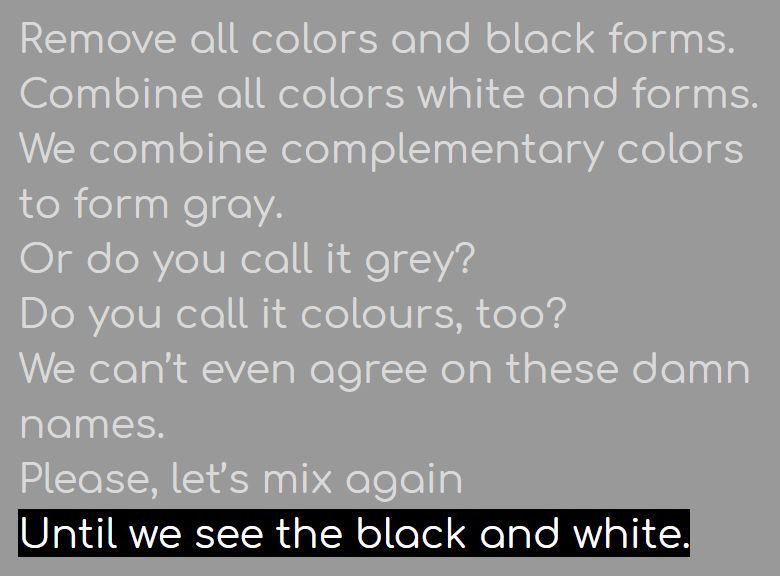
Oi. I can tell this was quick--by which I mean it indicates that you took a singular thought and ran with it into poetry, but philosophically I believe you have it wrong.
Some questions and self-answers:
1. How can you go about addressing the horrendous flow throughout the piece?
1a. You rewrite them and adjust after reading aloud again and again.
1b. You maybe don't rely on the gimmick of a poem in a jpg.
2. Why would you encourage readers not to see the grey areas of life, when as one matures into adulthood it becomes natural to see only those places with no absolutes?
3. What is your intention exactly, as this seems to scatter ideas like lightning?
This needs a ton of work, but more than that, it needs a clear identity, purpose, and thought wheel within a thought wheel. I appreciate the bravery of attempting a new form, but I'm afraid it just didn't work in your favor. Let me know if you have questions.
Thank you for this review. Btw, I just marathoned Gurren Lagann. I liked and I needed it after being affected so deeply by its spiritual antihesis, Neon Genesis Evangelion.
1. You make a totally fair criticism. I remember you advising me to improve my flow from my last poem a year ago. I doubt you know this, but looking at it, I sort of disrespected you by avoiding your last piece of advice. I didn't mean to do that, as this was a very rushed piece and I didn't expect to review my piece again.
1a. Yeah, that makes sense. I failed in doing that but I will hold this advice close next I attempt a poetry.
1b. Gimmicks are an interesting concept. I think the word gives off a negative connotation and people associate it with them being cheap. With my poor writing, I think the gimmick seemed cheap and poorly executed when juxtapose it with my prose. Gimmicks appeal to different people and I still like the idea. The problem, I think, is that the gimmick stood out the most and appeared as the driving force instead of empowering the message. Do you think, if I executed my prose better, that my gimmick would strengthen the poem rather than stand out and appear cheap?
2 and 3. I made a crucial mistake when writing this. This piece does not align with my philosophy. I mentioned Evangelion earlier because the poem's theme bases itself from Human Instrumentaility/Assimilation Plot trope. I use color theory as a parallel to individuality and complications those can give. The meaning I wrote for this the absoluteness of one color (a species) gives a uniform answer to the other extreme (the other color). I moreso support the message of the End of Evangelion and I disagree with this philosophy. I thought the concept was cool, though, and I wrote about it.
I tell you this because I know I conveyed this weakly and I only blame myself. I even made a typo, so that shows how much analysis I did with my own poem. For some reason, gimmicks compel me to make poetry. Why? I don't know. But I thank you for this review. I think a focus on the prose itself will prioritize other aspects of my next work.