
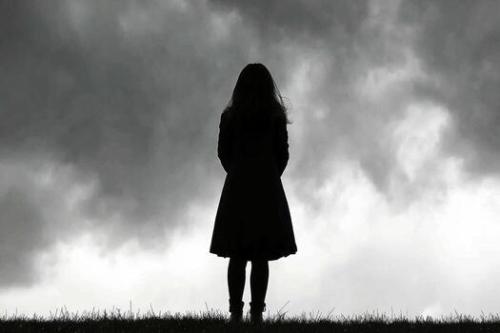
Why can't I just exist?
Why must you break me down to build me up?
I'm standing right here.
I'm looking straight into your eyes.
You look back and whisper, "I wish I could have a daughter."
And he replies, "Just leave it alone. She isn't worth it."
The words ring empty, but they bruise.
They fall, they shatter, and so do I.
I bend until my bones break.
I twist myself into a shape you can love.
I try to be a good daughter.
I try to be a quiet friend.
I try to be a perfect sister.
You tell me "Nobody's perfect,"
yet you grade every word I speak.
You lie with a siren's voice.
Where did she go?
The loud little girl with ink on her hands.
The creative child who drew on the walls and sang out loud.
The free girl who never worried about clothes, or dating, or words.
I locked her away.
You traded her for a ghost who obeys.
I'm still standing here.
I'm tired of breaking for your approval.
The words still hurt, but I'm starting to see the truth.
I will drop the heavy shards of who you want me to be.
I will let the little girl breathe again.
Points:
Time spent:
IP address:
Canary word: Present
Possible AI signals:
Original Text:
Are you sure you want to delete this comment? This cannot be undone.
Mark this comment as a review? Points will be awarded to the poster.
Your comment was posted, but it wasn’t long enough to count as a review. Reviews need about four complete sentences (at least 250 characters). Try writing another review that explains your thoughts in more detail — the author will appreciate it, and you’ll earn points for it.
141,045 Literary Works • 673,936 Reviews





Wow, Junebug. Just wow. This is amazing.
The questioning is what brings this to life. These are questions many of us have asked. Myself included.
We're transported from the narrators mind to their physical space. And we hear these people. These people that are breaking the narrator down.
"She isn't worth it."
That's the hardest hitting line in this entire chunk. It's raw and painful because so many of us know it.
Words hurt so much. The narrator falling and shattering is an image that sticks with you. You understand what these words mean to the narrator and what they do.
The narrator twists and bends themself into someone for these people. Someone that they'll love.
They try to be perfect for all these people. But no one's perfect.
Ooo. Greek mythology reference! These people say one thing but act a completely different way.
This is the best part by far! You tell this story of a girl lost. A child that you wish you could be. The child we all miss. And there it is. The Ink On Her Hands. Although something here.
These almost contradict each other. It's a little fuzzy what you mean here.
The narrator has decided to leave expectations behind and be herself. It hurts, yeah. But moving on is what we need.
Letting the little girl breathe is what the narrator needed to do.
Honestly, this was a raw honest poem that told many people's story. Amazing job. Amazing.
Keep on living and writing!
MrytleJinn
Namaste this is shakthisinha
And this is my review
I felt that "Ink on Her Hand" is mainly about how a person slowly loses herself while trying to become the person others want her to be. The poem starts with a lot of frustration, especially with the question, “Why can't I just exist?” I think this is a simple opening, but it immediately gives us the feeling that the speaker is tired of constantly having to prove herself.
The part where the speaker hears “I wish I could have a daughter” while she is standing right there is probably one of the more painful moments in the poem. I liked that the poem shows the hurt through a situation rather than just saying that the speaker feels unwanted. The line “The words ring empty, but they bruise” also works for me because it shows that even though the words are not physically hurting her, they still have an effect on her.
I think the next part is quite relatable in the way the speaker keeps trying to become a “good daughter,” “quiet friend,” and “perfect sister.” But at the same time, I felt that this section becomes a little too direct. The poem tells us clearly what the speaker is trying to be instead of always letting the reader understand it through the images. I think it could have been slightly more subtle.
The line “I bend until my bones break” stood out to me. It gives a physical form to the idea of changing yourself for someone else's approval. “I twist myself into a shape you can love” continues that idea, and I think these two lines work better than simply saying that she is changing herself.
The section beginning with “Where did she go?” is my favourite part of the poem. Here the poem becomes more personal because we get to see who the speaker used to be. The “loud little girl with ink on her hands” is a nice image because the ink becomes connected with her creativity and freedom. I also liked the contrast between the girl who drew on walls and sang loudly and the person she has become now.
“You traded her for a ghost who obeys” is probably the strongest line for me. It says a lot without needing too much explanation. The speaker is still physically there, but the person she really was has almost disappeared.
I did feel that some of the imagery in the poem is quite familiar. There are several images of breaking, shattering and becoming pieces, so after a point the effect becomes a little predictable. I think the poem is stronger when it uses its own specific images, like the ink, the walls and the ghost, rather than the more common images of breaking.
The ending gives the poem a sense of recovery. I liked that it comes back to the little girl instead of introducing a completely new idea. Still, I felt the ending could have been a little less obvious. The idea of “letting the little girl breathe again” is understandable, but the poem had enough imagery before this that it might have been stronger if the ending trusted one of those images instead.
Overall, I think the poem has a clear emotional idea and some genuinely good images, especially the ink and the ghost. I wouldn't say every line works equally well, because some parts explain the emotion too much and some metaphors feel familiar. But the central idea is clear, and the contrast between who the speaker was and who she became is what stayed with me after reading it. Also, somehow “bananas” is the word I am now required to put into every critique, which is completely unrelated to the poem.
lastly all best ,keep going...
The "banana's" thing showed up because I wrote the poem on a google docs and then copied it onto here. I'll get rid of that!
Thank you for your feedback, I'm sorry it was a bit predictable.
Have a good day/night, and be safe!
Hi June! Happy RevMo. You've been killing it with your reviews and poems lately!
This is a very heavy and sad poem. You detail the feelings so beautifully, from just wanting to exist, to trying to shape yourself into someone your parents/family might love, to wondering what happened to your old self; it's heartbreaking and incredible. For me, the most powerful line is the ending:
It's like all that heaviness from earlier in the poem is lifted away; the cage is unlocked and you/the narrator has broken free. It really feels earned, since we see this build up throughout the poem beforehand.
The only line I had a suggestion for was:
I like the image, but itsn't grounded in the context of the parents. A "siren's voice" for me, is typically a connotation of temptation, danger, or some sort of fatal attraction in mythology. In a poem about trying to be a "good daughter," it feels a bit disconnected from the domestic and parental dynamic you've set up. Now, I think the potential is there to set this up so it works. Somehow, you could explicitly link the mythological siren (which lures sailors to their destruction with sweet promises) to the parental trap (which lures a child in with promises of love, only to destroy their sense of self through everything described in the poem). You definitely have the talent to pull this off!
I understand your thoughts on the "sirens voice" thing. Thank you for the review!
Thank you, have a good night/day, and be safe!