
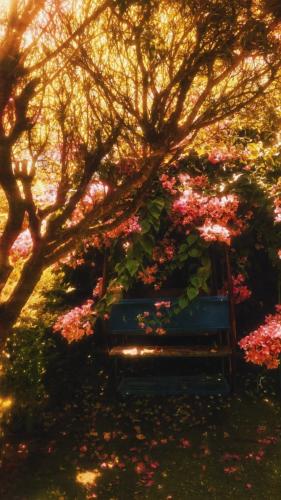
The young trees call it a rumor,
this thing called snow, this whitening,
this hush that supposedly used to fall
soft enough to break a branch with its silence.
Only the old oak at the field's edge remembers,
its rings dense with winters no one else believes in.
It keeps its bark rough the old way,
as if cold might still test it.
Tell us again, the saplings ask,
green and certain in every season now.
Is it true the ground goes hard as stone?
Is it true the sky can be that quiet?
Tell us about the white going quiet.
The old tree doesn't answer.
It answers in the way it still braces every October,
still hardens sap it no longer needs to harden,
still waits, out of habit, for a cold that stopped coming.
Someday it will go down in full leaf,
mid-afternoon, no one watching.
And when it does, no living root nearby
will have anything left to remember.
Not the snow. Not the hush.
Not the particular grey of a sky
about to let go of something
it used to let go of every year.
Points:
Time spent:
IP address:
Canary word: Present
Possible AI signals:
Original Text:
Are you sure you want to delete this comment? This cannot be undone.
Mark this comment as a review? Points will be awarded to the poster.
Your comment was posted, but it wasn’t long enough to count as a review. Reviews need about four complete sentences (at least 250 characters). Try writing another review that explains your thoughts in more detail — the author will appreciate it, and you’ll earn points for it.
141,599 Literary Works • 675,119 Reviews




I love this and I love this so much. The title, the use of words in your extraordinary poem, the way you build sentences that speak to the heart.
I really admire the fact that these important subjects can be brought up in the aesthetics of a poem. If our planet’s temperature won’t stop rising above the limit of where it becomes unhealthy, I’m afraid there will be a last, old tree that speaks to the younger saplings about the beauty of cold snow and ice. Wintertime is beautiful, yet challenging for many species on Earth. But just as beginnings serve their purposes, so do endings. For winter is the end of much life, so that they can grow and thrive anew when summer arrives. It’s a cycle that it just meant to be. Without winter, summer won’t exist.
I envy your title, really. It is just so beautiful and was the most perfect sentence that dragged me in. Good work!!!!
This was really beautiful and emotional. I loved how the old tree remembers the snow while the younger trees only know it as a rumor. The idea of memories slowly disappearing with the people who carry them is really touching. The ending especially stayed with me because it feels so quiet and sad without being overly dramatic. I really enjoyed reading this.keep writing
I enjoyed this poem. There is something quietly devastating about it. I appreciate that the oak never actually instructs the saplings. Instead, its memory exists in its habits, which feels deeply human. It reflects how the body remembers what the world has already forgotten. What stayed with me most is the ending. Nothing grand signals the death of the last witness. The snow simply disappears with the tree, and eventually, even the memory of the snow vanishes. This evokes a feeling of mourning something before anyone even realizes it is being lost.
If I were to point out anything, it would mostly concern restraint. There are a few moments where the poem explains ideas that its imagery has already conveyed, particularly the line "for a cold that stopped coming." I wonder if allowing the various images to stand without explanation would make the sense of loss even heavier. The phrase "this whitening" felt more abstract compared to the otherwise very tactile imagery. However, these are minor points. I believe the poem is strongest when it trusts its images.
Thank you for this read.