
Questions for reviewers, if you'd like:
1.) How would you describe houseflies, as they are portrayed in this poem?
2.) How does the poem make you feel? Feel free to elaborate on specific lines, if you have different feelings about different parts.
3.) Does the imagery feel cohesive and coherent throughout the poem?
Points:
Time spent:
IP address:
Canary word: Present
Possible AI signals:
Original Text:
Are you sure you want to delete this comment? This cannot be undone.
Mark this comment as a review? Points will be awarded to the poster.
Your comment was posted, but it wasn’t long enough to count as a review. Reviews need about four complete sentences (at least 250 characters). Try writing another review that explains your thoughts in more detail — the author will appreciate it, and you’ll earn points for it.
141,247 Literary Works • 674,329 Reviews





Text version:
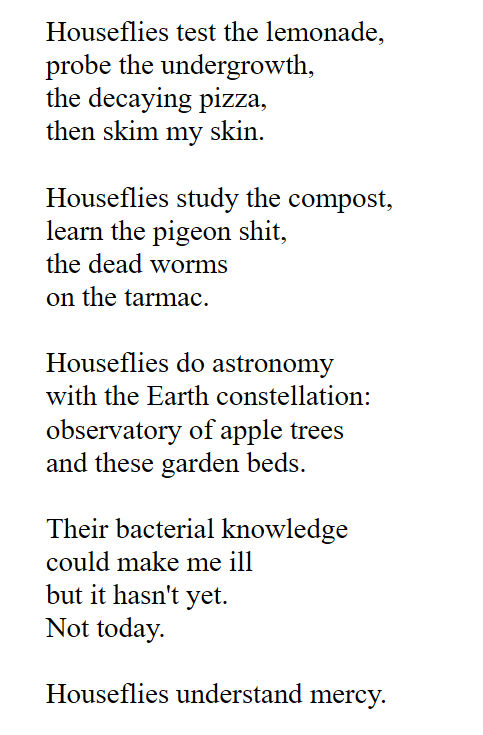
Houseflies test the lemonade,
Spoiler
probe the undergrowth,
the decaying pizza,
then skim my skin.
Houseflies study the compost,
learn the pigeon shit,
the dead worms
on the tarmac.
Houseflies do astronomy
with the Earth constellation:
observatory of apple trees
and these garden beds.
Their bacterial knowledge
could make me ill
but it hasn't yet.
Not today.
Houseflies understand mercy.
something constant I've noticed in your poetry is how you tend to weave these very complex philosophical ideas in - I think that is especially beautiful here with the houseflies. when you look closely enough at something reviled, they acquire a kind of ethics. what a gorgeous poem and reflection.
Thanks so much cocteau! <3
HEllo!! this is such an interestingly radical work and i mean that in the best way!
i particularly enjoy the way the poem rehabilitates something we instinctively dismiss, because there's definitely a real philosophical generosity in extending that kind of attention 2 a housefly, and it makes for a good reflection on just how much we overlook simply because we've decided something isn't worth looking at.
1. the housefly here is a scholar, a researcher, something that moves through the world with total commitment 2 understanding it, because it's all the same inquiry 2 it. what i find intriguing is the deliberate inclusion of "pigeon shit" alongside the lemonade and the dead worms, because the poem doesn't flinch or reach 4 a more palatable word, and that unflinching specificity is exactly what gives the fly its dignity, because it studies everything with equal seriousness and the language honours that. i hope this isn't a reach.
2. the first two stanzas had me slightly (positively) on edge - there's something almost forensic about the fly's movements, the way it studies and probes. and then "do astronomy with the earth constellation" stood out completely as the register shifts and suddenly we're somewhere else entirely. the finality of "not today" is especially stark 2 me, as it's just so spare and yet it carries such weight; mercy reframed as a daily reprieve rather than a given. that kind of understated vulnerability is very difficult to achieve and you do it amazingly here!
3.) very cohesive!!!! the progression from food -> waste -> cosmos using the exact same creature doing almost the exact same thing is elegant. its relationship with decay and its relationship with the stars are the same relationship, and that's a really clean and profound, almost thought-provoking idea and it holds the whole poem together beautifully (and economically!).
really assured writing, great job!!
Hi, thank you so much for the thoughtful review!! I'm so happy you picked up on the housefly being a scholar/ researcher, as that was the starting idea for this poem.
I don't think that's a reach at all, it's actually a great point! I made that choice intuitively, so it's really cool to see that it works well with the rest of the poem's theme.
Oh yes, for me it was definitely a sort of 'zoom out' moment. I'm building a sense through all the reviews that this stanza is kind of a point where things shift, which is really useful to know.
Thanks so much again!
thank you 4 explaining your thought process!! brilliant job once again!!!
1.) How would you describe houseflies, as they are portrayed in this poem?
Congrats. You've humanized houseflies. They feel nasty and non-judgemental
, completely indiscriminate of their surroundings. Not uncaring but not revenant/disparaging either. They value knowledge for the sake of knowing.
2.) How does the poem make you feel? Feel free to elaborate on specific lines, if you have different feelings about different parts.
"could make me ill
but it hasn't yet.
Not today." Congrats again. You've houseflied humans. The human is finally stopping their judgement borne out of fear and learning to treat the housefly as being burdened with existence, not the other way around(burdening existence by being themselves). Teaches us all a valuable lesson, if we're willing to learn.
3.) Does the imagery feel cohesive and coherent throughout the poem?
not at all and i think its perfect that way. that's all i'll say.
great poem, very whimsy. loved it <333
Thanks so much for reviewing! I love the phrase "houseflied humans". <3
This is a perfect poem and so knowledgable.
1. I would describe them as compost fiends.
2. It makes me feel seen that humans are not the only sentient beings on this earth that is why you never kill a spider.
3. The imagery was lost during the second stanza but was found again in the magnificent third stanza.
Overall I LOVE this poem. No notes beyond 'pigeon shit' to 'pigeon shite' just a wacko thought.
Thanks for the review!
Hello! I just came across your poem, and I have to say: well done! I like it a lot. I'll answer your questions first, then add my own observations, okay?
1.) How would you describe houseflies, as they are portrayed in this poem?
If I knew nothing about flies but what you use in this poem to describe them, I'd classify them as a sort of carrion species (study compost, decaying pizza etc.), and a gross one at that - you use many negative verbs associated with their behaviour, like "shit", "decay", "dead worms", "make me ill". Nevertheless, at the end of the poem, you ascribe to them a sense of mercy - it's an interesting contrast, which I think has to do with the fact that it is the only positive you use for them, and then "mercy" is also assiociated with death, or a mercy kill.
Now, I do know what houseflies are (obviously, nasty little creatures), and this adds a layer of majesty to them, I think. You have "knowledge" and "hasn't yet" and "mercy", which as a concept I think links them back to how many people would see vultures: kind of creepy, kind of gross, but ultimately useful.
2.) How does the poem make you feel? Feel free to elaborate on specific lines, if you have different feelings about different parts.
It's a strangely peaceful poem, to me. It evoces the unsteadiness of flies as you describe them with quick movement in lots of different places (test the lemonade, skim my skin, observatory of apple trees), and then you put a lot of emphasis from going to unclean environments (decying pizza, horse shit) to places associated with more positive feelings (apple tree, garden bed). It is a journey from unhealthy and unsavoury to more positive to almost clinical (the "bacterial knowledge" does that).
I find I quite like the last and second to last stanza. Just... they could make you ill, but they don't, because flies are merciful.
3.) Does the imagery feel cohesive and coherent throughout the poem?
The imagery is very much cohesive and coherent! You have a clear escalation (dirty/off food, dead skin cells -> compost outside/more "natural" environment -> personal observation). The zoom is a bit off (I probably would have gone outside->inside->personal), but it works well with how you word the observations.
My own observations:
I like the progression of sounds in this. In every stanza, you go from round vowels like o and u (lemonade, probe, undergrowth) to lighter, more crisp ones like i and e (pizza, skim, skin). You have this in almost every stanza (compost -> shit; astronomy, observatory -> these, beds; knowledge, could ->ill, it, yet), and the deviation at the very end (o in not, today -> understand, mercy) ties the last two stanzas together nicely. Ending on "mercy" with it's sharp i sound at the end, the c and the overall shortness of the word makes it work well as a climax.
It's all in free verse, but the rhythm is very consistent (works something like HOUSE-flies TEST the LEM-on-ADE in most verses), and the repitition of "Houseflies" at the beginning of every verse makes the poem feel grounded, structured - a bit like a scientific report, almost.
Anyway, overall I have to say I like this very much. It reads nice, and frames decay as something wholly natural, flies as a part of the natural cycle, and also, ew, gross.
Thanks so much for this thoughtful review!
Oh that's a good point! I didn't consciously write death and decay into the poem, or at least I wasn't focusing on it explicitly, but I can see how it's connected with those word choices.
Your sound observations are very cool!
I feel like you've picked up on a lot of the things I put into this poem! This piece was very inspired by ecological themes and the idea of a "natural cycle" as you put it. At the same time, you've also found interpretations I haven't thought of before which are very intriguing.
Thanks again!
You're welcome! I really can't state enough that I liked this. I'd never read a poem about flies before, either, so <3