
Questions for reviewers, if you'd like to answer them:
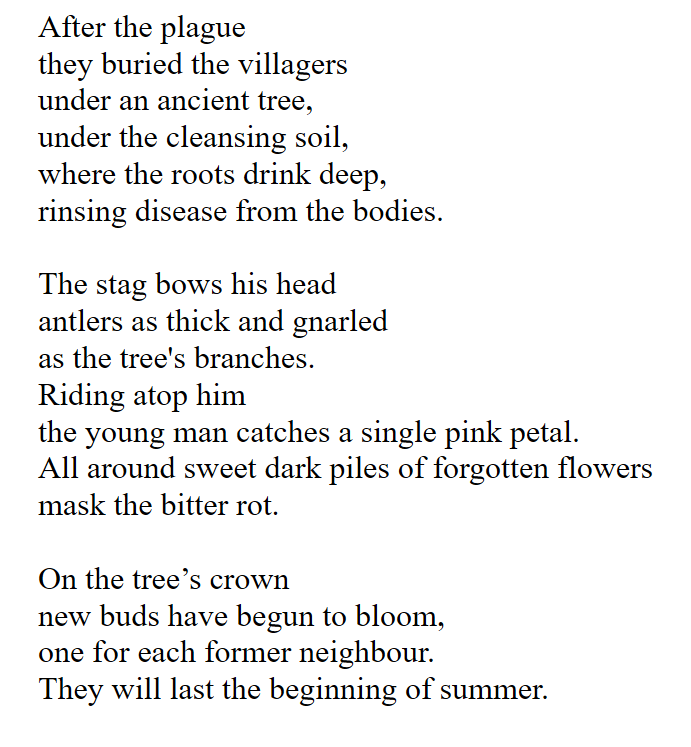
1.) What do you think this poem could be about?
2.) What do you think of the title? How do you think it relates to the poem?
3.) What do you think of the tree in this poem?
Points:
Time spent:
IP address:
Canary word: Present
Possible AI signals:
Original Text:
Are you sure you want to delete this comment? This cannot be undone.
Mark this comment as a review? Points will be awarded to the poster.
Your comment was posted, but it wasn’t long enough to count as a review. Reviews need about four complete sentences (at least 250 characters). Try writing another review that explains your thoughts in more detail — the author will appreciate it, and you’ll earn points for it.
142,081 Literary Works • 676,566 Reviews



hellooo! this poem is quite an interesting one! in general, it's still, calm, but describes melancholy throughout itself. it's just "what it is." rather than prioritizing direct rhymes or sing-songy prose, it reads like a tale being told to you. resulting in a prose that prefers direct storytelling. even so, there is a structure to these lines and specific word choices flowing with each other that reads like poetry. there remains a distance between the reader and the poem that seems purposeful, as the poem is about telling you a tale instead of you being "in" the tale, which works really well! this poem is so strong in what it wants to sound like the reader, the tone & mood, while still managing to be broad enough for your interpretations too, which is a great quality in this piece.
i notice there are a set of questions in the end, and i must say it is great for authors to encourage others to analyze their works with specific questions. it really makes you think, and can provide guidance to someone who may struggle with analysis on the spot. though, rather than just immediately answering the questions, i'd prefer to go with my usual way of reviewing to gather my thoughts before answering!
this first stanza establishes a very familiar scenario of a village being a victim of a plague that takes its own people. however, there are very specific descriptions that makes this overall scenario stand out and hints to a deeper meaning or commentary on other than death. the tree these villagers are buried under is specifically ancient. then here comes a pattern of descriptive words: the soil is specifically "cleansing", the roots "drink" and the disease is "rinsed"—all of these have a theme of washing. particularly, washing away something, likely dirt (hence the words "cleansing" and "rinsed"), which in the process may "feed" off of something (hence the word "drink").
though, it's not even this pattern is notable, but also the contrast of this theme with the tree described as ancient. as if the ground "takes away", but the tree itself is still and stands. or perhaps the ground "feeds", while the tree itself is "full". this alongside with the clearer contrast that the tree is described as ancient with the villagers who are dead, this contrast is deepened by the theme to "wash away" disease, as if the tree is being kept "alive" due to this feeding. as if it's keeping a memory, while still honoring these people before the disease took them.
the imagery here is well, and quite strong with this comparison! the parallels between the antlers and branches being rough and twisted by old *age* is a lovely touch to the imagery. antlers and branches aren't just similar due to its shape, but due to how they are able to transform and grow, and keep injuries (and can damage its shape) until they fall and grow again, basically having their own cycle of life, death, and renewal. while the both of these are old, there comes a man who is young riding on the stag. and this man catches a single pink petal, young like him, while all around him are old flowers like the deer and tree. the overall theme of this stanza is old & youth and reincarnation & renewal, adding to or perhaps building the overall topic of the poem that is life & death.
this second stanza establishes that the first stanza is a distant history in the poem (as told by the second stanza), as well as it is for us. interestingly, there seem to be "layers" to history. the young man rides on the older stag (perhaps "riding" on history). the ground the stag walks on is filled with death in the past, under fallen flowers old but fresher than this death. the fallen, older flowers lay under the hovering ancient tree carrying younger flowers. it's a cycle of both life/death, the creation of history constantly being born (single petal) and lost (flowers on the ground, and that pile over death), or underneath the present (young man riding on the older stag, the older stag walking on the ground), and the interconnections in history, referred to by this imagery.
while a "crown" is technically an anatomical term for a tree's top, i thought this choice of term was very intriguing and tickled in my brain. for me, the usage of this term encapsulates a sense that this tree is this hovering, brooding, authoritarian entity that is some ultimate form of life. which is very compelling, especially when it's next to all of these more gentler and softer lines in the rest of the stanza! but generally, here it just really reinforced how central the tree is to this whole poem.
drawing back to the second stanza, new flowers grow then die. and it will happen again and again, perhaps for a long time. "one for each former neighbour"; whether the bud being for a "former neighbour" refers to a traveler who will stumble upon long history that will later be forgotten, or one for each villager who died long ago. perhaps it's not being cynical about death; it's just how it is, and was, and will be. that is the cycle of life, death, and renewal, that is throughout constant in this poem just as it is in real life.
the ending is even more engaging and memorable for this poem due to the similar but not exactly the same rhyming ("neighbour" / "summer") that is very whimsical, considering the poem is rare in rhymes!
time to answer questions!
1.) What do you think this poem could be about?
gosh, what a loaded question! i prefer to be interpretive instead of claiming a stern meaning to poetry i read, so this is a bit intimidating to think. what could it be "about"? i think this poem is many things—life & death, old age & youth, and the cycle of life. i think especially, what it says about there being death in life and life in death contributes to the big theme that is the cycle of life & death. another thing my mind contemplate on is history. how history under this whole tree was been made, and is still being made, regardless or not it is forgotten or present. how the history in the past builds up the history being made in present times, which will later be history itself. that there is still the interconnection that makes all history around here alive.
2.) What do you think of the title? How do you think it relates to the poem?
the title, "names", is one that definitely peeked my interest while the poetry itself is full of these events full of complexity in what it says, while the title itself is simple. while there are people in the poetry, none have names - they are just villagers, or a young man traveling, or a neighbor. for me, "names", gives emphasis on history. how names' popularity and relevancy can come and go or be forgotten, however they all root back to a far history. the cycle of names throughout centuries is reminiscent of the cycle of life & death or the complicated creation (or cycle) of history. like these villagers, or the travelers who come, names may be forgotten but are still present in history, and can be kept alive by a memory.
3.) What do you think of the tree in this poem?
this tree that was alive throughout the decades of history being told through a short poem, even to the point of being *history* in the time the villagers died, is very ingrained to the poem. and its place as both history, and being present in history and life & death, guides you to what this poem could potentially be about. i believe that this tree represents memory. keeping history, and being apart of it, even when it's been forgotten. even when forgotten, history is still there. its the continuation and memory of history, and perhaps what connects all what's happening in the poetry together.
~
overall, this was a great read that was wonderfully crafted to be pensive and thoughtful! i enjoyed reading this, thinking so deeply about it and test how far my mind could analyze about in this lovely poem. and regardless if you don't have that definite claim on what this poem is about or what some things say, i think everything just works great together and has ties to each other very well, and is generally a pretty solid poem. keep writing!!
Thanks so much for this thoughtful review lalalucky! Your observation on the old and young coming together with the stag and the young man is super interesting. I hadn't thought of that when I was writing but it's a really cool interpretation. I'll definitely keep all this in mind when revising this poem. Thanks again!
Hey there, Lim! Rox here with a review for this poem :]
When I read the poem, I noticed this really calm tone in contrast to something quite gloomy, not only because of what events unfolded but also because of your word choice. It sets the tone so decisively - I think that’s incredibly well done. It was the first thing that piqued my interest, so I’ve decided to review it. It feels realistic, almost melancholic, and even with the omniscient perspective, it still has this conscious feeling.
What do you think this poem could be about?
I had to read the poem two times to make sense of it, because I feel like there’s a lot happening at the same time / quite a few things being described, and it focuses on different parts of the setting and events. Having the poem start with "after the plague," it immediately suggests something like a huge loss. And the bodies were buried "under an ancient tree" that later has new pink petals, so I suppose that suggests something about a form of renewal? Having a form of reincarnation or memory of them in the tree - but they are "sweet dark" piles of "forgotten flowers," so that makes me think that they are not quite remembered, but still carry a memory.
The last stanza changes the narrative somehow, or at least the train of thought that is being provoked by the poem - because here we see "new buds" that bloom for the neighbours. So, it almost seems like a cycle. The last line, however, really emphasises the change in the train of thought - "they will last the beginning of summer." This makes me think of something that is ephemeral. Things that don’t last. Perhaps like the neighbours whose lives abruptly ended, or just in general, for they will only last the beginning of summer and then they’re gone, or "piles of forgotten flowers" again.
I read through the other reviews, and I see you meant something along the lines of "impermanence of life," and I can definitely see a part of that in the poem, but it’s just a small part of the poem, because this only became more clear for me when I read the last line.
2.) What do you think of the title? How do you think it relates to the poem?
I think the title is interesting, as the word "Names" hasn't appeared in the poem. I feel like there could be many interpretations of the title, though the first thing that came to mind for me was that "Names" probably references the names of the neighbours. It's almost a juxtaposition - because names can be written things or possessions that somehow last forever even when a person is gone, but they can also be forgotten after a while.
3.) What do you think of the tree in this poem?
In some way, I suppose it ties back to the central thought. But since the tree has stayed there, it could be a form of continuity, or a source of memory of all the "names" in the form of "new buds."
This was a thought-provoking read for me, and I enjoyed reading it. I don't know how the stag would suddenly relate to the entire scene, even with the comparison of its antlers to the tree's branches, so that's something that stayed vague for me. Overall, I think you captured a feeling wonderfully in this poem!
That's it, that's all.
Have a great day!
Cheers,
Roxanne
Thanks so much Roxanne! I like the idea of the tree being a form of continuity/ memory. You've got a good point about the stag - I'm thinking of ways to try and incorporate him more into the story. Maybe he was a guardian of the village, or something like that.
1) I have no idea what this poem is about, but from my guess, it could be about after some disease that broke out in a peaceful village, a young man visits the place and learns about what happened perhaps from the ghosts of those who died.
2) I think the title is very fitting for this sort of poem. The people who died, probably have their names buried along with them, and no one knows them. On your last part of the poem, about new buds beginning to bloom, that could probably mean that the people who died are going to have their names be recognized again.
3) I think the tree kind of reminds me of the Tree of Harmony from one of my little pony infections aus, namely, Swamp Fever (I would recommend you not watch it at night). It sounds like the tree is the root cause of everyone dying, or maybe it's the one that started the plague.
As I end this review, I'd like to say I really enjoyed how you put the questions at the ending of the poem. Sometimes when I'm writing reviews, I don't know what to write about, but the questions really make me ponder and think.
Have a good day/night friend!
Thanks for the review!
1) I have no idea, but the villagers could be desire and the plague sexual assault. The second stanza makes this seem more likely with the ‘pink petal’ that a man catches. Another possibility that springs to mind is that it’s a metaphor for anxiety. Whatever it is, it’s clearly improving by the end, or there is water on the horizon at least.
2) Well shoot, I didn’t consider the title at all and now i’m thinking it’s perhaps about a trans man’s journey to find a name. Then once the name is found, his life blossoms while still accounting for his past self.
3) It’s a great narrative tool to craft the metaphor. Whatever that metaphor is.
Taking all this into account, it’s coming into focus better i think. This has to do with funerals and the waning of attention after, yes? The last line was not considered carefully enough by myself before, I think.
At this point I feel I must diverge into pointing out a pet peeve of mine; accidental rhymes in non-rhyming stuff. They’re jarring and feel like they must mean something even if the context doesn’t give any context for it.
Tree/deep is the culprit this time (I chastised someone else about this in my very last critique!) and I’m not sure what to replace what with but it could use addressing.
Good stuff.
Thanks for the review!
1) Huh, that's interesting. I guess I can see that, with "catches" seeming a bit violent and flower petals have connotations of . . . innocence? Vulnerability? And maybe the man "riding atop" the stag might convey that as well.
2.) Ah, that's cool! I can definitely see how the death/renewal elements of the poem could lead to that interpretation.
"waning of attention" could certainly feed into the last line. When I was writing it I was going for the impermanence of life in general (that's what the "single pink petal" and the "sweet dark piles of forgotten flowers" meant for me). But I can certainly see a more critical view of it, since the language in this poem has quite a brooding tone, now that I re-read it.
Thanks again!