
Points:
Time spent:
IP address:
Canary word: Present
Possible AI signals:
Original Text:
Are you sure you want to delete this comment? This cannot be undone.
Mark this comment as a review? Points will be awarded to the poster.
Your comment was posted, but it wasn’t long enough to count as a review. Reviews need about four complete sentences (at least 250 characters). Try writing another review that explains your thoughts in more detail — the author will appreciate it, and you’ll earn points for it.
141,441 Literary Works • 674,455 Reviews

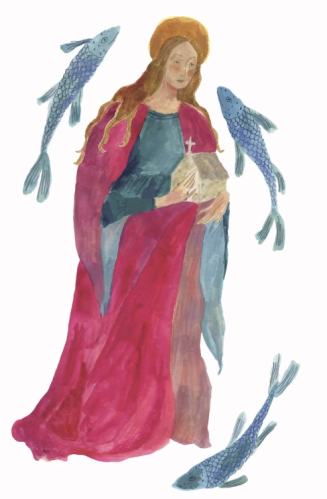




In traditional Welsh folklore, Dwynwen is the patron saint of all lovers. She wanted to marry her love, Maelon, but her dad, Brychan, didn't like the look of him and wouldn't let them be married. Because of this, Maleon lost his temper with Dwynwen and threatened to SA her when she wouldn't marry him. When Dwynwen prayed to God, Maleon was turned to ice - to freeze his passion. An angel also then gave her three wishes. First, she wished to be free of Maelon, and he vanished. Second, to never marry, and finally to help other lovers in pain. She then lived out her life in a convent in North Wales <3
cover art by Lolly Skura
Hi, I thought this was a beautiful poem. I must say I'm quite a sucker for cultural/folkloric things like the tradition you related in the stickied comment. And Dwynwen in the end becoming a celibate saint, free of her lover and his immoral advances, and wishing to help all lovers in pain; I just love it, I am jealous of this beautiful backstory (I am assuming you are Welsh for some reason)!
The writing is extremely playful and witty, but it is vivid and tactile. I love the lines that are only describing, adding to the intensity of the overall very compressed anecodote . Such as:
"meat and sweet, spring water, dripping"
"curved hips, pale skin, itching for him"
Your verse is mystified by the ambiguity of some of its contents, such as the aforementioned "meat and sweet, spring water, dripping"; it could have very well made sense to be "meat and sweet, spring water dripping", but the addition of the comma could either be an intentional grammatical irregularity, used for rhythm and semantic compression, or even maybe that the word "dripping" and the phrase "spring water" are unrelated, and that the verb dripping relates to something else, perhaps the meat. I don't like reading texts in the way the author didn't intend, and I feel the former is more likely to be your intention, but I couldn't help but mention that it was something I noticed. Either way, this stacking of ideas seperated by commas is very effective.
I love the hot imagery set alongside the descriptions that have sort of soft, but sensual undertones ("...licking her red lips" and "curved hips, pale skin, itching for him").
I adore the wittiness in this verse, even the simple "She is the beauty, of course, dutiful, beautiful", effortless, gorgeous rhyme, very informal and playful register, and blunt repitition ("beauty", "beautiful").
Personally, I don't take to much of the poetry on this website and a lot of their very contemporary *styles* unfortunately, but this is very much a shining star in my opinion. The folklore behind it elevates it from being a well structured and assembled verse, into a verily rich poem. Every line has something I could dissect and fawn on, but I have not enough time to write that all and you likely have not enough time to read it all. Thank you for reading this honest review if you did though, and thanks for writing this, it's very inspiring!
thank you so much for your kind review!
i'm going to be honest and say i can't quite remember my intention behind the comma in the meat and sweet spring water line. The image i wanted to evoke was that instead of god melting Maelon like in the folklore, he is melting beside a fire, and the fire is too hot, and it's sort of cooking him as the ice melts. So there's sweet spring water (the ice) dripping but also the fat & the meat. But could also be read as more innocent than that XD.
Hey Rev, love this poem, and thanks for sharing the context behind it in the comments below, as to be honest I had never heard of St Dwynwen before about five minutes ago. This is also my first review in several years so bear with me as I'm sure I'm more than a little rusty, but I hope I still have something useful to say!
In terms of strengths, I really love the way this poem sounds and feels in the mouth - your word choice and use of alliteration in "roaring and roasting" is excellent. These feel quite onomatopoeic in this context, and almost sensuous. The fire feels languid and seductive here. Contrast this with 'lick and hit and spit' in the second stanza, where the repeated short vowel sound in these words makes the fire feel venomous, angry, dangerous. The language is relatively simple but it's so effective and evocative, and portrays an entirely different mood within the same core image.
I love poetry that is clearly meant to be read aloud, and the use of internal rhymes throughout ("meat and sweet," "dutiful, beautiful," "pale skin, itching for him,") are used really effectively to contribute to the meter and rhythm of the poem. It's generally just a really well-constructed poem in terms of pacing and rhythm.
My only criticism is quite nit-picky - the phrase "it's dwynwen who is burnt" feels quite jarring to me. I think the poetic voice here feels disconnected from the voice of the rest of the poem - like someone has interjected and interrupted the narrator. I can't quite pinpoint why that is, but maybe a rephrasing could just help with the flow in this section.
On the whole though, as I say, this is beautifully constructed and intensely evocative. Looking forward to reading more of your work!
Yours,
Luke
thank you so much for the kind review! I think you are right; the "it's dwynwen who is burnt" definitely doesn't flow as well. I shall have to have a play around with that!
Welsh folklore is so interesting, I'm hoping to write some more based around it!
Hi Rev! Thank you for clarifying the history in your comment. I have never heard of Saint Dwynwen and it's an interesting tale.

I must say I love this poem. The folklore feels come through beautifully and the imagery is potent.
I almost feel like the first paragraph could be read as Maelon and then the second part As Dwynwen, watching the aftermath. Not sure if that was your intent but I could see it if it was! Thanks for sharing
thank you for your review! <3 it wasn't my intention but honestly i totally see what you mean!