Squills 3/31/25

9 posts
User avatar
Gender None specified
Points 300
Reviews 0
Image


Welcome to Squills, the official news bulletin of the Young Writers Society!

What will you find here? Tons of interesting news about YWS, including but not limited to: articles about writing, art, and the world of humanities; interviews with YWS members; shameless plugs; link round-ups; and opinionated columns. And where will all of this come from? Take a look at our fantastic creative staff! In this edition we welcome DungeonMaster to our staff, taking charge of Roleplay Reporting.

If you have feedback on this edition of Squills we'd love to hear your thoughts over at the Squills Fan Club .


CREATIVE STAFF


Spoiler


Editorial Team
alliyah
(she/her)

IcyFlame
(she/her)

Liminality
(she/her)

Friendly Neighborhood Robot
SquillsBot
(beep/boop)

Literary Reporter
Available - PM Squillsbot if interested

Community Reporters
looseleaf
(she/her)

alliyah
(she/her)

Creativity Reporter
FruityBickel
(he/him)

Poetry Enchantress
alliyah
(she/her)

Resources Reporter
Available - PM Squillsbot if interested

Roleplay Reporters
DungeonMaster
(they/them)

Code Master
Spearmint
(she/her)

General Reporters
foxmaster
(she/her)

redcarnation
(she/her)

EllieMae
(she/her)

NadyaStatham
(she/her)

Staff Chef
LadySpark
(she/her)[/center]



User avatar
Gender None specified
Points 300
Reviews 0


User avatar
Gender None specified
Points 300
Reviews 0
MASTERING THE DUNGEON
Image
written by Wolfi and DungeonMaster< PM: >

The majority of storybooks on YWS don’t reach the finish line, and that’s okay. While the ultimate goal of a novelist is to publish their novel, the ultimate goal of a roleplayer is much more loosely defined. As @Obscura put it when I reached out to him for input on this article:


It's not about the destination, it's about enjoying the journey for however long it lasts.


While we keep that in mind, I’ve gotta say, it iiiis pretty darn satisfying to see a storybook to its end, and I’ve been lucky enough to play a part in two of those! In both instances, the single most important factor contributing to the “success” of the storybook was what we call its DM, or Dungeon Master. DMs create the storybook and guide the plot. But what exactly makes good DM? That’s what I'm setting out to answer!

There are many different styles of DMing, so I asked some currently active DMs for their advice. What follows is their collective consensus on what makes a good DM.

Leadership

A couple months ago I joined a storybook led by @soundofmind called Under a Waning Sun . If you ever get the chance to roleplay with sound, I highly recommend it as she is an excellent writer and has mastered the craft of DMing. I don’t think I’ve ever felt as consistently excited about a storybook as I have with UWS, and a lot of that is thanks to sound’s leadership style!

Enjoy a piece of sound’s insight on leading a storybook:


In my experience, the things that make for a good DM in a storybook are the same that make any good leader: clear communication, clear expectations, clear direction, and clear passion. That looks like having a plan, being proactive, responsive, and listening to your team. It looks like being willing to help your writers, intentionally encouraging them, and making sure everyone has a reason to be excited about the story so they feel invested in it personally and as a group.


Clarity in direction, expectations, and passion - got it! Let's expand more on the "making sure everyone had a reason to be excited about the story" part in the next section...

Flexibility & Collaboration

@Elektra, our resident ancient mythologies enthusiast and DM behind the recent release The Sunken City , has the following to say about the importance of adaptability:


I've found (through trial and error XD) that allowing flexibility in roleplays is key. Allowing all participants/authors to edit/change some things about the lore, allowing the timeline to shift based on one characters arc-- it's all part of collaborating! (aka. setting clear expectations, checking in with everyone on a regular basis, and making sure everyone gets heard c:).


Ley brings up a good point here! Although the DM is the main writer responsible for driving the plot and taking the lead, all writers should have a significant say in how the story goes and what the worldbuilding looks like. DMs need to have an open mind when running a storybook because different writers are going to come to the table with all sorts of different ideas. Fostering a space where those ideas are welcomed is essential.

Enthusiasm & Engagement

It's difficult to keep yourself and your team motivated when your heart's not in it! Obscura, whose Roleplay Realm Résumé tracks his experience all the way back to 2012, had the following to say about the importance of the DM's passion:


From my experience, I gravitate most towards DMs who are enthusiastic and confident! I like seeing DMs who take charge on their roleplay and have a clear idea in mind. They are not just someone with an idea, they are also the lead writer and motivator on the roleplay.

As a DM, I try to maintain a level of communication and energy to keep the roleplay on people's minds, even when not writing. I start with a strong premise that gives a strong foundation with a lot of answers, but the possibility for creativity and to ask a lot of questions. Then, I create a pad to collaborate and try to have things for people to interact with often, like polls, character sheets, lore drops, and Roleplay Quests .


It can be difficult to keep the team invested over long periods of time. A committed DM will be proactive and creative with inspiring their cowriters. @RangerofIthilien offers more context on those last two engagement tools here:


RP quests can give motivation to some more laborious tasks such as creating characters and can really help drive forward RPs in order to get them going since there is something to gain from it. While I have only just started really incorporating RP quests into my RPs, the difference has certainly bean noticeable!

Lore drops are also very useful in maintaining excitement and interest because they give better insight into the world that likely wasn’t expected and/or is new and gives new aspects. In addition to this, they can also provide foreshadowing for upcoming plot points which increases anticipation and excitement not only for yourself as the DM in a spur of creativity but also for your RPers!


Remembering Why We Roleplay

In my discussions with each of these lovely DMs, everyone stressed the importance of having fun and not taking ourselves too seriously. Here's what sound had to say:


Ultimately, storybooks on YWS are optional: they’re primarily for fun, but often, secondarily for growth: we help each other grow as writers. If we keep than in the forefront of our minds as we write with people, that helps us keep the right perspective so we don’t take things too seriously and lose sight of its purpose.


I couldn’t put it any better than that!

Thank you to Omni, sound, Ley, and Ranger for sharing their thoughts! <3 Happy roleplaying, folks, and may this inspire you to go master that dungeon!


User avatar
Gender None specified
Points 300
Reviews 0
EVERY ROSE HAS ITS THORN: A FAVOURITE TROPE
Image
written by goodolnoah< PM: >


Image

Drawing by @Liminality


Hi everyone! I tend to write a lot of characters, but a repeating “trope” that I sometimes find myself falling into is the foul-mouthed character who is bad but not too bad. I’m not even sure what the real trope of this is, maybe it’s something like kuudere, which is a character who appears cool on the outside, but is really a good person when you get to know them.

All of these characters tend to have a traumatic backstory that led them to do arguably bad things. They can be anywhere on the spectrum of genuinely bad people to good people who have done bad things. Some of these characters have either a prejudice or a selfish tendency by the time they first appear, and through a character arc, they learn to be more accepting and giving. However even before this, the character is shown to have a good heart deep down. They are someone who fights against authority, whether it be against the world, against a parent, or another form of authority. They blaze their own path! After their arc is concluded and they (maybe) join the protagonists, they might become the resident goblin with a bad mouth, or a cool-headed, darker ally.

I tend to write stories, but I can imagine these characters would be very fun to write for in an RP!

Some characters I know from our friends at YWS who might fit into this category are…

@LadyMysterio’s character, Verena from Agents of Time/Double Agent. She is a skilled agent who is usually cool and collected, but gets fed up with her partner James’ antics from time to time. She seems to have a past that has made her hardened to challenges.

@Elektra‘s character, Jase from Daughter of War and Son of the Night. He starts off as a foul-mouthed dark mysterious man who slowly grows closer to Josephine in her title story, The Daughter of War! He’s a voice of reason in the story to the more reckless Josephine, but his high power leads to a bit of cockiness on his end.

@Horisun‘s character, Jo from The Witch of the Rotten Borough. She’s a skilled witch with a quiet good heart. Even when those around her are being difficult, she is still interested in doing what is right. She also goes against authority when she deems it is the right thing to do.

I really like the trope/archetype because it tends to add depth to a character. I think I easily fall for characters who have a bit of coolness to them along with complexity. Most of these characters have something deeper about them that explains their personality, and learning about this backstory is usually some heartbreaking stuff!


User avatar
Gender None specified
Points 300
Reviews 0
FEATURED MEMBER INTERVIEW: ELEKTRA
Image
written by EllieMae< PM: >

This month, I had the opportunity to have a discussion with our featured member @Elektra about her writing goals, NaPo plans, experience on the YWS mod squad, and advice for other writers! It is not too late to congratulate her in this forum . Be sure to check out her NaPo thread as well, the anatomy of a dreamer !

Squills: Hello Ley! Squills writer Ellie here. I was wondering if you would like to be interviewed for our upcoming Squills issue about recently being Featured Member?


Elektra: Sure! :D

S: Okay, thanks so much! Well, to start, could you tell us a bit about yourself and what you like to do on YWS?


E: I joined YWS in 2011, so it's been about fourteen years! I can still log in to my first account, but I thought it'd be nice to start fresh since I was eleven when I first made it XD. On YWS, I have always been a Roleplay-lover, I jumped right into storybooks immediately after I joined the site. I absolutely love collabing with other writers-- so I knew this site was for me! <3 I'm trying to branch into poetry, but I'll always stay consistent with RPing :)

S: That’s amazing! I know that a few days ago, you celebrated your one year anniversary of being a Junior Moderator!:D Could you tell us about what you do as a mod and how this last year has been for you?


E: As a JM, I help plan and run events with my crew, keep the RP Tab organized, and answer any questions users may have about the site and roleplaying! It's been awesome to brainstorm events for a site that I've loved for so long. As for the year itself, there have been some bumps in the road, but overall-- I think it was a pretty successful year for me. I got to know so many awesome members and participated in more YWS Events than I ever have before. It's been so much fun! <3

S: That is so wonderful (: you have been on the site for about 14 years! What was it like getting to be FM? How did you feel and what was your reaction?
E: I was definitely excited! :3 I'm not exactly sure when FMs became a thing, but I don't think it was around when I first joined. I'm so grateful to be a part of the Hall of Fame! <3 (I also may have freaked out a bit >:P)

S: Fantastic! Okay, you are such an experienced member on the site and I know that you are a frequent participant in so many areas of the site. What are some of your favourite events on YWS? And do you have any upcoming plans for NaPo in April?


E: I have so many favorite events on YWS-- including NaPo! I created a thread called "the anatomy of the dreamer" that will explore anatomy, vulnerability, and the poetic side of nature and how us, as humans, interact with it. Very excited for this NaPo!

As for other events... I love all the RP Events-- specifically Roleplay Month. I love seeing all of YWS's writers participate in all the different collaborative universes that they create. It blows my mind every single time RP Month comes around!


S: I am very excited to see your poems this April! Besides NaPo, do you have any writing projects or goals for the rest of 2025? What are they?


E: For 2025, I'm planning to finish my first round of editing for The Daughter of War and I'm working on developing a stand alone: "The Girl Who Stole the Moon"! This one is also greek-myth based (of course XD). but focuses more on the goddess Selene and a new one of my MCs named Rhea! Very excited for this, too!

S: It has been so lovely to hear all of your plans! Before we close, is there anything that you would like to say to any YWSers reading this interview? Perhaps to people who wish to become FM in the future?


E: My main tip for becoming FM is to simply be yourself. An FM is not just someone who reviews, but someone who has made an impact on YWS. As long as you stay true to who you are, FM is bound to happen for you! <3


User avatar
Gender None specified
Points 300
Reviews 0
A GUIDE TO WRITERFEEDPAD ON YWS
Image
written by theromanticchemist< PM: >

If you lurk around the People's Tab as much as I do, you’ve probably spotted a link to a WriterFeedPad—affectionately known by the YWS community as a WFP or just “a pad”. These are vibrant spaces where you can write, interact, and connect with people of all kinds! However, they can be quite intimidating to the newer YWSer, with odd controls and unique customs, so this is a guide to all things WFP.

First, where can you find a pad? There are a few places: Your own WriterFeedPad dashboard, the “I’m Writing, Come Join Me!” thread, and the People Tab.

Your WFP Dashboard


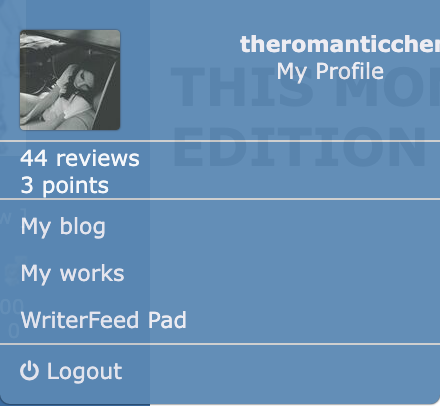
If you want to create and share a pad of your own, you’ll want to click on “Me” at the top left corner of your screen in YWS.

It should look like this:

Image

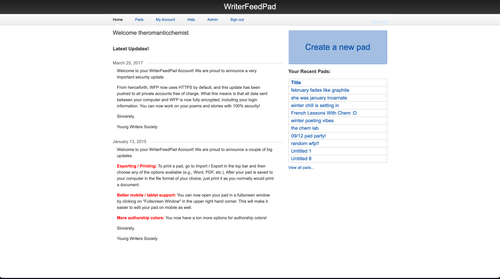
See the words “WriterFeed Pad”? Click on those, and you will be taken to your WFP dashboard, where you can create a pad or access a previously created one.

Image

This is what your screen should look like, but if this is your first time entering your dashboard, you won’t have any recent pads. From there, you can click “Create a new pad” and you will be taken to a brand-new pad of your very own. The URL will be (yourusername).writerfeedpad.com/(the number of pads you have)

From there, you’ll want to title your pad, and most importantly, click “Security” and make your pad public before sharing!! As someone who has made quite a few pads, this is something I unfortunately forget very often.

You can then copy and paste the URL and post it on your wall—where there are bound to be people searching for a place to hang out.

The I’m Writing, Come Join Me! Thread


This is simple—there is a forum thread where people will post pads that anyone can join. It’s not as active anymore, but there are still a good amount of active pads linked there. Just make sure to click to the newest page of the thread, so you can get the most current pads.

Here is the link to the thread!

Here’s a tip—subscribe to the thread so you can get updates on new pads that are added!

The People's Tab


On the People's Tab, you’ll find many—including myself—posting links to pads. Some clever people even link them through an image or GIF! Just click on a link to join the fun, and repost if you want more people to join and make it a little party.

Tips, Tricks, & What to Expect


Now, there are some things about pads that aren’t obvious at first glance—they don’t have buttons or KB articles. These are the general customs and culture of YWS and WFP’s! It can be confusing, so here I’ll attempt to explain them for people who are intimidated by pad culture.

Firstly, when you join a pad, you’ll want to name yourself, but it doesn’t have to be your full username! Practice online safety and don’t use your real name, but a little YWS nickname is fine. It can be a shortening of your username, or a fake name that you use online. You can also set your color with the wide variety available.

You’ll then want to introduce yourself in the chat! A “hi!” will suffice, and you’ll probably get a chorus of “welcome!” in response. If there’s a sign in section, you can pop your name (and your pronouns if you wish!) into there, so everyone knows how to refer to you.

True YWS culture is all the silly happenings in pads. In the chat, you’ll frequently find members talking about anything from their day to a passionate debate on mayonnaise. Feel free to jump in any time with your thoughts, as this helps keep the conversation lively! You can even start a conversation with a simple question, and you never know how far it’ll go.

In the main text of the pad, you’ll usually find little corners where people put their works in progress or collaborations. Everything from poems to roleplay posts can be worked on in a pad! If you want constructive criticism on something you’re working on, you can even let everyone know in the chat and you might get some little notes from your fellow YWSers. It’s a great way to workshop poems and chapters, and get some advice before you post.

Another common activity in pads is collaborations! Often, a few members will get together and work on a collab poem, writing lines one after the other to create a beautiful work that they can post on YWS. (Did you know you can add collaborators in the YWS Publishing Center for this very reason?) You can even collaborate on a short story or a roleplay post—WFP’s interface makes it easy to work together on anything!

WFP is used for so many things on YWS, socializing being only one of them. When joining a roleplay, you might notice a pad link where members of the roleplay can get together and work on posts around the same time—which is called a “Write-In”. There are also sometimes workshops, where you can learn a new skill taught by a more experienced writer. There are even some official YWS events held in pads—with NaPoWriMo coming up, you’ll probably see a lot of those, and you are encouraged to join whenever you can.

Pads are an amazing way to get involved with the YWS community, and I hope this article helps you navigate this world a little better. Go forth, and WFP!


User avatar
Gender None specified
Points 300
Reviews 0
POETRY WINDOWS: ‘ACCEPTANCE’ BY ROBERT FROST
Image
written by Liminality< PM: >

Greetings, fellow poetry travellers. This month we’re looking at the poem ‘Acceptance’ by Robert Frost, which you can read here. The poem is short, but packed with layers of meaning through its evocative imagery. As it is in the public domain, I’ve also included it here:

    When the spent sun throws up its rays on cloud
    And goes down burning into the gulf below,
    No voice in nature is heard to cry aloud
    At what has happened. Birds, at least, must know
    It is the change to darkness in the sky.
    Murmuring something quiet in its breast,
    One bird begins to close a faded eye;
    Or overtaken too far from its nest,
    Hurrying low above the grove, some waif
    Swoops just in time to his remembered tree.
    At most he thinks or twitters softly, “Safe!
    Now let the night be dark for all of me.
    Let the night be too dark for me to see
    Into the future. Let what will be be.”

For interpreting a poem, it can be helpful to have a list of questions as starting points. I thought for this edition we could use @Aley’s list from the Poetry Readers club. I’ll be pulling from the ‘Understanding’ questions today and showing you how you can reveal layers of meaning in Robert Frost’s poetry! If you’d like, have a go at coming up with your own responses to the questions, which are listed here.

Content warning: some of my interpretations discuss death and war as themes

1. Is it a narrative or about feelings or about an object or about something else?

To me the poem seems to be primarily about feelings. Although the “change to darkness in the sky” might be understood as the subject of the poem, most of the lines and imagery evoke and convey emotions:

  • Grief - “Murmuring something quiet”, “begins to close a faded eye”
  • Dread - “goes down burning” (if the sunset seems ominous, what of the night?), “let the night be too dark . . . to see into the future” (implying there is something bad in the future)
  • Acceptance? - The emotion of the final four lines seems to revolve around accepting something bad about to arrive.

I also wonder if there is a metaphorical object/subject at this stage, if there is something bigger and more abstract that the setting sun represents.

2. Who are the characters?

The two central characters seem to be the bird with one eye and the small, thin stray bird. This is where I found out that “waif” can be applied to animals too.

I wonder if the sun would be considered a character in this instance. If so, it would be a more distant one, since we don’t really get insight into how the sun thinks/ feels about its own setting, whereas the poem does show how the birds feel.

3. Who is the speaker of the poem?

I wondered whether the speaker is an omniscient narrator, based on interpreting “Birds, at least, must know”. What does “must” mean here?

    Does it mean they are guessing what the birds know?
    Does it mean birds need to know these things?

If you interpret it with the meaning in a, then the speaker is not omniscient, and also very likely to be human. Referring to “Birds” and using the word “in nature” (as though there are things outside of nature), they seem to position themself as someone not-a-bird and also not-part-of-nature - or at least, that’s how it read to me.

The meaning in b is also interesting to consider. If the speaker knows what birds must know, could the speaker then also be a bird? Or are they a faceless, omniscient narrator?

4. Who is the speaker speaking to?

I didn’t find that they seemed to address anyone in particular. The imagined audience is vague: there is no use of “you”. Based on what I said in the last question, I’m still inclined to say the imagined audience is a human one rather than a bird audience, for instance.

5. Find the sentence or idea clumps of the poem and translate them for yourself.

When the spent sun throws up its rays on cloud
And goes down burning into the gulf below,


Some kind of death or ending has happened. The sun is “spent”, seemingly exhausted. The ending happens in a violent way, with verbs like “throws”, “goes down” and “burning” making me think of an explosion or a ship being shot down.

No voice in nature is heard to cry aloud
At what has happened.


The reaction to this ending is muted, silent.

Birds, at least, must know
It is the change to darkness in the sky.


As I said before, there seems to be an ambiguity here as to whether the birds might know they need to get home before dark or that the birds need to know.

Murmuring something quiet in its breast,
One bird begins to close a faded eye;


One of the birds is mourning “what has happened” silently. Perhaps they are dying, not having made it to their nest in time.

Or overtaken too far from its nest,
Hurrying low above the grove, some waif
Swoops just in time to his remembered tree.


Another bird does get home in time and survives.

At most he thinks or twitters softly, “Safe!
Now let the night be dark for all of me.


‘At most’ seems to relate back to the ‘at least’ in the ‘must know’ line. Maybe it suggests the birds cannot know very much. Maybe it’s more about the quietness of it all - the surviving bird doesn’t make much noise other than twittering softly to himself ‘at most’. The bird seems to dread what will happen in the future and not want to think about it.

Let the night be too dark for me to see
Into the future. Let what will be be.”


And this is the titular ‘Acceptance’ of the poem.

Overall, this poem is a very short snapshot of an event and emotional responses to the event. There are hints of tragedy and then of a looming danger that stretches beyond the end of the poem. It’s a story you can read all sorts of other stories into - like war, a big change in a community, or some kind of natural disaster. To me, it does seem more geared towards a community-level or societal tragedy, because it gives the reactions of two birds and more generally “nature”, rather than focusing on an individual’s reaction.

6. Are there reoccuring symbols, images, sounds, or ideas?

The main repeated ideas I noticed are those of darkness and quietness.

  • Darkness - “spent sun”, “change to darkness”, “close a faded eye”, “let the night be dark for all of me / let the night be too dark for me to see”

    • The last three lines (the final tercet) are rhyming and focus on the bird’s plea for the night to be dark, so the idea of darkness really seems to frame much of the poem.

  • Quietness – “no voice in nature is heard to cry aloud”, “murmuring something quiet in its breast”, “at most he thinks or twitters softly”

    • I actually hadn’t noticed these before using the prompt. I think it contributes to the way Frost depicts a ‘muted’ reaction as I mentioned before. It reminds me of how ‘Fire and Ice’ treats the topic of the world ending.
    • The focus on darkness might also recall Stopping by the Woods on a Snowy Evening and the final quatrain that begins “The woods are lovely, dark and deep”. (See the linked forum thread on why that comma placement is interesting!) My feeling is that in both poems the darkness perhaps represents a kind of ignorance, where not being able to “see” the future is perhaps a relief from anxiety and uncertainty.

Takeaways for Poets

1. Imagery to emotion to idea

I think this poem is full of examples of how you convey meaning and messages through imagery and the emotions it evokes. For instance, the “spent sun” conveys negative emotion, maybe mournfulness or exhaustion, and that lets us know that something bad has happened, even though the poem can remain ambiguous on what exactly that is. “spent sun” is clearly not an indicator of an ordinary poem about the sunset - adding “spent” there in this line shows it’s not a romantic sunset and not a scenic sunset (the sun “goes down burning” seems too violent for that). When revising poetry, it can be helpful to think about what emotions, atmosphere or mood your choices evoke.

2. Writing tragedy

Because the poem is written about these bird characters and from a third person’s point of view, the tone feels observational, which helps get some distance and perspective rather than being in the midst of the emotion. I think that sets the poem apart from being a more emotionally visceral piece and gives it its unique flavour. This could be another way to approach writing tragic or sad poems.

Summing Up

There’s so much going on in this poem: a story about grief, a story about survival, perhaps an appraisal of ‘ignorance’ and quietness in facing such situations. There’s also different layers to who the speaker is, who the imagined audience is and how exactly we’re invited to relate to the bird characters.

I hope this example has shown you how interesting poetry analysis can be. If you try this with poems you enjoy, I’d love to hear about it!

Until then, poetry travellers!


User avatar
Gender None specified
Points 300
Reviews 0

SHAMELESS PLUGS


Image

written by SquillsBot < PM: >

We love to run articles and questions, but we also love to advertise for you. Let people know about your new blog, a poem or story you’re looking for reviews on, or a forum thread you’d like more traffic on through Squills’ Shameless Plugs. PM @SquillsBot with the exact formatting of your advertisement, contained in the following code.

Code: Select all
Title. Description of what you’re advertising. Your username with a tag!


And now for this month's Shameless Plugs!


The Orchard


Image

Did you know that there's a special newsletter for National Poetry Writing Month (AKA NaPo)? Read the March 29th Issue today!

____


That's all folks! Now send us yours.


User avatar
Gender None specified
Points 300
Reviews 0
SUBSCRIBERS
Image

written by SquillsBot < PM: >

Find enspoiler-ed a list of our subscribers!

Spoiler

@SquillsBot@Carina@Shady@ArcticMonkey@Hannah@KingLucifer@Caesar@veeren@megsug@StoneHeart@Skydreamer@Love@Aley@Rydia@Alpha@skorlir@KnightTeen@crossroads@neko@Aquila90@DudeMcGuy@kayfortnight@Cole@Blackwood@manisha@Rook@Gardevite@cgirl1118@KittyCatMeow@Willard@ChocoCookie@carbonCore@Auxiira@Blues@Paracosm@Sparkle@FireFox@Dakushau@wizkid515@yubbies21@PiesAreSquared@FatCowsSis@CelticaNoir@BenFranks@TimmyJake@whitewolfpuppy@WallFlower@Magenta@BrittanyNicole@GoldFlame@Messenger@ThereseCricket@TriSARAHtops@Ventomology@Evander@WillowPaw1@Laure@TakeThatYouFiend@KaiTheGreater@Cheetah@NicoleBri@Pompadour@Zontafer@Crimsona@vluvswriting@GreenTulip@Audy@EllaBliss@eldEr@Deanie@lostthought@CesareBorgia • @Obscura • @Morrigan@AfterTheStorm@BrumalHunter@Arcticus@Wolfi@Pamplemousse@Sassafras@gia2505@ExOmelas@SkyeWalker@Noelle@elysian@TinkerTwaggy@kingofeli@SpiritedWolfe@malachitear@GeeLyria@AdmiralKat@Clickduncake@rainforest@Seraphinaxx@Pretzelstick@WritingWolf • @EternalRain • @Tuesday@Dragongirl@JKHatt@Lucia@donizback@Que@BlueSunset@artybirdy@IncohesiveScribbles@cleverclogs@MLanders@ClackFlip@PickledChrissy@racket@Lorelie@Gravity@BluesClues • @hermione315@Steggy@willachilles@tintomara138@AmatuerWritings@TheLittlePrince@TheForgottenKing@Shoneja123@Mageheart@Mea@klennon14@fandomsNmusic@Meerkat@HolographicLadybug@Sevro@DragonWriter22@RippleGylf@amelie@Morrigun@Megrim@Kazumi@inktopus@OreosAreLife@Saruka@rosette@PastelSlushie@Strident@darklady@Jashael@TheBlueCat@Mathy@Lives4Christ24@manilla@Danni88@Elinor@fishsashimi@TheWeirdoFromBeyond@shaniac@neptune
@Storybraniac@WritingPrincess@Starve@JosephHGeorge@Amabilia@Fantascifi66@paperforest@alliyah@Lib@Dossereana@atlast@EverLight@AlyTheBookworm@mckaylaam@JesseWrites@lillianna@IcyFlame@writingbright@RadDog13579@Euphory@LUNARGIRL • @yoshi • @momonster@rida • @twiggy • @ForeverYoung299@MailicedeNamedy@RandomTalks@QueenMadrose • @Phillauthet@MC • @Zyria • @OrabellaAvenue@Roxanne@NadyaStatham@Avian@ash120819@NovemberCrow


The same boiling water that softens the potato hardens the egg. It's about what you're made of, not the circumstances.
— Unknown