
Points:
Time spent:
IP address:
Canary word: Present
Possible AI signals:
Original Text:
Are you sure you want to delete this comment? This cannot be undone.
Mark this comment as a review? Points will be awarded to the poster.
Your comment was posted, but it wasn’t long enough to count as a review. Reviews need about four complete sentences (at least 250 characters). Try writing another review that explains your thoughts in more detail — the author will appreciate it, and you’ll earn points for it.
141,249 Literary Works • 674,330 Reviews



What a fascinating poem!! Admittedly, I've been reading more poetry with religious undertones lately due to a bit of culture shock in real-time, and this one stands out to me with its deep feminine, maternal themes. It really makes you think. Truly, great work on this!

Also, on a side note, you are absolutely crushing it in the review game lately! I just know so many of us on here appreciate it and love the energy!!
!!! That means so much to me!! Thanks for reading and being so kind!! <3
Of course, no problem!
Hi @candyhearts - and welcome to Young Writers Society! I hope you enjoy it here - we've got a great community of writers and especially poets!
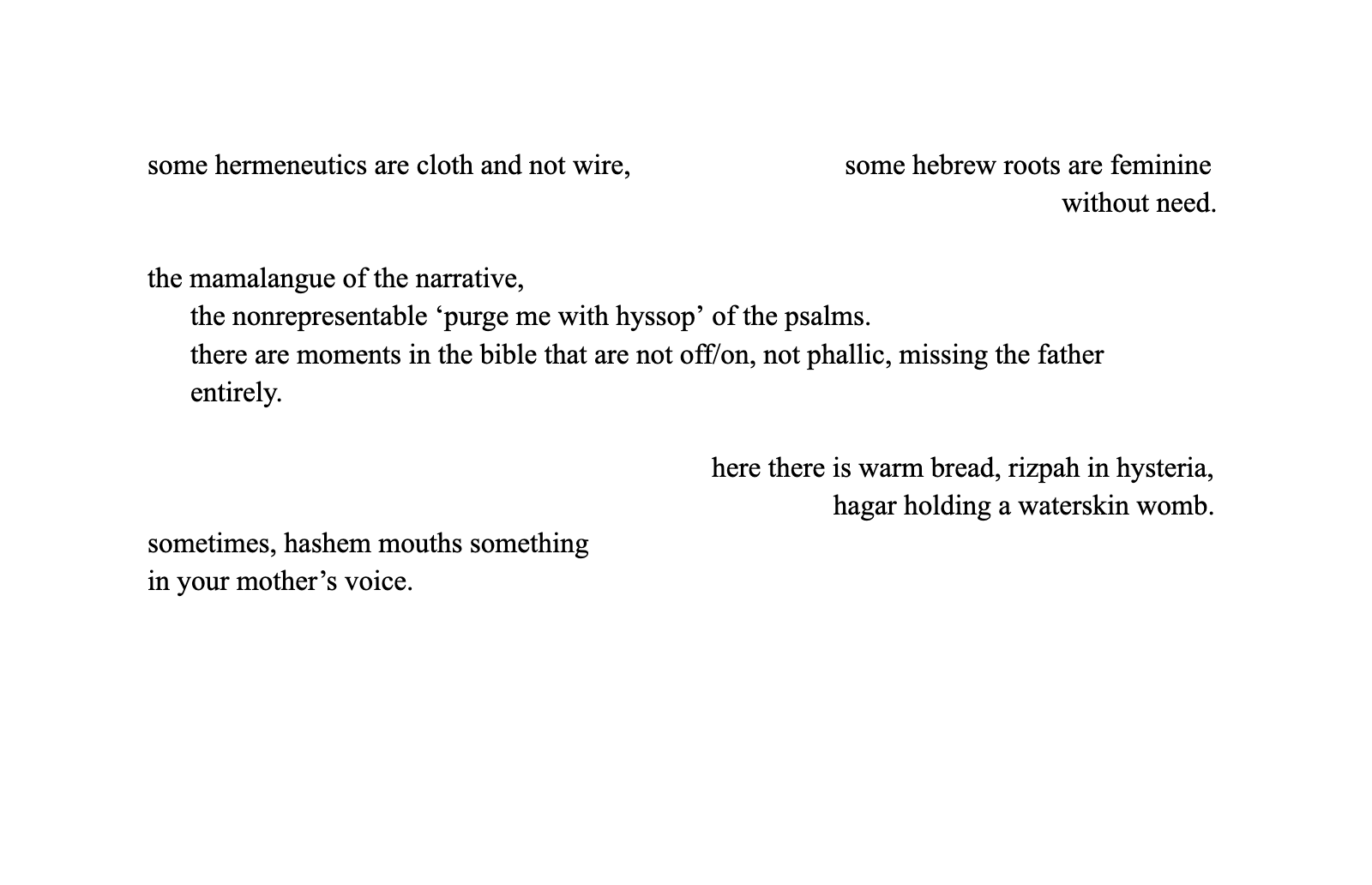
Oh this is absolutely lovely, and striking, and warm. As someone who has studied Hebrew and written a few poems imagining the Christian G*d as a mother hen, I certainly love this poem. This poem in particular of mine I think has a very parallel message to this poem you wrote, so maybe you'd enjoy
Some thoughts -
I like that the format was loose and organic - went with that more earthy / less rigid feeling of the whole poem. You did a good job keeping this utterly concise so that the reader can really just focus on each image / sentence without getting bogged down with unnecessary filler. It's very tight!
Let's look at each section / stanza individually.
I agree with the claim that hermeneutics are sometimes more "cloth-like" than "wire-like" - and I think that's such a unique metaphor too - but to me speaks at language being flexible, healing, soft, gentle, and encompassing rather than rigid, practical, objective, thin etc. Language is so contextual / cultural that this is really true.
As for the second half of that stanza -> I almost wonder if it'd be a better point for this piece to say some hebrew roots are 'masculine' without need. .... ie. people are always pointing out masculine names of "G*d" or leaders but ignoring the feminine ending of spirit / ruach etc. I think it might be interesting if elsewhere in this poem you played a bit with the image of roots -> both as linguistic markers, but also as ancestral / familial connections.
so "mamalangue" is a new word for me, and I think will be new to most English readers -> I'm assuming this means something like "mother tongue" - > great use of the word there. I think this would be quite a diversion and difficult to mix in -> but I could see how "purge me with hyssop" might be contrasted with levitical purity laws regarding menstruation. Interesting how blood is "cleansing" in one sense, but defiling in another sense.
I don't so much like the "off/on" it seemed a bit too technical / repetitious compared to other images used. Maybe "either / or"? Also I felt "not phallic" while correct and descriptive - could be a little distracting a bit too much for some readers. Wonder if there'd be a way to say that in a bit more of a subtle innuendo or way that's less direct / shocking? - An example of where the father is missing could be helpful too - ie. Elimelech, Mahlon, Chilion? I wondered if that line was meant double meaning though as "missing the father" like missing paternal / masculine presence, but also missing the "Father" when G*d is absent from the story of scripture.
Lovely. Rizpah and Hagar our such powerful examples here. Especially Hagar - evoking her just trying to keep her baby alive when everyone has betrayed her and G*d comes to speak and provide and give her baby something to drink. Womb is also a very divinely-connected word in Hebrew (connected with Tabernacle) so is a good one for this poem.
I think "hashem" will be a new word to some readers, and maybe some will choose not to look up if they don't already know that - > I think there may be some concern with the accessibility of this poem because of the biblical and Hebrew references - though for someone who has studied Hebrew and the Bible extensively I really enjoyed it and loved the connections / points that you made. Sometimes in poems that have a lot of "insider" knowledge or words that will be hard to understand for those who haven't studied other languages, you can make the poem more accessible by use of footnotes where you define (maybe not even technically but just poetically) the words/names with meanings that won't be familiar for everyone -> like manalangue, rizpah, hagar, hashem.
Overall I really loved the images you used and the directness of your poem - it was a good intriguing read.
I think the final stanza is the most powerful and really leaves a lasting impression. What a very fabulous point, that sometimes G*d speaks in the maternal and though controversial this is absolutely Biblical if we read deeply.
Thanks for sharing such a fabulous piece! You're a very skilled poet and I look forward to reading more of your work!
alliyah
Aaa!! Thanks for such an in-depth review!! I am studying theology rn, so I've been honing in on what I've learned in my writing ~~ I esp wanted this poem to evoke something not just maternal, but feminist. That's like sooo basic when I think abt it, but I feel like from a theological pov, the state of womanhood holds something special.
I wrote this poem when I learned that there is no real word for "my mother" in the Hebrew bible. Mothers are not spoken of relationally as they lack the possessive "my" ~~ but they are in vocative / accusative cases. I started to sympathize with biblical mothers (Hagar, Rizpah, even Mother Mary) and women in general (Ruth, Lot's wife, etc). To be a woman must be the closest I will ever be to G*d in this life.
What you said about "off/on" and "not phallic" I completely get!! My purpose for it being so straightforward is to reference the presence of male dominance in religious writing. For me, these texts are not monolithic. I wanted to write from a non-traditional perspective!! I feel the same abt the insider knowledge comment, but it's so hard to balance how I write vs what is easier to stomach...!
Again, thanks sososo much!! This review means the literal world to me and I am thankful someone understands what I've written. Sorry if this is a yapfest I am always thinking about this stuff looool ^_^
Hi hi!
Payton, it is always a pleasure to read your poetry! I am so glad that I introduced you to this site because I see that others enjoy what you write as well! ^-^
This is one of the most compelling poems I've ever read! It's so insane to me how you balance religious symbolism with personal reflections. There are so many layers to this poem. You almost challenge patriarchal interpretations of the Bible in a way, as well as uplift the often overlooked feminine voices in it. I had to google who some of these women were! I learned so much reading this, and I'm glad I did!
I am not the most religious person, but this hit very close to home for me. I grew up in a very faithful household where thinking this way would've been deemed a sin. I don't think you are negatively portraying anything, but it is very brave of you to point out how some women are badly treated in these texts. There is a very profound depth to your words and descriptions! It's almost haunting for me!
The poem feels like a conversation between scripture and an intimate reckoning with gender... I feel it deeply! Growing up a woman is something that sticks with you forever, even despite how hard it can be. I love the mention of the mothers here!
Though, I wish everything wasn't so rigorous. The language is intellectually loaded and draws on philosophical ideas, but it feels forced at points. For example, the word "nonrepresentable" is very clunky! I understand what you're trying to say, but I wish it was more visual. I could argue the same for all of the maternal and feminist imagery throughout! It's somewhat flat, but at the same time, it's not.
As always, this is amazing! This must be your calling, friend! You're brilliant <3
~ Seoyoung
Seo!!! *bites you* Thank uuu :3
I have just one thing to say, its awesome.
Thanks! :3
i cannot comprehend this poem and your writing is...indescribably beautiful. this is literally one of the best poems i've ever read. incredible.
Aww~ That means a lot!! Thank u!!
stunning
Thanks! :3
so so so beautiful
Thanks! :3