
Points:
Time spent:
IP address:
Canary word: Present
Possible AI signals:
Original Text:
Are you sure you want to delete this comment? This cannot be undone.
Mark this comment as a review? Points will be awarded to the poster.
Your comment was posted, but it wasn’t long enough to count as a review. Reviews need about four complete sentences (at least 250 characters). Try writing another review that explains your thoughts in more detail — the author will appreciate it, and you’ll earn points for it.
142,053 Literary Works • 676,495 Reviews

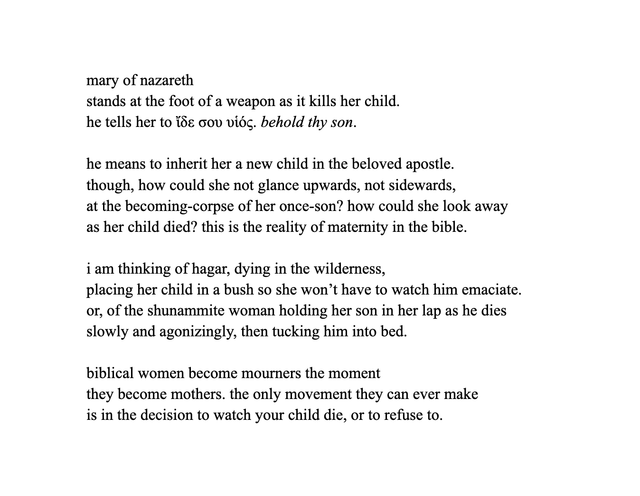


Thematically, this is wonderfully executed. It's consistent, it's poignant, and it feels finished. It explores the ideas without exhausting them, and each new biblical example has its own new nuance to add to the closing thoughts in the final stanza.
It's interesting that you used the word "weapon" to describe the cross - I suppose it is one, but not in a traditional way. Typically a weapon is something wielded, but the use of the word here feels dramatic, to drive the emotion home.
One thought I had while reading this is that you used the word "bible" and "biblical" in two places. For me, it felt too on the nose as someone familiar with biblical themes, but I know that biblical knowledge is not universal. That said, however, seeing as this is intended to be a spiritual and religious poem, I don't think you have to spell it out for the reader. There are enough giveaways: "mary of Nazareth" being the most immediate and most obvious.
This is the emotional and thematic summit of the poem. I think to let it shine, leave out the former:
Or at the very least, leave out the word bible - it would make for a more subtle, gradual build. At present, it feels redundant, and the former line has the most impact, as it is wonderfully written. This might require some reworking to maintain the same syllable count and rhythm you have in the two middle stanzas.
Insofar as content goes, I think the concept is well explored here and the weight of the grief and inner turmoil is communicated well. My only thought after reading is: how is this different from modern motherhood? Is it not fated that all mothers face the possibility of losing their children before their own death? This isn't something your poem has to explore, but you mention in this piece that this kind of loss is a recurring experience for mothers who are mentioned in the bible. These are just my musings to add to your thoughts if you choose to return to this concept and explore it again.
Your voice as a writer is very distinct and clear in your word choice and the flow. I thoroughly enjoy how clear it is and I think it's one of your greatest strengths in your poetry - it really shines here.
I think that's it for my thoughts, but this is a really solid poem. Thanks for sharing it and pointing me to it! I hope you keep writing. :^)
-sound
hi payton!
this has been sitting unreviewed for a while, so here i am!
diving into this, the rawness of mary of nazareth's symbolism here is stunning. it's pure maternal grief. the weight of this poem is heavy; really, it sits with you. you've captured this gut-wrenching aspect of biblical motherhood that feels both ancient and painfully relevant. especially in today's societal and political climate. these women: mary, hagar, the shunammite woman, they're all caught in this horrible space of powerlessness. it is an inescapable truth for them.
the framing of the poem, using direct references to the bible and these scenarios, really makes it feel grounded in history. though, it's also timeless. you're not just telling a story, you're painting a portrait of grief that's been repeated throughout the ages. it's about being forced to witness, and maybe even accept, the suffering of what you love most. it is a cycle that never ends.
like this. this is a gorgeous line, but it's also painful!
this is a perfect encapsulation of mary's grief. it is profound. it just emphasizes her confrontation with the brutal reality of her son's transition from living to, well, not. i feel speechless reading it. the phrasing of "once-son" is particularly haunting for me tbh, and it's like he is now irrevocably altered by death. there is no escape from the sight before her, no relief in looking away, as each direction only offers reminders of her loss. that speaks volumes to the love she felt!
the imagery here isn’t just biblical, but it's universal. it really taps into the very real theme of parental love and the extremes of emotion it encompasses. while the themes are grand, it remains intensely personal, almost intimate. it's like each line mourns not just for these biblical figures, but for all mothers who have faced such heartbreak. that's a common theme in your poetry.
ughhh go ahead and break my heart some more!
this poem, esp this line, does so much with so little. that’s something not easy to manage. maybe, just maybe, fleshing out a bit more about each woman’s individual story could add even more depth? i would imagine there are tiny rebellions or resignations that each woman shows. it is only natural to want to go against something like this, even if it is written in your fate. humans are like that. you gloss over the idea of these women, but i could see more.
still, what you've done here is create a space that’s both a mourning and a tribute, and that’s no small feat. it is hauntingly beautiful and somewhat bitter, as always!
best,
chi