
Points:
Time spent:
IP address:
Canary word: Present
Possible AI signals:
Original Text:
Are you sure you want to delete this comment? This cannot be undone.
Mark this comment as a review? Points will be awarded to the poster.
Your comment was posted, but it wasn’t long enough to count as a review. Reviews need about four complete sentences (at least 250 characters). Try writing another review that explains your thoughts in more detail — the author will appreciate it, and you’ll earn points for it.
141,497 Literary Works • 674,544 Reviews

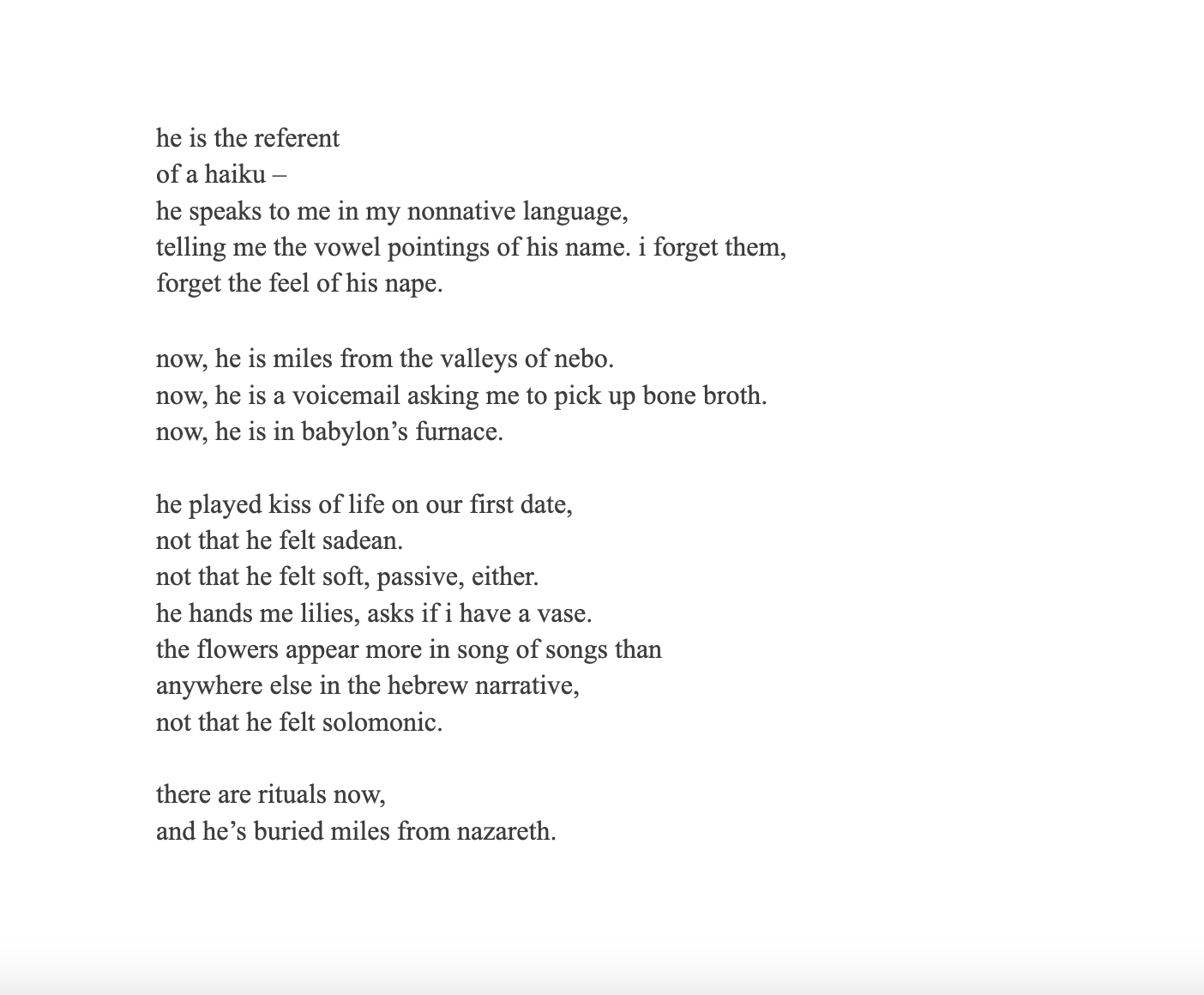


Right away, this line lands for me. It sets up a relationship of distance between the narrator and the man of their affections. It is abstract, minimalist, and bound by form. It introduces the idea of language as both bridge and barrier, as well, which I think becomes central to analyzing the poem.
This person, the "he," exists not just as a person, but as a symbol. A referent is meaning-making -- it anchors language. But here, the narrator can no longer hold onto that anchor.
There’s such depth in the references, as well, and I feel that each one adds weight without being overtly explanatory. These allusions create an emotional geography that the narrator is navigating, especially through all of the locations. I love that! The juxtaposition of the sacred and the mundane is especially striking here:
This line made me think. It’s so domestic placed in between biblical references, and I think that’s the point. He was all these things. He was a valley-walker, a voicemail, Solomon, and a song. What I am taking from this is that you’re showing that grief is both grand and ordinary.
Though, there are a lot of references that people are just expected to know. Unless you're incredibly into theology, they'll go over most people's heads. This isn't a bad thing, but it is something to keep in mind.
There are some areas with clarity issues, as well. For example:
A pop culture reference is really interesting for this poem. I don't mind it, but I am unsure where it fits into everything. It's personal, but very sudden.
If “sadean” is meant to reference the Marquis de Sade, the line becomes a critique of projected desire or discomfort. If not, and it is a reference to the singer, you might want more context. "Kiss of Life" is a song by Sade, but why that song? Ambiguity is very useful, but there needs to be a foundation.
Are you mourning or recalling or trying to understand this man?
Great poem though!
hi payton!
this has been sitting in the green room for a while, so i figured i would check it out!
stunning. this line does so much with so little. it suggests he’s both distant and poetic, something only pointed to, never fully captured. i love how you've tied it to a haiku. it's a form defined by precision and absence, so that feels so right for a love that’s no longer fully present. when you write poetry, especially haiku, you have to make meaning out of something with very little words. love is kinda like that; you don't get an infinite amount of time with someone you love.
now this is what i'm talking about!
i feel like this is a perfect stanza, maybe the strongest in the poem. it's mundane but absurd, distant but intimate. it's also where the grief angle of this poem starts to form, and oh boy it comes on strongly. that works though. bone broth becomes symbolic as well. it's domestic, nourishing, but also so clinical. it’s what remains of someone who was once filled with so much life. all of that, but everything that remains of him is metaphorical or abstract.
these biblical references are strong, but i wonder if the geography and symbolism could be clarified. like i know nebo is moses’ final view, babylon represents exile, and nazareth is for burial. however, i think that could definitely be obscure for people unfamiliar with scripture. there's dry humour, spirituality, grief, intellectualization, etc. there is a lot of tonal juggling. that isn't necessarily a BAD thing, but it might make this poem harder to digest for the average reader.
i love the tension here! sadean vs. soft vs. passive. you’re playing with masculinity here in a really delicate and clever way. he's not dominant, but he's also not gentle. he exists in this middle road where it's really difficult to find words to describe it, especially in terms of manhood vs. womanhood. he's something else. undefined, perhaps unknowable.
this is also really neat juxtaposed with "the flowers appear more in song of songs than / anywhere else in the hebrew narrative, / not that he felt solomonic" since kinghood is now also in the equation. i love how you're pulling from religious text and recontextualizing them! he’s not solomon. he’s not wise, not poetic, not profound. so despite the lilies and biblical allusions, the gesture doesn’t carry the gravity it seems to. it's just a shallow imitation of a deeper, more spiritual love.
ouch! what i'm taking from this is that you’re grieving someone who was only ever half-visible, and yet the weight of ritual still falls on you. you love him, even if he isn't some big name or story to tell. nazareth is, of course, where jesus grew up. there is no myth here, just death. it’s quietly brutal. his burial isn’t sacred, but it's distant. ordinary. maybe forgotten. this line is so powerful as a closing because it withholds hope and leaves us in this ambiguous place.
so yeah, this is amazing! i always expect that from you.
best,
chi