
Points:
Time spent:
IP address:
Canary word: Present
Possible AI signals:
Original Text:
Are you sure you want to delete this comment? This cannot be undone.
Mark this comment as a review? Points will be awarded to the poster.
Your comment was posted, but it wasn’t long enough to count as a review. Reviews need about four complete sentences (at least 250 characters). Try writing another review that explains your thoughts in more detail — the author will appreciate it, and you’ll earn points for it.
142,082 Literary Works • 676,572 Reviews



I have enjoyed reading this poem.It’s about love and how connected people feel with each other,that they’d do anything for each other.They’d wish for their very love to never,ever end.Alas,not all things will go as planned.Stuff happens and love starts to fade away.I hope you have an amazing and lovely day and night.
Hi there Silver! Lim here with a review.
First Impressions
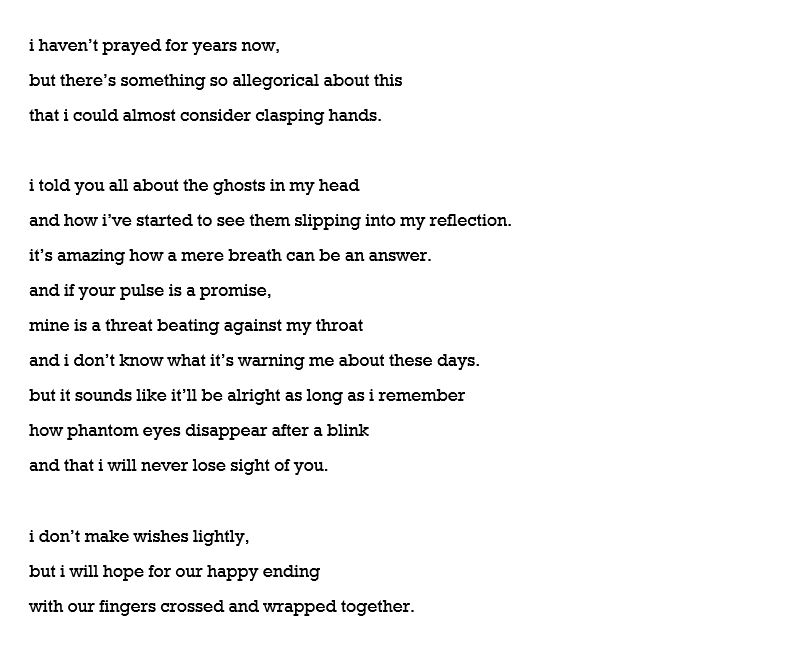
I think the parts of the poem that popped for me when I first glanced through it were the word choice “allegorical”, and the contrast about the pulses, between “promise” and “threat”. The poem’s mood seems to be one of desperate hope, with the ending being something like having fingers “wrapped” together, as if they’re crossing them really, really hard. The speaker’s tone does seem to be prayer-like, from the first stanza, but also from some of the other word choices that I’ll get into in a bit.
Subject, Themes, Interpretations
The main idea of the poem seems to be that the speaker, after a long time, is hoping for something. Parts like “haven’t prayed for years . . . but” and “don’t know what it’s warning me about . . . but”, and actually the frequency of the word “but” after the speaker says something uncertain suggests this.
When it comes to interpretations, this poem also makes me think of that idea of mind, body and spirit as a trio and how that relates to the relationship between the speaker and the ‘you’. The speaker seems to be more spirit than mind or body, which is why their own pulse, a symbol of something corporeal and one of the few straightforwardly body-related images attributed to the speaker, comes across as a “threat” to them. The word choices like “ghosts”, and “phantom eyes” sort of associate the speaker with incorporeal things for me, and also the fact that a lot of the words here are abstract concepts, like “wishes”, “hope”, “warning”, which also gives the sense of a prayer or something spiritual anyway.
In contrast, the ‘you’ is described with physical images like “breath” and their “pulse” as something positive, a “promise”. I think this ties into the above narrative in that the ‘you’s solidity seems very promising to the speaker, because it contrasts with the things from the past like the “ghosts” and “phantom eyes”. Also the contrast between the statements “phantom eyes disappear after a blink” and “i will never lose sight of you” sort of portrays love (?) as something stable and corporeal, whereas the incorporeal and unstable is its opposite.
Structure
The rhythm is very conversational, with there only being some subtle sound devices. I think that’s quite different from some of your previous work I’ve read, which is interesting. It sounds good read aloud, too.
As for the title, I read the phrase as ‘no mirror lies between us’ first and then something like ‘[there are] no mirror-lies between us’. I think the bracket introduces an element of distortion or confusion, so the denial of the bracket with “no” seems, based one the rest of the poem, to be enforcing the idea that the speaker and the ‘you’ are having a moment of clarity where they realise they can, or want to hope.
In the second stanza, the speaker seems to go back and forth quite a bit to make the contrasts that I brought up earlier, for example “and if your pulse is a promise . . . mine is a threat” suddenly dips into a different story and mood than the prior “i told you all about the ghosts . . . it’s amazing . . . “ which starts out negative then flips into positive. So it does have a flip-flopping feel when it comes to the mood I experienced as a reader.
I just thought it was worth mentioning since the last stanza seems to be a resolution to the ‘story’ of the poem, and with the very turbulent second stanza, the resolution felt a bit sudden. “i don’t make wishes lightly” means the speaker is making a heavy wish here, and so it seems there could have been a few more lines of constancy before the final stanza, which would reflect the constancy of the ‘you’ in the language, if that makes sense?
Language and Word Choices
The language here seems to be a mix between conversational colloquialisms and more ‘high-brow’ language so to speak. For instance, there are loads of contractions like “haven’t” and “it’s” that give a sense of closeness, but there are also words like “allegorical” and “clasping hands” in the beginning.
Now that I think about it, the word choices in the beginning are quite a bit different from the rest of the poem. Even in the ending, where the speaker sort of returns to their original point, they use words like “wish” and “happy ending”, as well as “fingers crossed”, which seem to evoke a more fairy-tale-like or maybe ‘casual superstition’ type of hoping, rather than the suggestion of prayer in the first stanza. Those are just the associations I had with these word groups, anyway.
I think in general the mix word types works. I mean, the speaker’s voice is just casual enough to sound like natural speech and also loaded enough to convey the emotion of their realization here.
Overall
This was a pretty well-structured piece, with intertwining images that convey a coherent mood and atmosphere of tentative, yet somehow intense, hope. I kind of like the idea of playing with concrete vs abstract in this subtle way, to make the ‘good’ more concrete and thus suggest the speaker’s feeling is ultimately positive.
Hope some of these comments are helpful, and keep writing!
-Lim
Thank you for the review, Lim! You're super great at finding the poetic devices and interpretations that I hadn't even noticed when I was writing it <3