
Points:
Time spent:
IP address:
Canary word: Present
Possible AI signals:
Original Text:
Are you sure you want to delete this comment? This cannot be undone.
Mark this comment as a review? Points will be awarded to the poster.
Your comment was posted, but it wasn’t long enough to count as a review. Reviews need about four complete sentences (at least 250 characters). Try writing another review that explains your thoughts in more detail — the author will appreciate it, and you’ll earn points for it.
141,254 Literary Works • 674,330 Reviews

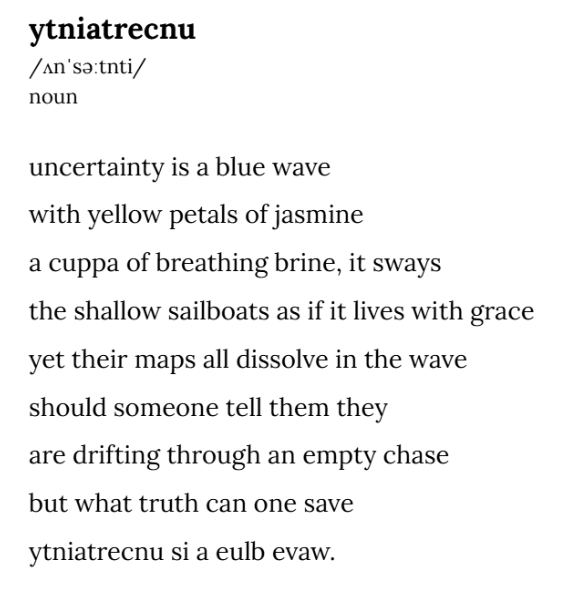

Hello Roxanne! Lim here with a review. This will be mainly interpretations, what I got out of the poem, but feel free to ask if you'd like any more specific feedback.
When I first read this poem, the thing that made the biggest impression was the structural story, the scrambling of the letters for "uncertainty" and how the metaphor of the blue wave supports that illustration of what uncertainty means. I kind of interpreted it as a textual drawing of what uncertainty feels like, especially with the dictionary entry format that prepared my mind for a definition or representation. I like the placing of the line breaks. The enjambments in "it sways/ the shallow sailboats" and "they/ are drifting" pulled my eyes towards the next line, creating this sound symbolism where the reading of the lines really feels like the rocking motion of sailboats on the water. The line breaks also emphasise the rhyming of the vowel sounds between "sways", "grace" and "they", which adds cohesion to the poem's structure.
On a second read, I tried to dig a little deeper into the meaning of the poem. The choice to use colour in the first two lines actually surprised me when I re-read the piece. The poem is written in black-and-white and dictionaries aren't known for being very colourful, so the image of yellow jasmine flowers in a blue ocean wave feels like it's contrasting all that, maybe even rebelling against it. In next line, we jump from uncertainty is the sea to the sea is its own being and so is uncertainty with the phrase "breathing brine". Through all this, uncertainty is portrayed as a force that people can't control.
I noticed an additional metaphor to this (three metaphors!) where the sea is being compared to a cup of tea. This one feels like it conflicts with the earlier metaphor, as I associate a cup of tea as being something quite calm and sedate. The water in tea is stagnant, while the water in the sea is always moving. Additionally, the word "cuppa" is very colloquial (compare: "cup of breathing brine", "vessel of breathing brine"), which creates a sense of intimacy with uncertainty/the sea, almost as if the speaker is fond of it. So there appears to be this tension between uncertainty being an uncontrollable force and uncertainty being a sort of friendly, familiar thing.
But then the next line comes along:
The "as if" seems to suggest the friendliness of uncertainty/the sea is deceptive, it isn't really a cup of tea after all. The word "shallow" seems to imply the sailboats would be easily flooded, easily overcome by uncertainty. "yet" suggests that the maps dissolving is a bad thing - the sailors have now lost their sense of direction. (If the line had been written as "their maps dissolve in the wave", it would have been more ambiguous, maybe uncertainty can be freeing?) So now in the poem's story, uncertainty reveals itself to be dangerous.
The final two lines convey a sense of resignation. The speaker declares the sailors can't save themselves from uncertainty, but uses the word "truth". This seems to imply a more specific theme for the poem, perhaps that it's about uncertainty of what's real/ not, whose stories to believe, as opposed to general uncertainty about the future. Then the scrambling of the last line reflects again the dynamic nature of uncertainty. Thinking about the uncertainty of this poem as an uncertainty about truth, I think the dictionary formatting has a deeper meaning - as much as people believe there can be an objective reality and that we can catalogue its contents like words in a dictionary, this poem paints a picture of the world that is always rebelling against such order, like the sea, and that this is an inevitable part of life.
Overall, this piece is engaging because it manages to convey a 'turn' or a reveal in the narrative despite it being so short. Additionally, the contrasting images made me think about how they make sense and cohere, which was fun to do.
Hope this helps, and keep writing!
-Lim
gorgeous, remind me to review
Review
I liked this a lot and it’s fun that it’s managed to become the #2 featured work on YWS right now and yet I’ll still be the first review. So it goes, as the Tralfamadorians say.
As I’m sure you’re aware the ocean and the ships that sail it have oft been used as a metaphor for uncertainty, so you’re in good company here.
You use the metaphor skillfully, not relying on any basic comparisons but crafting imagery of waves gilded with flower petals and figurative coffee cups of living saltwater. It’s nice.
I think you’re missing a chance for a killer rhyme scheme though. As it happens, every single ending word of each line is a near-rhyme with the others with the sole exception of “jasmine”. If you found a different adjective for the petals that also has the “ay” sound in the last syllable, the poem would have an AAAAAAAAA rhyme scheme, which would be pretty impressive. Something to consider.
But overall, this was done very well! It’s not a surprise people are just liking and not bothering to offer feedback. It’s an intimidatingly skillful poem that doesn’t reveal the details of its meaning even in response to careful analysis.
Have a good one.