
Points:
Time spent:
IP address:
Canary word: Present
Possible AI signals:
Original Text:
Are you sure you want to delete this comment? This cannot be undone.
Mark this comment as a review? Points will be awarded to the poster.
Your comment was posted, but it wasn’t long enough to count as a review. Reviews need about four complete sentences (at least 250 characters). Try writing another review that explains your thoughts in more detail — the author will appreciate it, and you’ll earn points for it.
141,261 Literary Works • 674,331 Reviews




Hi, Roxanne!! I was very excited to see you mentioned this piece and wanting another review on it. Let's get into it!
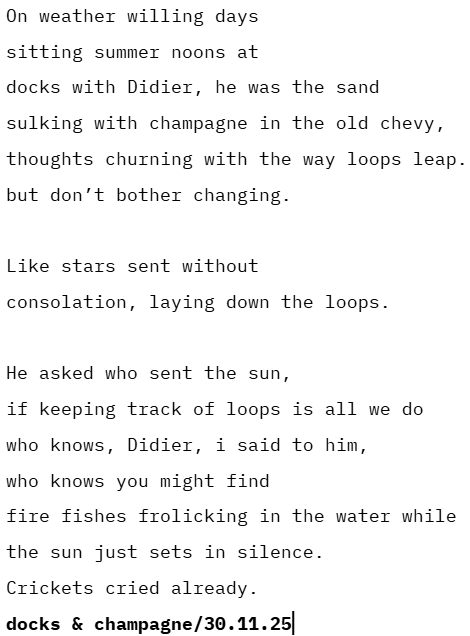
The way I generally do reviews for poetry is going section by section (sometimes line by line), and then I talk about things overall! I think for this one, I'll go closer to line by line because there's a lot of stuff happening! : D
Small grammatical note: if "weather willing" is meant to, together, describe the days (in contrast to "willing" being a verb with "weather" as the subject), then there should be a dash in there! --> "weather-willing."
I don't normally love cutting off sentences in poetry reviews, but felt like I needed to for this one. Firstly, you've got some LOVELY alliteration going on throughout this whole piece. "Weather willing" and "sitting summer" both stand out in these lines, in a gorgeous way. I also really enjoy your choice of words that don't normally combine together to craft new meanings. "Sitting" is not normally a verb combined with a time of day, as it is used here, but normally goes directly into describing the place, so it's a really interesting sentence structure to get from a reader's POV. "Weather-willing," if a combined adjective, is also really interesting and sparks my imagination. It gets me thinking about what it means for weather to be willing, and also implies some level of consciousness from the natural environment. Great work on this!
Adding on the next line here. This is where it changes. For the first two lines, you've got a pretty steady rhythm and pacing, and with this next line, it expands and folds out. It feels like you're opening the world of the poem to the audience. I was unfamiliar with the word "Didier," so I looked it up, and Google said it's a French name, but can also be a reference to some specific characters. I'm going off the assumption that it's just a name you chose because of the alliteration and the uniqueness factor, rather than a reference to a specific character or person, but if it is meant to reference a specific famous person, then that might affect the accuracy of my interpretation, haha.
As I already pointed out, the alliteration here is nice too. I think "he was the sand" is where the entire poem shifts from alliteration and rhythm to narrative-driven. He was the sand. Great use of metaphor and also super intriguing! This could indicate that it happened in the past tense, OR it could mean he was the sand and is no longer the sand? We'll see :]
Grammatical note: If you're going to capitalize the proper noun of the name "Didier," it probably makes sense to also capitalize the proper noun of "Chevy." Also, since you capitalize the beginning of the sentence at the top, it makes sense to capitalize "But" since it's the beginning of a new sentence.
Okay, adding a few more lines this time. Really nice alliteration with the "ch" for champagne and chevy. I also like the contrast of drinking a drink traditionally viewed as fancy like champagne in a car traditionally viewed as middle-class, like a chevy. Champagne can also imply there's something celebratory about the gathering, but Didier is sulking anyway, which I find really interesting. The narrator is also able to see into Didier's mind (First person omniscient, if that's a thing?), since the narrator states that Didier's thoughts are "churning with the way loops leap." More alliteration. In a way, this poem feels a bit like loops with the alliteration and continual connection between lines, and I'm intrigued to see how you expand on the idea of loops "leaping."
Also, maybe it's just personal preference, but I wonder if the final line in this section would be stronger without the "but," since it's the start of a new sentence? Because all the other lines have run together, it feels odd to start a new sentence with a connecting word like "but" instead of just stating "Don't bother changing." Food for thought, I guess!
VERYYYY interestinggggg. Firstly, once again giving some autonomy and consciousness to a natural element like stars through the idea that they can: 1), be depressed/sad, and 2), can be given consolation for it. However, there is still some bigger power that sends them down without that, leaving the stars "laying down the loops," which makes me think that even in the first instance of "loops," it's being used more metaphorically to symbolize mental health struggles, implying that Didier is struggling with mental health and thinking through how depression spirals and makes logical "leaps," even when it doesn't make sense, to support its own arguments.
Another instance of "loops," once again changing the definition! (This time, to years/how many times we circle the sun would be my interpretation.) LOVE it. I really enjoy how you're using one word but changing the meaning based on the context, really great job with that!
Okay, once again cutting it off very shortly so I don't forget to say the things about these lines. Grammatical note: Since you're using commas in other places, it makes sense to be consistent and include them where grammatically called for, so I'd suggest adding one here --> "who knows, you might find."
This confirms the first person narration, which is interesting. I'm a little confusing on the choice to de-capitalize "I" in this sentence. I think maybe why I'm confused is because you capitalize the beginnings of sentences, suggesting you're sticking with traditional grammar for capitalization. If you want the "I" to stay de-capitalized, I'd suggest not capitalizing anything at all save for the beginning of Didier's name, since that seems to be a point of emphasis for this piece.
I also REALLY love the choice for the narrator to not know and to admit not knowing. It adds to the mystery and profoundness of the questions the poem is asking about the universe. The inherent "I'm not able to know" of it all, if that makes sense.
Gorgeoussssss. Really love you playing with fantastical elements of what all is possible when we don't know the exact answer. Fishes on fire under the water (besides the obvious alliteration) is a really pretty image to paint in the mind of the reader. Really, really nice. I also love the fact that the sun "just sets in silence." The "just" implies that Didier expects the sun to do something more, and the narrator is saying it might not. The return of nature to unconsciousness, rather than the awareness the rest of the poem has been affording the natural elements. Really pretty.
The final line has me a bit stumped, honestly. I like the alliteration but it doesn't fully feel like the proper ending to this poem. I read the other review and your response, and I really love the meaning you have behind the crickets. I think making it its own separate stanza could help (because currently, without quotation marks, it seems like the narrator is saying out-loud that crickets cried already, rather than a thought experiment in the continuation of the poem). I also think that adding a bit more to the line (maybe making it part of a couplet as the last stanza?) could help to tie back in the idea of loops. Loops are SO IMPORTANT in this poem that I want the word to appear just ONE more time to really hit home that point, and I think adding it with the crickets could help punch up the ending.
OVERALL:
The strengths of this poem really lie in the alliteration and rhythmic techniques you've utilized to make the poem flow while emphasizing points you're making with the words themselves.
Areas to grow: I think the ending is the weakest part of this poem. I also don't think the title fully sums up the poem. The champagne and the docks don't feel like the most important part of this story and thought experiment taking place in the poem, and I wonder if, instead of choosing words from the poem, you could create a title that ADDS to the interpretation of the poem. Something that, before reading, intrigues, but after reading, makes the reader go "OH, so THAT'S what that meant." That's a lot easier said than done, but you're extremely talented, so I'm sure you could find a way to do it if you wanted.
As always, all of my thoughts are just suggestions and interpretations, not the word of law, so you should stick with your instincts if they differ! I'm quite obsessed with this poem, and I am so glad that you mentioned it for me to review. Really, really gorgeous work. If you have any follow-up questions or want to talk about anything, please feel free to comment here or PM me if it's a longer convo! I'd love to talk more about this and your interpretations of it with you!!
Sending love!
~Winter
Thank you for the review, winter!!
Hallo Roxanne, the fifth December is a very special day for me so I'm looking forward to your poem
I really like the feel of the poem, I can't quite describe it but it calms me down.
I also like that there's a bit of narration in it, this conversation with Didier. I also find a fascinating that you describe this person as being the sand. Kinda gives me the impression that he has a very flighty unfocused personality, but still managing to be interested in everything.
I'm not sure what to think abt the loop motif. Loops repeat themselves, they don't have a clear beginning or end. I also think of time loops or routine. I also find it interesting that the poem states that loops don't change but the narrator still encourages Didier to look for changes/new things with this: "who knows you might find" BC this means that even in loops there are new things to discover or sides of the story we haven't seen. I'm sure I'm missing so many things but I do like thinking abt this:)
No idea what the fishes and crickets symbolise ^^°
Thanks for the review, Tikaya! Your interpretation of the loops is on point! The fish technically symbolise the "changes/new things" but I closed the poem on a kind of ironic note, with the crickets symbolising another loop that doesn%u2019t change (crickets crying every evening)