
Published September 18, 2016

Points:
Time spent:
IP address:
Canary word: Present
Possible AI signals:
Original Text:
Are you sure you want to delete this comment? This cannot be undone.
Mark this comment as a review? Points will be awarded to the poster.
Your comment was posted, but it wasn’t long enough to count as a review. Reviews need about four complete sentences (at least 250 characters). Try writing another review that explains your thoughts in more detail — the author will appreciate it, and you’ll earn points for it.
141,328 Literary Works • 674,349 Reviews



(This is definitely overdue, and for that I'm profusely apologetic. But better late than never.)
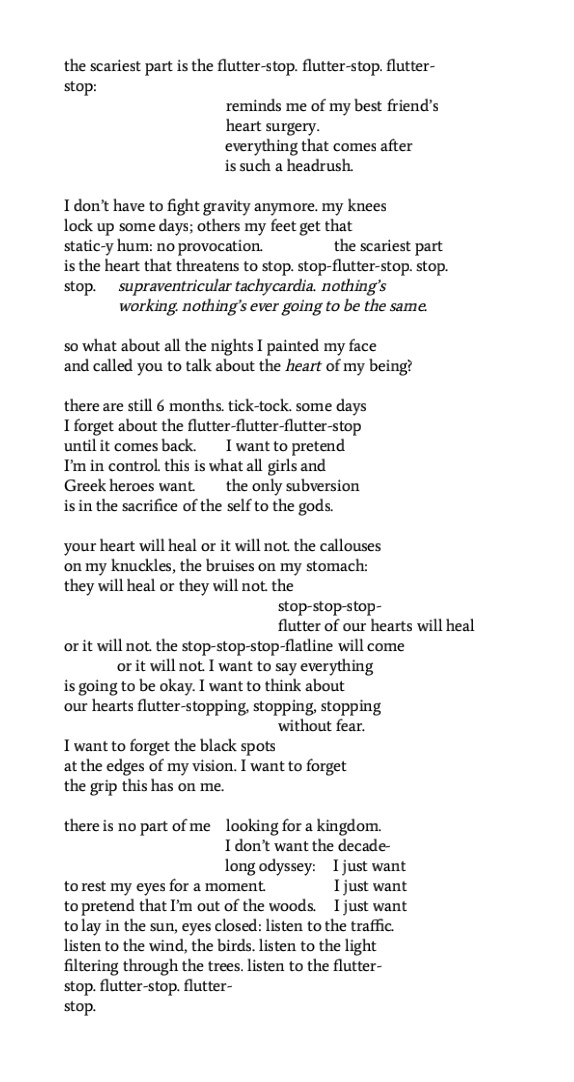
I love when a piece starts off in such a fashion: 'the scariest part is' / 'the best part is' / 'the worst part is', where the author makes a conscious effort to capture the most vivid moment of a given situation (whether it inflicts major or minor connotation). As a reader, I'm drawn closer by your opening because it provides a window through which I'm privy to the narrator's most intimate metaphysical experience. The simplicity with which you execute the first two stanzas is impeccable. You introduce us to your coping process, and from that moment on, we are accepting a deep state of infatuation with you and with your work. Mostly because we feel connected to your story (and more importantly, like you've connected us).
It seems that throughout the poem, your mental stability is being challenged by thoughts of what's to come. It's a kind of tug-of-war in your subconscious; a poignant back-and-forth that tortures you hourly. The narrator is plagued with inner conflict and worried by the passing of time. It's very much a 'glass half-full; glass half-empty' ("flutter-flutter-flutter stop" vs. "stop-stop-stop flutter") vibe, which might've become bothersome if you'd only given us the two alternatives and had left out the minute personal detail.
And that's what you do exceptionally well, I think. You're able to extract an personal experience you've had (whether fictitious or autobiographical) and make it relevant to the message you're trying to portray. That message is often just an expression of raw emotion, but it does its job and those little narrative tidbits (e.g. "I don't have to fight gravity anymore. my knees lock up some days; others my feet get that static-y hum: no provocation") are vital assets. That ability is what most poets are lacking, and you do it beautifully.
In my opinion, your repitition helped in some places, but it didn't add [per se] in other places. It makes noticeable how you might be lacking grace transitionally, though I don't think it really takes me out of the poem's grip. There are ways that this could be slimmed down, but many of the iffy places I'm seeing might be necessary to reflect the haphazard emotional concatenation that you're trying to relay.
Either way, there's nothing obvious subtracting from the piece for me, and at the end of the day, if I'm feeling differently at the end of the piece than I had at the beginning, then you've done your job.
Like I said, I think this is your best yet.
Best of wishes,
Sav
This is by far the best poem I have read here... so far. I can't say that I absorbed enough of what I was reading to understand anything, my attention span is compromised at the moment. But at least it doesn't rhyme. I hate rhyming poems.
You've no idea how much of my heart I wrenched apart to try and wound this with a scalpel. Your content is excruciatingly potent and your delivery, while dense, moves flows in near-perfect motion--
--until the final fourth. The technique you employ that is inherently a risk and we both know it--the repetition to invoke longing and desperation (I just want I just want I just want)--produces a feeling akin to that of a car having trouble shifting between gears in automatic transmission. But this really is speckled throughout the piece in varied forms, and I'm unsure how I feel about it into my dozenth-or-so read.
At the same time, this could be a note that falls into our ongoing discussion regarding the differences in styles. Density vs. Weightlessness. The density must be driven by something, but on the same token I've seen you pull off these feats without grinding gears before.
And the repetition WORKS in part two because it's ensconced in the lyricism--it will or it will not--and it delivers such a wonderful ache. Maybe it's the replication of the technique with phrasing that doesn't leave an echo that has me bothered. That seems accurate.
This is gorgeous for the haze. You make me want to thread my needle whenever I get near your work.
Ty xo
<3 <3
There's a density and complexity of thought that I really struggle with in my personal life; I've devoted pages and pages of writing to the sheer depth of my thought. I can't get down to the bottom of it, or at least I haven't yet. You know this. The haze doesn't help, but I've never quite been able to fathom myself. Hence the dense, heavy poetry.
I hit a wall here, I agree. There's a grace that I think I'm lacking: this I feel comfortable attributing to the haze, at least partially. The desperation got across, but without the softness I generally aim for. That stanza gives me mixed feelings. On one hand, I do agree that I've done better. On the other, there's a desperation in the depths. I think I haven't quite gotten that across; I'm trying. It'll show up one day.
Thank you thank you thank you <3<3 I love your reviews.
Okay so this is really honestly beautiful, and I'm going to attempt to review it but it may not actually be of any help, so sorry in advance.
I love how you tie the literal heart problem to anxiety. I think it's a really powerful connection and it's beautifully woven together here. However, I feel like a less-careful reader would miss the anxiety portion and think this is just about the narrator being worried about her best friend's heart. This is mostly the case in the first part of the poem - "the scariest part is the heart that threatens to stop," the six months and the way the narrator forgets about it sometimes all feel more like she's just worried about her friend.
This is much less the case in the second part of the poem, though - I especially love the last stanza for how it shows how anxiety never lets you rest, it always says you should be doing something, you're doing something wrong, or just that something bad will happen.
There were a few lines I wasn't quite a fan of - the first being "I don't have to fight gravity anymore." It just seems to have too positive connotations when it's used in what feels like a negative context, and the poem never really goes back to that theme, so we don't have a chance to understand how you're subverting it.
The other line was "the only subversion is in the sacrifice of the self to the gods." It felt awkwardly phrased to me, probably because there were four 'the's right after each other, and it also feels like a kind of vague sentiment. I'm just not remembering many Greek myths where the heroes gave up their will to the gods and I'm not sure it fit in the wider context of the poem.
But ah, what am I saying. This is such a solid, beautiful poem, there's little to actually critique beyond wild thoughts about one line or another. Thanks for the great read, and I wish you and your friend the best of luck.
Thanks for your feedback! If you don't mind, I'd like to clarify the intent behind a few moments that you mentioned (and, of course, consider them in my revisions.)
I'm quite vague as a poet; I hope to leave the heart of the issue somewhat ambiguous whenever I write. This may seem an odd choice, but I am actually quite reserved as a person and don't want to give my heart to just anyone. To the point: I don't think there is any one way to correctly interpret my poetry. I'm interested in whatever you see there.
That said:
The gravity line is meant in a few different ways. The first is dizziness, a common symptom of cardiovascular illnesses (due to bloodflow.) The second is maybe a little more about my issues: the nature of my mental illness has me dissociating sometimes: a disconnect from myself, essentially. A sense of floating.
I agree wholeheartedly with the Greek gods line: it's out of place. The intent behind it isn't so much a sacrifice of the physical self as it is a sacrifice of individuality and will. I mean to evoke a sense of the ways the gods are unjust; that is, they punish mortals for acts against them that they commit c o n s t a n t l y. Moreso a comment on injustice and circumstance than religion. (It is vague though.)
I'm so so so grateful for your praise. You're too kind. <3 Again, thank you so much for taking the time to write this.
im really emotional because of hormones and what not. this made me cry because its so beautiful. ah.
thank you<3
This means the world.
your welcome <3
hi love.
if your poetry is a theatrical performance, this is the show-stopper. it's heart-wrenching and in the best way.
definitely stay tuned for review <3
this is the kindest thing anyone's ever said about my work. thank you so much sav %u2764
Hello.
I like this. You've accomplished a certain amount of showing the fear and uncertainty with the repetition, and at first I was a little worried about the repetition but it works really well.
I am potentially biased in this, and feel free to disregard; the mid-sentence spaces feel like they aren't exactly obviously placed. Especially in stanza six, where you start with "there are still six months." When it's a line break, I can tell its purpose, but the "held breath" effect isn't quite as obvious as I'd like? But, again, could just be personal preference about mid-line breaks.
I can't tell if I like or I don't like the fact there are multiple parts in here I can't tell who the poem is talking about. Anxiety generated heart issues kind of weave in with the friend's heart issues, and on the one hand, the blending provides a nice middle ground you two share; on the other, it can make the poem confusing in spots, where I'm never quite sure if it's actually meant to be your heart or hers and you're just there to watch the episodes.
At the same time, I'm really not sure what to say about this poem. It is subtle and blunt and just "sticky". Some of the lines in here are downright haunting, and while I feel this poem could be better, maybe, it's not something that can easily be revised. There's a beating heart here, and I think the only thing I can really point out is that heart stanza. It's a transition that feels forgettable and unanswered. It doesn't weave back into the poem, and it comes out of nowhere, just a little.
But part of me likes the messiness of how nothing quite feels finished, considering how this is discussing an unfinished event.
Take of this what you will. The poem is solid, and lovely, and I hope your friend does find a good quality of life— and that you find some peace, as well.
Let me know if you have any questions or comments.
~Rosey
I agree with everything you've said. There's so much here that's just...personal, in a way that I would ordinarily avoid. I've mentioned before that I'm quite reserved as a person, so this was difficult for me to write in a lot of ways. That's why it's so dense: it's much easier to wrap up the honesty in lots and lots of layers than to put it all out on display.
I assume the transition you're talking about is the face-painting one? That'd be my guess; I feel the same way about it. It's a very individual moment; based in actual memories. The sudden fear and retrospection bad news brings up, you know? Anyways, I've been toying with it; I'm not sure where to take it. I just want to say I agree; I'm working on it.
I think confusion is kind of the primary reaction to my poetry; this is the case most of the time, at least.I'm never certain whether I like or dislike having that kind of power, but it's easier for me to say things densely than it is to lay everything out neatly for the reader. I like my privacy but I crave intimacy, so I've compromised in my poetry. I find that it's sometimes more than enough to evoke something--some ghost of what I'm feeling, or something more personal and individual.
I appreciate the time you took to write all this out so much. Thank you so much for your interest. <3