
"If you want to read this as a document and with supporting music, checkout the google doc!"
* This essay was written for my professor, who is already partially aware of Oyasumi Punpun and Solanin. And more vastly knowledged on Fruedian terminology - if sections feel more vague or as if you may not understand it ; 1,200 words were cut due to max word count so I wrote it mainly in mind that my reader is already aware of these topics!
A Freudian take on Oyasumi Punpun
The expectation of most readers is to pick up a novel, read it, and walk away with a happy, comfortable ending. Safe, ideas that won’t manifest into further ideations. You wouldn’t pick up a manga, expecting to be faced with all the consequences of “what if It doesn’t get better?” But when that does happen, the world so finely crafted to be broken is orchestrated as a grand marvel of despair. An analytical lens can save you some of the headache, completely altering the structure of the world you’re shown. Oyasumi Punpun, which is already heavy with psychological tension, reveals something beyond a typical coming-of-age story. Looking at Asano Inio’s work through a Freudian lens shows his own psyche. A breakdown displayed through Punpun’s changing form and his relationships with Aiko, a childhood crush, and Sachi, a burgeoning manga artist. In doing so, Asano externalizes the structure of the psyche itself, turning internal conflict into something tangible.
To understand this, we have to look at Freud’s model of the psyche, which breaks the mind into three parts: the id, the ego, and the superego. In his words, “The ego is not the master in its own house” (Freud). The id and superego are on a balancing scale; both function as opposing pressures upon the ego. Freud explains that the id operates on the “pleasure principle,” meaning it is driven by impulse and immediate satisfaction rather than logic or consequence. When paired with Jungian psychology, the id begins to resemble the “shadow,” the repressed and unconscious parts of the self. A part of self that is not erased, but rather buried. Similarly to the id, it does not always remain visibly present. Jung proposes that “everyone carries a shadow, and the less it is embodied in the individual’s conscious life, the blacker and denser it is” (Jung 131). To return to the balancing scales, the superego acts as an internal authority, prioritizing morality and order over desire, leaving the ego trapped between the two forces. In this position, the ego “represents what may be called reason and common sense” (Freud 25). To continue, Freud complicates this idea further by grounding the ego not just in the mind, but in the physical body itself. We can gather that from when Freud suggests that “a person’s own body…is a place which both external and internal perceptions may spring.” (Freud 25). The flesh is the beginning; identity needs a source, and that is the body. Within Oyasumi Punpun, these forces become externalized through character. Punpun functions as the ego, trapped between Aiko, who embodies desire and emotional fixation, and Sachi, who repeatedly forces him toward self-awareness and moral confrontation.
To transition into the analysis, let me emphasize the notion that Asano Inio had started Oyasumi Punpun as an outlet for deeper interpersonal emotions. In an interview with Quick Japan, “Reality Is Tough, So Read This Manga About Cute Girls And Feel Better.” Asano had told his editor, “I was finished with feel-good stories” (“Reality”). It was a reflection on how he disconnected his personal pain and ache when writing Solanin. With Oyasumi Punpun, Asano abandons emotional distance and openly confronts themes of despair, violence, alienation, and identity. Even with this, Asano knew no one would interest themselves in his existential crisis, choosing to “give the characters some pop appeal. In other words, if I made something pop, I could pull it off.” (“Reality”). The strange forms of Punpun were sometimes there just for humor, but ultimately, they were bait. Something absurd enough to pull readers toward a story that is, at its core, about isolation, repression and psychological collapse.
Yet underneath all of Punpun’s shifting forms lies another structure quietly threading itself through the manga: the Tanabata myth. Throughout the beginning of Oyasumi Punpun, our main character receives a telescope as a gift from his father, as he talks about Vega and the Summer Triangle. The topic of space drifts throughout the story, with the drawing of the Milky Way that is made by Sachi showing up closer to the end. These subjects all tie back as a reference to the myth of the Cowherd and the Weaver Girl. The myth goes over the story of Hikoboshi and Orihime, two lovers separated across the Heavenly River and allowed to reunite only once a year. Their longing mirrors Punpun and Aiko’s relationship throughout the manga, where desire survives through distance, memory, and idealization rather than present reality.
Asano directly references the myth in interview discussions surrounding the manga, specifically comparing Punpun to Hikoboshi, the cowherd separated from Orihime across the Milky Way. (“Reality”). With this framework laid out, Punpun and Aiko become our Hikoboshi and Orihime, leaving Sachi to be Tentei (Sky King), who divides the two lovers. Yet Oyasumi Punpun is not truly a love triangle. Asano goes over how he wrote the manga to overcome his own fears surrounding violence and alienation, admitting, “It can never be completely erased, I think, but as I made the manga it felt like I managed to put it behind me, little by little.” (“Reality.”). He reflects on the person he was at the beginning of Punpun compared to who he became afterward, viewing the manga itself as a means of processing personal doubt, fear, and emotional instability. Because of this, Oyasumi Punpun becomes especially compelling through a Freudian lens. Where each character functions as a part of Asano's cogs, Punpun as the Ego, Aiko as the Es/id, and Sachi as the Superego. Before fully examining those dynamics, however, the narrative itself requires more context so it can be understood.
Though relatively short at seven volumes, Oyasumi Punpun spans Punpun Onodera’s life from childhood into early adulthood. Published between 2007 and 2013 in post-recession Japan, the manga reflects growing youth isolation and emotional alienation. We follow Punpun through a slow but devastating sequence of what life offers. Within a hyper-realistic world, with detailed characters and places, he is the simple, childish, absurd bird. Through his formative years, Punpun faces various struggles for a simple boy. The difficulties of navigating a life when your dad is a neglectful alcoholic, and your mom is emotionally abusive, having no one to guide him as he grows is hard and burdensome. With Aiko’s transfer to Punpun’s school, he falls in love. It’s his first crush that develops into a lifelong obsession rooted in childhood promises and projection. The promise for Punpun to save Aiko by saving her from “this fate.” To Punpun, she represents a version of life that was comfortable, freeing, not dirtied by reality, and he clings to that ideal past. Punpun, with an angst growing over life events and failing to keep a promise to Aiko, who has now moved away. Only begins to get the growing pains of puberty, and unfortunately, his growing interest gets relieved in a twisted way. He is raped by his aunt Midori, an experience that later manifests through his own harmful behavior toward women. Punpun does terrible things. He hurts people, withdraws into himself, and spirals downward, but you can’t hate him. Because so many of us have felt his fears and torments. The small time after Aiko disappears again, and before Sachi comes into frame, Punpun feels the most human. He is aimless post-graduation, gaining the independence he wanted from moving away from his aunt and uncle, but now having no clue where to go. Working a dead-end job, with the only goal of reuniting with Aiko again. It is during this stagnant period that Sachi comes in. A complete opposite of what Aiko offered, reality. She's a burgeoning manga artist who sees through his emotional walls, offering him the opportunity to work on her manga as a writer for her. Sachi is not there just to simply save Punpun. She is blunt, emotionally flawed, and quick to criticize the parts of him she recognizes within herself. She’s willing to even drop Punpun to pursue a manga career on her own when Punpun’s writing is appraised as inadequate by an editor. Like Asano himself, Sachi carries the heavy dream of becoming a mangaka, making her feel painfully grounded compared to Aiko’s dreamlike presence. Punpun ultimately leaves Sachi to reunite with Aiko. Their reunion triggered the manga’s final tragic descent. Together, they flee on a desperate escape after they murder Aiko’s abusive mother, a journey that culminates in Aiko’s suicide and Punpun’s complete psychological collapse. In the end, Punpun again survives only through Sachi’s intervention, left to live a hollowed-out life that offers no clean resolution. There’s a part where Sachi recounts memories with Punpun’s post-high school graduation circle and his estranged dad; they talk fondly of him and understandably of his position. But it contrasts back to Punpun beating a man to near death, the act of violence juxtaposed with everyone’s memories of him, guts you harder. We end, and there's a panel that shows Punpun as his innocent bird surrounded by his friends, an ending worth some tears and ruminating.With the story established, Punpun’s psychological framework becomes easier to trace and digest. Punpun functions as the ego, not as a stable mediator, but is consistently overwhelmed by the forces acting upon him. Those opposing forces, Aiko and Sachi, become clearer as we flesh out Punpun’s forms in relation to his growth. Throughout the manga, Asano begins expressing his psychology less through dialogue and more through Punpun’s body itself. At the beginning of the story, he appears as a simplistic bird, drawn childishly compared to the hyper-realistic world surrounding him. 

The choice itself immediately alienates Punpun from everyone else, visually separating him from reality before he even understands himself. We all have moments where we become caricatures of ourselves, monuments for our own grief, and Punpun’s form makes that process tangible. When you ask a child to draw themselves, the drawing comes out incomplete, rounded, simplistic. Asano’s decision to represent Punpun this way reflects the instability of the ego during childhood, where the self is still being constructed through external perception and internal feeling. Freud writes that, “the ego is first and foremost a bodily ego” (Freud 26), suggesting that identity develops through the experience of inhabiting a body and recognizing oneself physically. In a tragic sense, Punpun is denied a stable human body entirely. Instead, fluctuating alongside his psychological deterioration, externalizing emotional states that the character himself cannot put into language. As Punpun enters puberty, his body increasingly becomes associated with sexuality and shame. In several panels, he is represented not as a bird, but as an exaggerated sexual organ, reducing his identity entirely to impulse and desire. His sense of self is overtaken by instinct and confusion rather than emotional maturity.


The “pleasure principle” twists his understanding of intimacy into destructiveness, warping his relationships with both women and himself. There are brief panels of the Hyottoko mask appearing, a folkloric figure associated with humor and exaggerated expression. In several interpretations of the folklore, Hyottoko is portrayed as a disabled boy whose role within the village was to keep the fire alive, granting him a place within the community despite his differences. Punpun often shifts into this shape during moments where he attempts to integrate himself into society or perform some version of normalcy. Still, the expression itself is uncanny, smiling while the eyes remain in a fixed, hollow expression, astonishment, and discomfort. Jung’s concept of the shadow becomes more relevant again here, because the more Punpun represses his instability, guilt, and desire, the more distorted his outward form becomes. The mask does not successfully pull a cover over his suffering, instead making him stand out more. We gradually simmer alongside Punpun, until the crushing news of his mother's death, and the finding of the letters crumble him. Throughout his childhood, Punpun viewed his mother almost entirely through anger and emotional distance, remembering her as more violent, unstable, and neglectful than affectionate and loving. It is only after his mother dies that he learns about them, so late, that he can never reconcile with her. Forever trapped in a form of unresolved grief that festers into guilt. Running naked through the streets, with only the thought of his life ending. 
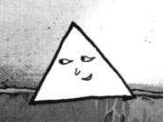


Waking up in the hardened shape of a pyramid,having already decided that, “if nothing had changed by then, he would kill himself.”The known status of pyramids is as tombs. To preserve the already gone. Making the form itself resemble a monument to his own psychological ruin. Rigid, immovable. Punpun’s identity no longer bends or develops naturally, orbiting and calcifying into a stagnant depression and suicidal ideation. Now less human than before, signified by a shape and looming with the background of death. With his mother's unintended secret lingering, Punpun realizes how much emotional truth he failed to understand while his mother was alive. A cruel pattern, only seeming to understand people once they are already gone.
Despite the emotional petrification, there is still a want for meaning and attachment in his life. Sachi perfectly encapsulates both, giving him a temporary structure. The lines of his pyramid occasionally soften, brief moments of his ego attempting to stabilize itself again. 

But that is just a mere moment, and the return of Aiko completely disrupts that fragile balance. Reuniting with her seals his fate, and with the murder of Aiko’s mother, he mutates again. A horned figure resembling Hikoboshi, the cowherd from the Tanabata myth. “The horns Punpun eventually grows (Volume 11) aren’t devil horns; Hikoboshi is also called the cowherd star, so those horns are supposed to be Bull horns,” (“Reality”). Earlier, it symbolized childhood hope and distant romantic yearning, tied to stars, promises, and escape. But by adulthood, the symbolism has curdled into obsession, a distorted version of the lover he spent his entire life fantasizing about becoming. He no longer appears as a monument of grief, but as a monstrous form consumed by instinct, desire, and self-loathing.
When we peer through a simplistic view at the manga, it is still noticeable how the forms of Punpun stick out to be more than artistic aesthetics. The characters aren't there for ‘plot relevance’ or the expansion of one single main character. They are all a part of a system that functions to serve a bigger analysis on trauma itself. And it lingers, because you can’t sit and say one of them is your favorite. With that comes implications of what does that mean to you? When you’re faced with the ability to finally run away, and isolate yourself, does that truly guarantee freedom? The end for Punpun didn’t gratify that need, it prolonged it. “But I didn’t let him do such a thing,” as Sachi brings Punpun to the hospital, “as long as Punpun continues to suffer, the stronger I’ll have to be,” (Volume 13, 143). For her, it was the way to prolong her morality, for him it was the way to prolong his suffering. We’ve seen this tragedy play out a million times, Punpun never getting to be with Aiko, isolated, always dragged out to be in touch with life. There is no romanticization in his world of choices and decisions, they are all played out. Even after Aiko’s death, he is still haunted by her desires, her false dystopia that he will never get to experience again.
Linger, she will. Aiko, the girl with a missing tooth. Our manifestation of the id within Oyasumi Punpun, not because she herself is the irrationality, but because she is the flame that keeps Punpun’s deepest fears alive. She sees no flaws in pursuing his wants, acting naive to the dangers she herself will be under. Even when absent from Punpun’s life for years at a time, she continues to dominate his psyche from the shadows. Rumbling under his bones, hiding under his skin, always a reminder of how he failed her. The love Punpun holds, is the manifestation of guilt from severing and breaking his promise to Aiko. Becoming a symbol for his childhood, that everything that came after her, wasn’t truly there. If he can take her away again, it’ll all be okay. A conclusion reached with zero thinking of what would happen. As an adult, Punpun reconstructs himself into whatever version best sustains that dream. Even convincing himself that Yaguchi, Aiko’s boyfriend at the time of middle school, must have been abusing her. In those scenes, the dialogue is pasted over parts of the Milky Way. Asano repeatedly ties Aiko to the stars, the Milky Way, and the Tanabata Myth. Later on Punpun insists they can still run away together, still projecting his grandiose delusions over truth. Aiko becomes the embodiment of that for Punpun, the reflection of his inability to let go of longing itself.
In the opposite direction, there stands Sachi, who functions much closer to Freud’s conception of the superego. While Aiko pulls Punpun towards regressing into fantasy, Sachi forces him toward confrontation with his actions. She is one of the few characters who consistently challenge Punpun’s self-pity instead of romanticizing or dismissing it. Sachi’s emotional honesty makes her one of manga’s most painfully human characters. Her entrance grounds the next chapters in an air of maturity. Suddenly, we are exploring Punpun’s troubled life and recognizing it for how bad it truly is. At one point, she tells him, “You may make it seem like you’re suffering and that you want to find her badly, but what you really want is to continue your pathetic, unproductive life without thinking or doing anything.” Harsh, but a necessary truth to break his detached view. Sachi represents moral awareness, the painful obligation to continue living even when life feels unbearable. Yet Asano avoids making her this perfect, virtuous, emotionally untouchable character. Like Punpun, Sachi also carries deep insecurities; she is so human, filled with regrets, feelings of failure, especially surrounding her manga career and her sense of adulthood. The superego isn’t portrayed as perfect morality, but as the exhausting burden of self-awareness, as Sachi understands suffering and attempts to continue moving through it even when everything deems it fair to surrender. Trying to get him to surrender what he’s been built off of so far so he can finally find a different philosophy to life.
This is ultimately why Oyasumi Punpun matters beyond its shock value or depressive reputation. To mourn older versions of who you once were, the desire for connection while hiding and burning all bridges that are made. When we end on the note of Punpun being saved by Sachi, his solitude denied when he chased it his entire life, is grief beyond simple words. Dragged back into ordinary life, back into society, back into the exhausting responsibility of continuing to exist. He is back to a childish bird at the end, having to now rebuild himself into everything he wasn’t before. Isolation and solitude, silently romanticized as purity and escape, now broken, the fantasy dying alongside Aiko. I would not be able to explain to you the toll this manga took on me. Living out the “God” we so see in Punpun, the smiling, detached face that shows up when things are at their worst. So human when I’d wish it didn’t, a mirror into the structure of my being. My analysis, in and of itself, is my blueprint to the world I’ve been crudely walking through without having to point out and say, “Look at me.” Asano took that and transformed the suffering into a beautiful, uncomfortably haunting work. Perhaps that is why Oyasumi Punpun resonates so strongly with readers despite its ugliness. We all ache to be looked at through each stage, and have them fully stay. Asano understands the quiet, humiliating reality f wanting to be understood when you feel fundamentally unknowable.


Points:
Time spent:
IP address:
Canary word: Present
Possible AI signals:
Original Text:
Are you sure you want to delete this comment? This cannot be undone.
Mark this comment as a review? Points will be awarded to the poster.
Your comment was posted, but it wasn’t long enough to count as a review. Reviews need about four complete sentences (at least 250 characters). Try writing another review that explains your thoughts in more detail — the author will appreciate it, and you’ll earn points for it.
141,247 Literary Works • 674,329 Reviews





Hah, I do appreciate the music rec but I generally don’t have music on when creating or reading^^ But I love the idea!
 It reads more like a story which neat and clever phrasings! At least in the beginning. I think once you head into the analysis, it feels more academic again :3 (and toward the end it gets… narration-y again with “zero thinking” and other such phrases)
Hmmm I feel like your essay has a very peculiar style and I do like but it doesn’t feel quite academic
I feel like this line is a bit too vague: “these forces become externalized through character” what character? Given what you say in the next sentences, maybe going for “the characters” might be better?
That’s the first time you mention “Solanin” and maybe you should have explained what this is in a brief sentence? “when writing Solanin“
Idk what you mean by “bird” here? “he is the simple, childish, absurd bird” Why use that word? Is he literally a bird? I don’t think so… maybe it’s a quirk of English I am unfamiliar with… Okay… so maybe… he actually is a bird, or shown as a bird while everyone else is not? Maybe you could have made this more clear? Earlier you did mention that manga does have some grotesque or abstract forms? Oh I get it, he becomes different things depending on what happens to him. Still think you should have made this more clear early on.
What fate?
I like this phrasing: “We all have moments where we become caricatures of ourselves”
Ok what do you mean here? “It is only after his mother dies that he learns about them” about whom? The letters? It is ok to repeat that here bc I completely missed this and had to go back and reread several lines.
Did you really mean “dystopia” here? “her false dystopia that he will never get to experience again.”
Because… I do like the idea that he’s so far gone that he longs even for suffering under a dystopia as long as it includes her.
Thanks for sharing. I didn’t know the manga before and I don’t think I will read it but I do love essays about stuff I didn’t read :3
Join the fight! Write more reviews!
Hello!! Thank you for your response this essay was written in mind that my previous essay was also read for the manga/previous knowledge of Oyasumi PunPun Freudian terminology as my professor is aware of these subjects partially. A lot of what I wanted to explain more had to be cut out due to word limit :') as I was sitting at 4,500~ when max was 3,000. Also for the bird part! There are pictures that accompany it, and maybe some parts seem unclear but I do believe I explained that the paragraph would be a summary of Punpun - my previous essay my professor read had a bit more on that haha so thats a bit on me. Ill disclose this info in the post but thank you so much for reading!!!!
hi there oirichu!
I don't know anything about Oyasumi Punpun, but I do know some things about Freud!
For starters, I think the ambition here is genuinely admirable - you do A LOT here! I can see each individual move: Punpun as ego, Aiko as id / shadow / desire, Sachi as superego / moral confrontation, Asano’s visual distortions as bodily manifestations of psychic collapse. You clearly have knowledge on what you're writing about, but you also have passion; that is great!
The Freud section is solid as a foundation. You introduce id, ego, and superego clearly, and the balancing scale image is helpful because it gives the reader a concept before the manga analysis begins. The Freud quote is especially well-chosen because it anticipates Punpun’s entire condition -> he is never fully sovereign over himself. I also like that you bring in Jung’s shadow, because Aiko as id alone (from what I've read about the manga online) may be too simple, while Aiko as a shadow / desire / fixation gives you more interpretive range. Jung tends to be better for having more wiggle room with such things.
BUT the Freud and Jung pairing needs more care, and I'd say you should decide on one to use. Now, you move from Freud’s id to Jung’s shadow as if they are nearly interchangeable. They are related in the broad sense that both involve unconscious, repressed material, but they are NOT the same concept. Freud’s id is instinctual, pleasure-driven, pre-moral. Jung’s shadow is the disowned or unintegrated part of the personality, which can include what the id may liken itself to (like impulses, shame, envy, vulnerability, aggression, etc). If you want to pair them, you need to name the distinction. Otherwise, it seems to me that Jung is being used as a decorative extension of Freud rather than as a separate framework - he is his own guy! He has some cool ideas on his own!
Though, I do like that you do not treat Punpun as only Western psychoanalysis grafted onto a Japanese manga. It's easier to look at different culture from a "kitschy" perspective, especially intellectually where you are bombarded with mostly Western thought, but I enjoy how you brought in the Tanabata framework. That is GOOD. It keeps the essay from feeling like Freud has swallowed the entire text whole, even if he tends to do that a lot.
^ However, it's not really something you focus much on. You introduce Tanabata, then return to Freud, but your essay does not explain how these systems modify each other. Is Aiko the id because she is Orihime, or does the Orihime symbolism complicate the idea that she is id? If Sachi is Tentei, the separating Sky King, does that make the superego an external law that prevents fantasy-union? That would be fascinating! You could argue that the superego in this essay is not merely morality and instead is something other, if you can decide what that "other" may be - separation, maybe? That could also be a nice way to explore more of who Sachi is and how her role develops throughout.
This is probably the biggest structural issue in the essay, though: you have several brilliant interpretive systems, but you don't synthesize them. You need to decide which framework is primary and which ones support it.
The assault by Midori is another moment that needs more care too -> you mention it as a formative trauma that later manifests through harmful behavior toward women, which is relevant, but it appears quickly inside a plot-summary paragraph. Given the gravity of that event, I think it either needs more space or needs to be integrated more strategically. Since your essay is about the ego and the body, then this event is central. It connects directly to Freud, the pleasure principle, sexual shame, dissociation, etc. I'd say to either integrate it into the body / transformation analysis or reduce its placement in the summary. I'd also say that you should consider rating this work differently, as this discusses multiple topics that are more adult in nature.
Organization-wise, I would suggest a different structure since you have a substantial amount of information to explain. I don't think the current organization is poor, per se, but I do think you should consider condensing this. Maybe something like: Open with the core thesis. Then, give a short theory section on Freud, Jung’s shadow only if clearly distinguished. Then, move into the manga, analyze Aiko and Sachi, discuss the little details. Then, end it. Something like that!
I mean, this is awesome though. You've put a lot of time and effort into this, and I can feel that in your writing. Keep this for revision!
best,
cocteau
Hello!! Thank you for all the good comments A lot of what you went over for comments was actually what I had to scrap to save my word limit for comp II... :') Unfortunately I had a max of 3k words, and a lot of the tanabata myth interaction/more information in the freud/jung sections. If I had more time this would've been way more fleshed out! But otherwise It's going to be reworked in a year or two when I revisit it.