
Why are we letting the said and unsaid literature of the souls die each second the ink stains the paper or wisps of air push against the keys, it’s inconsiderate of the future of the robots we’re creating, leaving them without knowledge beyond that insufferable full stop that jeopardises our sanity to express every feeling we hold and are yet to discover, and it's strange that no one questions this barrier and just fall to their knees to praise the door to the unknown and ignorantly hold the golden key in their hands, but no more can I just sit there a fool and be blind to the world beyond that dot, I am aware but alas I’m still human so I release the key and worship the door.
Points:
Time spent:
IP address:
Canary word: Present
Possible AI signals:
Original Text:
Are you sure you want to delete this comment? This cannot be undone.
Mark this comment as a review? Points will be awarded to the poster.
Your comment was posted, but it wasn’t long enough to count as a review. Reviews need about four complete sentences (at least 250 characters). Try writing another review that explains your thoughts in more detail — the author will appreciate it, and you’ll earn points for it.
141,342 Literary Works • 674,360 Reviews


Hi, I'm here to review this as part of the checklist challenge!

Firstly, I am so glad you call it a full stop. Because I am sick of having to say period when I review people's work! Like, c'mon, period had other meanings! The full stop is literal: a full stop.
Your poem shows the tension between the infinite and formless nature of human feeling and thought, and the finite structures like our language, punctuation, and grammar that we're forced to use to express ourselves. The form performs the very argument the poem is making, about resisting premature closure. I like that you bring up AI, but I am confused about your point; as someone who doesn't like AI, I would rather not teach them how humans use language, i'd rather they stay like robots and don't learn to copy us!
I like how you haven't used any full stops until the end, but I do think it deviates from your point because, to me, it signifies how important the full stop can be. I love grammar, and I think it only helps with expression because expression through writing is different from speaking. And your poem, for me at least, was very hard to read without the correct sentence structure and grammar, and at first I thought it might be about how people are not using grammar correctly and making a point about how we NEED full stops, lol! I think it goes slightly past the point where it pays off, and maybe even having two long sentences would help. But that's just me!
It would be interesting to counter this with a stanza that has too many full stops to show how it does hinder language, because the lack of them certainly hindered my understanding before I copied it into a doc and separated out the lines so i could read it! However, I do fully enjoy the idea here that you want to see what is beyond our grammar and structures, but people don't understand so you fall to it.
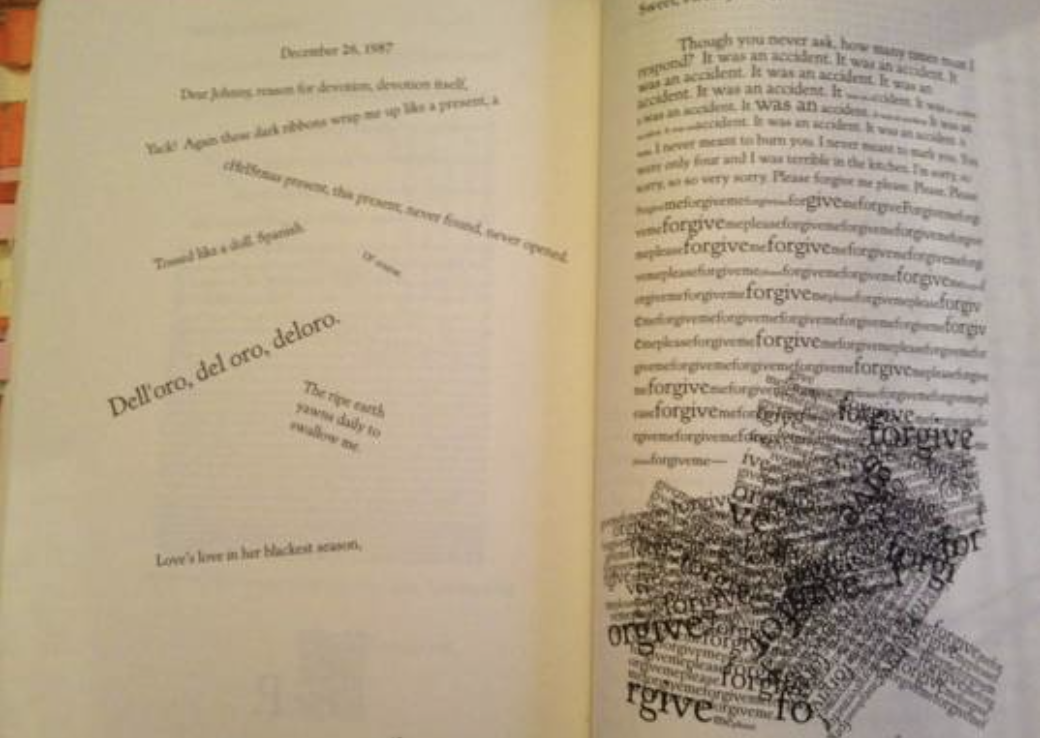
Have you ever read any ergodic literature? I think the next thing past correct grammar/structure is using the form of the page and the text to tell the story, not just the words. Mark Z. Danielewski is the main example (he created the genre) as I think you would enjoy how it can elevate the text and traverse it beyond ordinary eye movement or turning pages.
You can see here that formal structures and grammar aren't used, and it definitely has an impact:
A very interesting piece that really made me think! I think the language is lovely, particularly the opening line. I hope to read more of your work
Ah, poetry. I'm getting better with it.
The idea behind this is quite creative, I admit. The breathlessness mirrors the narrator's desperation to interrogate expression itself: the "said and unsaid literature of the souls," the tyranny of punctuation, the paradox of human awareness colliding with human limitation, the exhaustion of it all. It is ambitious. It wants to be profound. It tries very hard to be profound. Occasionally, it is.
The poem’s central conceit that every act of writing is both creation and destruction is strong. There is something compelling in the idea that robots, or future intelligences, artificial or derivative, inherit only the fossils of human expression. That concept deserves exploration, certainly. Instead, it is rushed past in the same breath as about human blindness, the worship of the unknown, and the self-cancellation of awareness... That is fitting thematically, but it is disappointing in the context of the work itself because of the little substance.
Still, the poem holds an interesting tension; the narrator resents the barrier, resents humanity’s blind obedience to it, understands there is something beyond it, yet succumbs anyway, admitting to "worshipping" the door. This last line is the poem’s strongest moment. It contains the emotional surrender the rest of the poem gestures towards but never fully articulates. Were the entire piece shaped around this conflict, awareness versus capitulation, it could have been more powerful...
Why punctuation? What does that structure mean in grammar and the cultures that we create grammar from?
I'm not too familiar with poetry but this is certainly interesting. The topic is well implied without being too on the nose. The ending particularly the line "I am aware but alas I'm still human" is good as well. I'm not sure if it's intentional or not but there are no periods which makes the whole thing something of a run on sentence. It's not too distracting but it can make some parts a little bit awkward to read. Overall, it's pretty good with a good concept and some nicely written lines.
I appreciate your comment a lot! Some parts are intended to feel awkward to show how we cannot live or move past the period since its a part of our everyday literature and we aren't used to things outside the norm (hope that makes sense).
Very interesting topic, a good a bit too in depth view into “full stops”, somehow the worst part is them not being called periods lol. Hoping for more like this.
Final rating. JABUNGA .