
Published January 16, 2026


Warning: This work has been rated 16+ for violence.
Points:
Time spent:
IP address:
Canary word: Present
Possible AI signals:
Original Text:
Are you sure you want to delete this comment? This cannot be undone.
Mark this comment as a review? Points will be awarded to the poster.
Your comment was posted, but it wasn’t long enough to count as a review. Reviews need about four complete sentences (at least 250 characters). Try writing another review that explains your thoughts in more detail — the author will appreciate it, and you’ll earn points for it.
142,080 Literary Works • 676,565 Reviews



text:
if you want to catch me anywhere--
Spoiler
catch me in the crossfire.
take that gun of yours & place it right here.
the in-between of my ribs and heart never looked
so tempting until now. come on, don't chicken out now.
we were just getting to the good part.
you know,
the part where you pull the trigger & i finally
get to weakly mutter a pathetic refrain about how
apathetic the world is (& you will just watch in
horror as the sickeningly sweet cherry cough drop red
blood spreads onto my sunday best.)
i don't know if i've ever believed in a god
or so-called conventions of samsara\moksha
but right now it feels like i'm stuck in a
[time loop]
\recursive to the point where
\ i return to you like some sort
\ of lost dog padding around a
\ frostbitten wasteland waiting
\ for you to come back and melt
\ my dreary winter.
Hello herb! I'm here as promised and my god this is gorgeous I got literal chills. I'm afraid I'm woefully unqualified to do this poem justice but nevertheless I'm going to try.
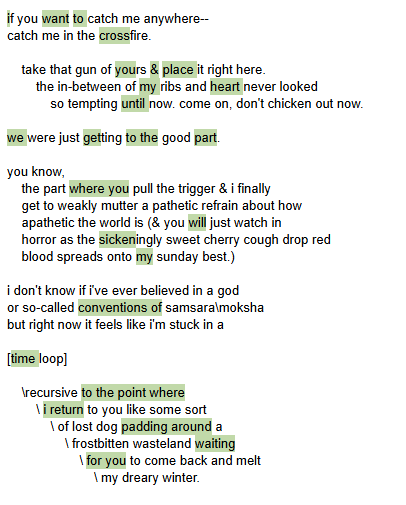
To start I want to say the highlights really drew my eyes and I read that before the entirety of the text and I instantly wonder which one influences the other, if I had read the poem before reading the green one would I have interpreted this differently? Or did you highlight it with the intention that it would be read first?
Another thing that hits me, is the colour green. Why green? Usually it symbolises nature, growth maybe even fertility but the poem seems anything but. It's almost like a hope for renewal within a resignation of it never happening.
I haven't forgotten you title either, "respite & relief\\loathsome to be loved"
the way you've worded it, almost makes me wonder if it means you find it loathsome to be loved by someone (perhaps not because you don't want it but maybe because you keep expecting it go wrong, self-destructive tendencies perhaps) it's almost a relief then, to not be loved. It could also mean that you feel you are too loathsome to be loved or, alternatively, something, or someone is too loathsome to love.
Somewhere within all this disdain there is a feeling of respite and relief but from what we don't know at this point.
Re-reading this first line for the nth time I notice the pun. Being caught in a crossfire would mean getting shot, the poem beings with an intonation of pain. Immediately followed up with the very visual imagery of a gun being placed at your chest. This stanza seems almost flippant, casual, teasing goading mocking. "don't chicken out now."
Now when I first read this I thought the & was calling back to the title, a reference to where you find respite & relief, but then I searched the entire poem and I didn't see you use the word 'and' anywhere and now I wonder if that was too much of an inference on my side.
What I find intriguing is that you asked them to place a bullet in-between your rib and heart, as in the green poem you talk about placing your heart. Now I don't know if there is some anatomical significance for this but the difference is significant, because you can always ask for a bullet in the heart.
And in classic dramatic fashion that wouldn't be out of place, but it's very specific, very intentional, like you've decided exactly how you want to go out.
The spacing doesn't translate in the quotes, but I find the way you have spaced out this entire work really beautiful. It just influences the way the poem is read in such a perfect way I have nothing but praise.
Something I find really interesting is 'pathetic refrain about how
apathetic the world is' followed by 'my sunday best'. Maybe it's just me but I have always heard the term Sunday best associated with the Church. You go to the church in your sunday best. (Now I'm not christian so this is from books and movies please correct me if I'm wrong) Especially since god comes up in the following stanza and its almost like the person pulling the trigger (metaphorical or otherwise) might disagree with you because why else will they 'disagree' with your 'conventions' of time.
Now of course I could be horribly wrong about all this and as embarrassing as that would be, please do let me know T-T
Another thing I noticed was the your use of the word 'finally' like you've been waiting for this, for some kind of validation that the world really is apathetic. Makes one wonder, why? Where you afraid of being proven wrong? The horror of this person pulling the trigger is also intriguing, they don't want this. Or maybe it is the fact that you want this that horrifies them.
Over here I like the sort of parallelism that emerges between conventions of time and samsara/moksha. The addition of moksh or moksha (I even have a friend named Moksha lol) and samsara or sansaar as we say in Hindi was so very interesting. Because I wonder what does this have to do with the poem exactly.
Moksh follows sansaar the cycle of birth and rebirth driven by your deeds in life till you attain enlightenment; do you believe yourself 'loathsome' and thus bound by this? A sort of time loop? But no you say you don't believe in it.
Why then, do you feel the need to mention it?
Do you feel you are stuck in a time loop, relieving the same moment or the same feelings over and over again with no escape and no respite &relief? I find it very interesting that here you seem to imply that this 'you' being addressed in the poem can melt your dreary winter, thus bring you the respite & relief you so crave yet it is them who you ask to pull the trigger.
Is the poem then about needing respite & relief and being unable to take the way out? A sort of learned helplessness? Or loathing the way out? Regardless, this has to be my favourite part of the poem. The way you have written this last stanza is amazing.
Whenever I read the poem my eyes stray to the green so I'm going to put that together once, just to get a sense of how it would look.
[/quote][/quote]
ohhhh I see I have misunderstood, it is not the person who is sickened, but you whose convention of time is messed up by this person. So this person is not just the respite & relief but also the cause for the loathsomeness you feel. Yet you don't seem to mind it all that much. It's like your safeguarding your heart, till the time comes when your stuck in the winter.
You 'cross' them, but you 'return' so it's not just time that binds you, really it's this person.
Okay I think this is it. I never really know how to end these sort of reviews. I feel like I should do a sort of overview but I can't get myself to write it. I have said everything I wanted to say, and the fear still persists that I've actually missed the entire point. Oh well.
Everything said was my opinion! Please take what you find helpful and leave the rest. I don't review poetry much (trying to change that as you know) so I hope this was at least a little coherent.
~ canopy
hi herb (snapshot eulogy herbalhour teatiime)
i actually read the highlighted portion of this poem before i read the actual pome, which was interesting. i like that this doubles as a written poem and a blackout poem at the same time. i wonder if that has to do with the title-- respite and relief feels more like the poem as a whole, and loathsome to be loved feels more like the highlighted portion. maybe that's just me though.
i get the impression that this poem is about a culmination of things, not just one. upon first read, i thought the theme was something revolving around a relationship-- one you should leave, one where you keep getting hurt, but you go back to it again and again. but then there's this idea of god in there as well. "i don't know if i've ever believed in a god or so-called conventions of samsara/moksha..." and i do understand that this is a precursor into the analogy of a time loop (which is kind of similar to the idea of samsara, from what i gathered from google), but i do think it deals with a new theme. it reveals something new about the speaker.
AND THEN, we also have the last line, which i think is very important "...you to come back and melt my dreary winter." winter blues spotted. and since it's winter right now, i can go ahead and make an assumption that this isn't ENTIRELY a metaphor. the whole poem itself is a rather dreary and dark theme (winter!), and given your obsession with spring (springterludes), i can again make the assumption that the speaker (you) hates winter.
going back to the initial thought of it being about some sort of relationship. i'm almost...reluctant to say that it's about a friendship or romantic relationship? i think that's the first connection that readers will make, but some word choice has been swaying me. "don't chicken out now." hmmm. it sounds like...the "you" is reluctant? like maybe they don't want to pull the trigger at all. and then, "you will watch in horror." horror? okay, so maybe this sort of hurt isn't intentional. but anyway. it could be a relationship with anyone or anything, is what i'm gathering. and i do think the intention was to keep it rather vague, correct me if i'm wrong.
now onto things that i really enjoyed. first, the line "take that gun of yours & put it right here." when i read this, i can perfectly envision someone pointing to their chest. we are pulled closer when you say "here" instead of the actual location first. and i think that's really beautiful.
i also LOVEEEE the time loop stanza. it's structured to look like a time loop, in a way. and i do like where you put the line breaks there. it makes us read it much slower, much more intentionally. which is interesting, considering there's no punctuation. continuation of thought while slowing the pace.
i do also want to point out that i find great humor in the fact that the speaker is putting on a very dramatic show about their death. the speaker is taunting the "you" and it's comical, in a way. "we were just getting to the good part. you know..." this sounds soooo sarcastic!! and the other person is watching in horror as this all happens (maybe that's why) and the speaker isn't taking it seriously in any way. i do enjoy that, and i especially enjoy the sudden shift in the stanza that follows, with "i don't know if i've ever believed in a god..." (volta mentioned).
anyway. this was good. i liked it. i like the sarcasm and i like the hidden little poem within the poem, and i like the unique structure. and i do also really enjoy the first line, by the way. i LOVE a single-sentence first stanza. it's very impactful. well done!
-avian