
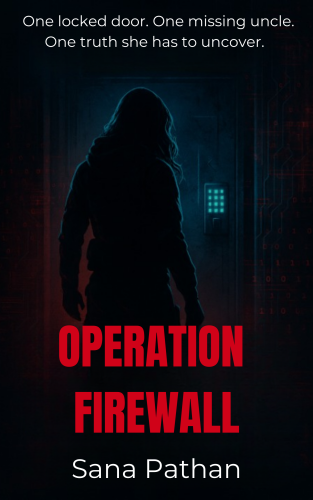
The keypad haunted me.
I couldn’t stop thinking about it. Even after I backed away from it—heart pounding, hands clammy—and buried myself under the scratchy quilt in my room, I couldn’t stop seeing it. That cold blue glow burned behind my eyelids every time I blinked.
ENTER CODE
It felt like a dare. A challenge. A whisper from the door itself, taunting me.
Like it knew I was going to try.
The dust around it had been disturbed—just slightly, but enough. Someone had used it. Recently. But who? Uncle Max? Someone else? And what was behind that locked door? A secret room? A vault? Something dangerous?
The questions wouldn’t stop forming. One after another, tangled and relentless. But the answers... they were nowhere. Just silence. Heavy and unsettling.
And the worst part?
I couldn’t ask Uncle Max. Not without giving myself away.
I couldn’t ask him without revealing I’d been snooping, poking around locked doors and touching things I wasn’t supposed to. And something told me that would not go over well. Uncle Max wasn’t exactly the “let’s talk it out” type.
So, I decided to keep my mouth shut.
The next morning, I came downstairs, expecting tension. Suspicion. A locked-down house and Uncle Max demanding to know what I’d seen.
Instead, he was already in the kitchen, sipping black coffee and reading a newspaper that looked older than me. He didn’t glance up when I walked in, but I could tell he noticed. That eerie sixth sense of his.
“Hope you stretched,” he said, flipping a page.
“Morning to you too,” I muttered, grabbing an apple from the counter.
He gave the faintest nod toward the window. “We start outside in ten.”
Like nothing had happened. Like we didn’t have a secret freaking panel in the hallway. Like he wasn’t hiding something.
I studied his face for a flicker of guilt, or tension, or anything. But there was nothing. Just that usual stone-faced calm. I was starting to think he could lie to a polygraph machine, and the machine would apologize for wasting his time.
I wanted to scream, ‘What’s behind the door, Uncle Max?’ But I chewed my apple instead.
Ten minutes later, we were out on the dirt trail behind the house. Trees on either side, morning mist still clinging to the leaves. Damp earth. Distant birds. A cool breeze that would’ve been refreshing if I weren’t already dreading what came next.
Uncle Max stood at the edge of the trail that led into the trees, arms crossed, stopwatch in hand.
“No warm-up?” I asked.
“This is your warm-up,” he replied. “Start running. You’ve got two kilometres.”
I gaped. “Two what now?”
He clicked the stopwatch. Then gave me a death glare.
I ran.
At first, it felt manageable. The terrain was mostly flat, the air fresh. It was almost peaceful. But then the trail started to tilt upward. My breath caught in my throat, and my thighs burned like someone had set fire to them from the inside out.
A squirrel darted across the path ahead of me, and for a moment I envied its effortless speed. I was a seventeen-year-old hacker who’d spent way too much time in front of a screen. Not a runner. Not a fighter. Not whatever Uncle Max was trying to turn me into.
I slowed, unable to run fast. Uncle Max’s voice echoed behind me.
“Pick up your pace.”
Of course he was following. I pushed harder. My chest heaved. My heart thudded like a drumline in my ears.
I wanted to stop.
I didn’t.
By the time I came back into the clearing, I was drenched, shaking, and seriously considering faking a heart attack to get out of the rest of the day.
“You trying to kill me?”, I panted.
“If I were,” Uncle Max said, tossing me a water bottle, “you’d be dead.”
He was calm. Unbothered. Like this was a warm-up.
“This is survival training,” he added. “Get used to being uncomfortable.”
I used to think gym class was torture. Uncle Max made gym class feel like a spa day.
He had me do planks. Sit-ups. Push-ups. Twisting nightmare things that made every muscle in my stomach scream for mercy.
Uncle Max didn’t yell or bark orders like a drill sergeant—he didn’t have to. His silence was louder than shouting. Whenever I slowed, I’d look up and see him standing there, arms folded, eyes steady, like he was waiting to see if I’d quit.
I didn’t quit.
Barely.
By the time we were done, I was shaking so hard I couldn’t tell if I was cold or just broken.
“That’s enough,” he said finally, tossing me a towel. “You’ll be sore tomorrow.”
“Pretty sure I’m sore right now. On a cellular level.”
Still no smile. But something flickered in his eyes—approval, maybe? It vanished too fast to catch.
Back in the kitchen, I downed a glass of water, two pieces of toast, and half a jar of peanut butter without speaking. Uncle Max sat across from me, sipping tea this time. Relaxed. Like he hadn’t just orchestrated my total physical destruction.
--------------------------------------------------------------------------------------------------------------------
Evening came, and with it, another round of training. But this time, it wasn’t physical. No sweat. No burning thighs. No threats of vomiting on pine needles. This time, it was my kind of test.
Uncle Max called it mental sharpening.
I called it finally, something I didn’t suck at.
He set a black case on the dining table and opened it like it held top-secret documents. Inside were puzzles—metal cubes, strange-looking disks, tangled wires, things that looked like props from a sci-fi escape room.
“What are these?” I asked, already reaching for one.
“A test,” he said.
“Of what? My eligibility to join the Avengers?”
He didn’t smile. Of course not. But there was something in his eyes—like he was curious to see what I’d do.
He slid a metallic cube toward me. It looked solid. A single red dot in the center. “Disassemble it. Then reassemble it. Fifteen minutes.”
I turned it over in my hands. This wasn’t just some dollar-store fidget toy. It was precise. Weighted. Designed to mess with you. Which meant someone had designed it. And if someone made it, I could unmake it.
A familiar buzz lit up in the back of my brain—the one I got right before cracking a firewall or spotting a backdoor in a school security system.
This was code. Physical code.
I leaned in.
My fingers moved instinctively, searching for seams, testing pressure points. The surface was cool, almost too smooth. I tapped along the edges, listening for clicks, shifts, anything that might give it away. Nothing obvious. No screws, no panels, no labels.
Good. I liked a challenge.
Then I noticed the red dot wasn’t just painted on—it was a button. Barely raised, but definitely pressable.
I glanced up at Uncle Max.
He didn’t say a word. Just watched.
I pressed it.
A soft click echoed through the cube. One of the corners shifted, barely—like a millimetre of movement—but it was enough. I twisted it carefully, and a hidden segment slid out with a satisfying snick. Inside: more complexity. Gears. Pins. A sequence of tiny interlocking parts waiting to be taken apart in the right order or jammed up forever.
I was grinning now.
This wasn’t just a puzzle. It was a trap with rules. A quiet dare wrapped in brushed steel.
I lost track of time. My body faded away—no aching muscles, no soreness from earlier. Just me, the cube, and the satisfying logic of unravelling something complicated.
When I finally clicked the last piece back into place and slid the cube across the table, I realized I was holding my breath.
“How long did that take?” I asked.
“Nine minutes,” Uncle Max said. “Not bad.”
Not bad?
That was basically a standing ovation from him.
He gave me another object—this one shaped like a double helix, all interlocking rings and hidden magnets—and nodded. Round two.
For the next hour, it was nonstop problem-solving: riddles, encryption wheels, logic puzzles that would fry the average brain. But mine was alive. I felt sharper with every challenge. My thoughts moved faster. Cleaner.
Like I was remembering something I’d always known.
After the fourth test, I paused, blinking at the latest contraption in my hand. “Where did you even get this stuff?”
Uncle Max poured himself tea like I hadn’t spoken. “You’ll need to be good at more than hacking if you want to survive the real world. You’ll need to think under pressure. React without panicking.”, he said taking out a thin metal sheet covered in symbols I didn’t recognize—some ancient-looking alphabet, maybe Cyrillic, maybe something he’d invented just to mess with me.
“Translate this,” he said giving me the sheet.
I frowned. “What language is this?”
He took a long sip of his tea. “That’s part of the challenge.”
Of course it was.
I studied the sheet, tracing my fingers over the etched characters. My brain kicked into gear, already scanning for patterns. Repetitions. Sentence structure. It wasn’t a substitution cipher—that would’ve been too easy. This was layered. Clever. Whoever made it knew how to hide things in plain sight.
It took me twenty minutes. My head throbbed by the end of it, but when I finally slid the translated paragraph across the table, Uncle Max looked down and gave the smallest of nods.
A flicker of pride sparked in my chest. Just a flicker, but it was something.
He packed up the puzzles, stacking them neatly back into the black case like sacred relics. Then he stood.
“We start again tomorrow,” he said.
“That’s it?” I asked. “No speech? No cryptic life lesson to end the evening?”
His mouth twitched—maybe a smirk, maybe just a shadow of one. “You already learned what you needed to.”
I wanted to ask what he meant. But I didn’t. Because something told me he’d just walk away again.
And he did.
I sat there for a while, staring at the empty tabletop, my brain still humming like a charged wire.
This was more than just training. I could feel it.
Every push-up. Every riddle. Every word Uncle Max didn’t say.
It was all leading somewhere.
And that keypad?
The thought hit me again like a cold jolt.
Whatever was behind that door—it wasn’t just a locked room. It was the heart of all this. The final puzzle. The truth.
And eventually, I was going to open it.
Even if I had to crack every code in this house to get there.
UPDATED VERSION OF THE CHAPTER:
The keypad haunted me.
I couldn’t stop thinking about it. Even after I backed away from it—heart pounding, hands clammy—and buried myself under the scratchy quilt in my room, I couldn’t stop seeing it. That cold blue glow burned behind my eyelids every time I blinked.
ENTER CODE
It felt like a dare. A challenge. A whisper from the door itself, taunting me.
Like it knew I was going to try.
The dust around it had been disturbed—just slightly, but enough. Someone had used it. Recently. But who? Uncle Max? Someone else? And what was behind that locked door? A secret room? A vault? Something dangerous?
The questions wouldn’t stop forming. One after another, tangled and relentless. But the answers... they were nowhere. Just silence. Heavy and unsettling.
And the worst part?
I couldn’t ask Uncle Max. Not without giving myself away.
I couldn’t ask him without revealing I’d been snooping, poking around locked doors and touching things I wasn’t supposed to. And something told me that would not go over well. Uncle Max wasn’t exactly the “let’s talk it out” type.
So, I decided to keep my mouth shut.
The next morning, I came downstairs, expecting tension. Suspicion. A locked-down house and Uncle Max demanding to know what I’d seen.
Instead, he was already in the kitchen, sipping black coffee and reading a newspaper that looked older than me. He didn’t glance up when I walked in, but I could tell he noticed. That eerie sixth sense of his.
“Hope you stretched,” he said, flipping a page.
“Morning to you too,” I muttered, grabbing an apple from the counter.
He gave the faintest nod toward the window. “We start outside in ten.”
Like nothing had happened. Like we didn’t have a secret freaking panel in the hallway. Like he wasn’t hiding something.
I studied his face for a flicker of guilt, or tension, or anything. But there was nothing. Just that usual stone-faced calm. I was starting to think he could lie to a polygraph machine, and the machine would apologize for wasting his time.
I wanted to scream, ‘What’s behind the door, Uncle Max?’ But I chewed my apple instead.
Ten minutes later, we were out on the dirt trail behind the house. Trees on either side, morning mist still clinging to the leaves. Damp earth. Distant birds. A cool breeze that would’ve been refreshing if I weren’t already dreading what came next.
Uncle Max stood at the edge of the trail that led into the trees, arms crossed, stopwatch in hand.
“No warm-up?” I asked.
“This is your warm-up,” he replied. “Start running. You’ve got two kilometres.”
I gaped. “Two what now?”
He clicked the stopwatch. Then gave me a death glare.
I ran.
At first, it felt manageable. The terrain was mostly flat, the air fresh. It was almost peaceful. But then the trail started to tilt upward. My breath caught in my throat, and my thighs burned like someone had set fire to them from the inside out.
A squirrel darted across the path ahead of me towards a worn-out swing hanging from a tree, and for a moment I envied its effortless speed. I was a seventeen-year-old hacker who’d spent way too much time in front of a screen. Not a runner. Not a fighter. Not whatever Uncle Max was trying to turn me into.
I slowed, unable to run fast. Uncle Max’s voice echoed behind me.
“Pick up your pace.”
Of course he was following. I pushed harder. My chest heaved. My heart thudded like a drumline in my ears.
I wanted to stop.
I didn’t.
By the time I came back into the clearing, I was drenched, shaking, and seriously considering faking a heart attack to get out of the rest of the day.
“You trying to kill me?”, I panted.
“If I were,” Uncle Max said, tossing me a water bottle, “you’d be dead.”
He was calm. Unbothered. Like this was a warm-up.
“This is survival training,” he added. “Get used to being uncomfortable.”
I used to think gym class was torture. Uncle Max made gym class feel like a spa day.
He had me do planks. Sit-ups. Push-ups. Twisting nightmare things that made every muscle in my stomach scream for mercy.
Uncle Max didn’t yell or bark orders like a drill sergeant—he didn’t have to. His silence was louder than shouting. Whenever I slowed, I’d look up and see him standing there, arms folded, eyes steady, like he was waiting to see if I’d quit.
I didn’t quit.
Barely.
By the time we were done, I was shaking so hard I couldn’t tell if I was cold or just broken.
“That’s enough,” he said finally, tossing me a towel. “You’ll be sore tomorrow.”
“Pretty sure I’m sore right now. On a cellular level.”
Still no smile. But something flickered in his eyes—approval, maybe? It vanished too fast to catch.
Back in the kitchen, I downed a glass of water, two pieces of toast, and half a jar of peanut butter without speaking. Uncle Max sat across from me, sipping tea this time. Relaxed. Like he hadn’t just orchestrated my total physical destruction.
***
Evening came, and with it, another round of training. But this time, it wasn’t physical. No sweat. No burning thighs. No threats of vomiting on pine needles. This time, it was my kind of test.
Uncle Max called it mental sharpening.
I called it finally, something I didn’t suck at.
He set a black case on the dining table and opened it like it held top-secret documents. Inside were puzzles—metal cubes, strange-looking disks, tangled wires, things that looked like props from a sci-fi escape room.
“What are these?” I asked, already reaching for one.
“A test,” he said.
“Of what? My eligibility to join the Avengers?”
He didn’t smile. Of course not. But there was something in his eyes—like he was curious to see what I’d do.
He slid a metallic cube toward me. It looked solid. A single red dot in the centre. “Disassemble it. Then reassemble it. Under twenty minutes or it self destructs.”
“Excuse me?! What?
“Time’s running.”
“I…you…you’re crazy.” I say as I turn it over in my hands my heart thudding. This wasn’t just some dollar-store fidget toy. It was precise. Weighted. Designed to mess with you. Which meant someone had designed it. And if someone made it, I could unmake it.
A familiar buzz lit up in the back of my brain—the one I got right before cracking a firewall or spotting a backdoor in a school security system.
This was code. Physical code.
I leaned in.
My fingers moved instinctively, searching for seams, testing pressure points. The surface was cool, almost too smooth. I tapped along the edges, listening for clicks, shifts, anything that might give it away. Nothing obvious. No screws, no panels, no labels.
Good. I liked a challenge.
Then I noticed the red dot wasn’t just painted on—it was a button. Barely raised, but definitely pressable.
I glanced up at Uncle Max.
He didn’t say a word. Just watched.
I pressed it.
A soft click echoed through the cube. One of the corners shifted, barely—like a millimetre of movement—but it was enough. I twisted it carefully, and a hidden segment slid out with a satisfying snick. Inside: more complexity. Gears. Pins. A sequence of tiny interlocking parts waiting to be taken apart in the right order or jammed up forever.
I was grinning now.
This wasn’t just a puzzle. It was a trap with rules. A quiet dare wrapped in brushed steel.
I lost track of time. My body faded away—no aching muscles, no soreness from earlier. Just me, the cube, and the satisfying logic of unravelling something complicated.
When I finally clicked the last piece back into place and slid the cube across the table, I realized I was holding my breath.
“How long did that take?” I asked.
“ Fourteen minutes,” Uncle Max said. “Not bad.”
Not bad?
That was basically a standing ovation from him.
He gave me another object—this one shaped like a double helix, all interlocking rings and hidden magnets—and nodded. Round two.
For the next hour, it was nonstop problem-solving: riddles, encryption wheels, logic puzzles that would fry the average brain. But mine was alive. I felt sharper with every challenge. My thoughts moved faster. Cleaner.
Like I was remembering something I’d always known.
After the fourth test, I paused, blinking at the latest contraption in my hand. “Where did you even get this stuff?”
Uncle Max poured himself tea like I hadn’t spoken. “You’ll need to be good at more than hacking if you want to survive the real world. You’ll need to think under pressure. React without panicking.”
He reached into a drawer and slid a paper across the table.
It wasn’t words. Just letters. Neatly written in ink, arranged into two long rows, perfectly aligned:
T T I K I C A O A Z L Y E Q C S C T P M R
O H N S I S U R C I D F M N V E F Y K E V
“Decode this,” he said as I pick up the piece of paper.
I frowned. “What kind of cipher is it?”
He lifted his mug and took a long, unhurried sip of tea. “That’s part of the challenge.”
Of course it was.
I leaned forward, elbows on the table, eyes scanning the letters. My brain slipped automatically into analysis mode, already scanning for patterns, repetitions and sentence structure.
I tried reading straight across. Nothing. I rearranged the rows in my head, paired letters, shuffled them mentally. Still gibberish. The longer I stared, the more the page seemed to resist me.
I exhaled through my nose, irritation prickling.
Okay. New approach.
What if it wasn’t meant to be read across at all nor an anagram?
The two rows were identical in length. Same spacing. They had to belong together — but maybe not line by line.
I grabbed my notebook and began rewriting the letters, top row first, then bottom. Slowly. Down. Up. Down. Three words appeared: TO THINK SICK.
Then the sentence collapsed back into nonsense.
I sighed and leaned back, staring at the letters, thinking like a hacker tracing a hidden thread. What if it wasn’t just vertical or horizontal?
I tilted my head. Then it clicked: zigzag.
My pulse quickened. I rewrote the letters again, slower now — one from the top row, one from the bottom, then back up. Down. Up. Down again. My pen scratched furiously as the letters began to align, forming real words.
Words emerged.
I didn’t breathe until the final letter fell into place.
By the time I finished, my temples throbbed and my tea had gone cold. I slid the paper across the table, the decoded sentence written neatly beneath the rows.
Uncle Max looked down.
THIS IS A RAIL FENCE CIPHER.
For a moment, he said nothing. Then he gave the smallest nod
A flicker of pride sparked in my chest. Just a flicker, but it was something.
He packed up the puzzles from earlier, stacking them neatly back into the black case like sacred relics. Then he stood.
“We start again tomorrow,” he said.
“That’s it?” I asked. “No speech? No cryptic life lesson to end the evening?”
His mouth twitched—maybe a smirk, maybe just a shadow of one. “You already learned what you needed to.”
I wanted to ask what he meant. But I didn’t. Because something told me he’d just walk away again.
And he did.
I sat there for a while, staring at the empty tabletop, my brain still humming like a charged wire.
This was more than just training. I could feel it.
Every push-up. Every riddle. Every word Uncle Max didn’t say.
It was all leading somewhere.
And that keypad?
The thought hit me again like a cold jolt.
Whatever was behind that door—it wasn’t just a locked room. It was the heart of all this. The final puzzle. The truth.
And eventually, I was going to open it.
Even if I had to crack every code in this house to get there.
End of chapter
Continue to next chapter Chapter Seven: The Waiting GamePoints:
Time spent:
IP address:
Canary word: Present
Possible AI signals:
Original Text:
Are you sure you want to delete this comment? This cannot be undone.
Mark this comment as a review? Points will be awarded to the poster.
Your comment was posted, but it wasn’t long enough to count as a review. Reviews need about four complete sentences (at least 250 characters). Try writing another review that explains your thoughts in more detail — the author will appreciate it, and you’ll earn points for it.
141,687 Literary Works • 675,575 Reviews




Forgot to mention it in the other review but: Nova is a hacker, yes! Keypad is basically her home turf, right???
I get the feeling I'm about to find out what their training is all about, exciting!
That said, I feel like this sentence doesn't really match the rest of the story:
It feels like at that point the worrying about the door is becoming repetitive.
This one is gooood:
Oh I love the ending, that the house is like these puzzles and that our MC has to solve the house. Wish you would update more
Hi Sana, I’ve been looking forwards to the next installations since the first chapter of this series came out. That being said though… I have some concerns. Apologies if this is a harsh review, as of the writing of this I am confined in bed with a 102 degree fever so I may not be in the best state of mind.
The first few sentences of this chapter are worded very differently then previous chapters. For one, it starts in past tense instead of present. Actually, the entire chapter is written in a different tense, which is kind of jarring for returning readers and also confuses me significantly. In addition, the phrasing is very indirect and short, which leaves me feeling kind of out of breath when I try to follow it.
The rest of the chapter is alright and sounds a bit more genuine, but it doesn't feel like it has the same punch as chapters 2 or 3. Again, the same concerns as the first few sentences are present. The sentences feel weirdly short and indirect, while also getting more wordy. An excerpt from this chapter:
I can’t place why, but it sounds very stiff and distant. Maybe it’s because of the paragraph spacing. It also doesn’t sound like Nova, who, given the first few entries, seems to be a sarcastic, unhappy, and reluctant. Now suddenly, she’s afraid and curious. A more gradual change of her thoughts would be nice.
Compare this to the first few sentences from ch.3, my favorite entry, that captures the contrast between Max and Nova much better.
It's very direct and gets to the point while remaining realistic in dialogue, and adds a sense of humor. You can almost imagine being Nova and blearily blinking your eyes while this ex-military dude threatens to pour water on you, while she already doesn’t want to be there.
I share the same concerns with the last few sentences. It doesn't sound like the rest of the entries in the series. Starting with the last few sentences of chapter 5, the story gets extremely cliche and repetitive in not only word choice, but also imagery. It’s almost too predictable, and doesn’t have the same suspense, exhaustion and twist as chapters 3 or 4, where you’re left wondering why and what Uncle Max is doing with Nova. I wonder if you tried a new brainstorming method or a new framework to write this chapter.
However, I do like the way the story is being built and developed. Perhaps in the future, you could include an interesting twist to reframe the story if you want to continue in this voice. So, while I have some reservations and suspicion, I am eager to see where it goes next.
Vic.