
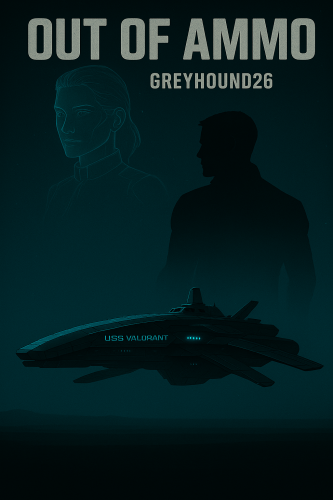
Warning: This work has been rated 16+ for violence.
Chapter 11: Into the Howling Dark
Part 1 — Orbit & Orders
“All hands, this is your Captain speaking. We are currently orbiting Titan at a cruising altitude of…” James glanced at the holo‑readout and let a smirk creep across his face. “…about 1,225 kilometers above the surface. For those still thinking in feet, that’s roughly four million of them—give or take a bootlace.”
The bridge crew stifled chuckles; elsewhere in the ship, a few laughs filtered back over the comms.
“Now, before anyone panics—yes, that’s higher than Titan’s atmosphere, which means the air down there isn’t exactly beach weather anyway. And yes, stellar winds are a thing. If one rolls through, it won’t feel like a breeze—it’ll feel like the universe chucking gravel at us at a few thousand kilometers per second. Relax. We’ve got shields. Allegedly.”
Legion cut in, her voice smooth and far too cheerful: “Confirmed, Captain. Shields holding at one hundred percent. Would you like me to run a live simulation of catastrophic shield failure for the crew?”
“Stand down, Legion,” James said, dry as ever. “Status update, not a horror show.”
He leaned back, voice leveling out into calm authority. “First flight of a new ship is never simple. But you’ve handled it like veterans. Keep that up, and we’ll make this bird sing.”
Then, after a beat, he let the banter return. “Oh—and if anyone’s feeling queasy, blame the inertial dampeners. Not my flying. Captain out.”
The comms clicked off, leaving only the low hum of the Valorant’s systems. James stood at the head of the meeting room across from the bridge, fingers drumming once against the recessed panel before he leaned in. A couple of steadying breaths—one for the crew he’d just reassured, another for the shadow he was about to confront. The show’s over. Time to deal with the spook who stalled my launch.
“Legion,” he said, voice even but edged, “locate our guest.”
Her reply was instant, laced with trademark smugness. “Armory. Looks like he’s making himself right at home. Want me to pipe a live feed, or do you prefer the surprise?”
James ignored the jab and toggled his comms to a direct line. He didn’t bother with pleasantries. Using the clipped cadence of rank and file, he keyed up one of the few men aboard he trusted without question.
“Sergeant Major Conrad,” James said, voice hard as steel, “grab your First Sergeant and meet me at the armory. Now.”
The channel popped once, Conrad’s gravel-thick baritone coming back without hesitation. “Yes, Captain.” Then dead air. No excuses. No questions. Just action.
James clipped the unit back to his belt. He hadn’t expected much from the ONI rep—probably cryptic orders wrapped in arrogance—but having Marines at his shoulder made the coming storm easier to face. Spooks carried hidden knives. Conrad and Reyes carried iron.
Part 2 — The Armory & The Spook
Fifteen minutes later, James stood outside the armory. Conrad and Reyes were already there, posted like statues, but both men gave him a look the second he arrived—half confusion, half disbelief, the kind you give a man who’s just said walkies to a war dog.
“Thank you for waiting, gentlemen,” James said evenly, tone clipped. “Let’s go meet the man who thought it was a good idea to stall our launch.”
The hatch slid open with a hiss, and the three of them stepped inside.
The armory was immaculate. Lockers stood in perfect rows, weapon racks lined with disciplined precision, ammunition stowed by code and caliber. Armor plates gleamed on their mounts, catching the sterile overhead light. At the far end, the ship’s weapons master hovered over a console, methodically logging inventory.
And then there was the spook.
He sat alone at a weapons bench, posture relaxed but deliberate. An assault rifle lay in pieces before him, parts laid out in meticulous order. A pistol rested to one side, magazine already checked and rechecked. Beside it sat an old whetstone, dark with oil. He worked the edge of a combat knife across it in smooth, unhurried strokes—the kind of rhythm that belonged to someone who sharpened steel as second nature.
Sensing them, he turned his head just enough to make eye contact with James. No surprise, no startle, just a calm acknowledgment, as if he’d been expecting this exact moment. He set the knife down carefully, almost ceremonially, before speaking.
“I was wondering when you’d come find me,” he said. His voice was low, measured—the practiced neutrality of a man who gave nothing away. Then, with the faintest trace of a smile: “Captain Hunter. Apologies for the tardy arrival. Command couldn’t decide who to send.”
James’s eyes flicked to the insignia on the man’s chest—a stylized silver eye stitched into black fabric. Recognition clicked instantly. Naval Warfare Special Operations. Office of Naval Intelligence.
A spook. One of FleetCom’s shadows, sitting in his armory like he belonged there.
James’s tone flattened to cut steel. “So what do I call you?”
The man’s answer came smooth, practiced. “You can call me Cipher.”
“Is that supposed to be funny?” James asked. “ONI officers rarely give out their real names.”
Before Cipher could answer, the armory itself seemed to exhale. Legion’s voice crackled through the fire suppression speaker grilles and the whispering vents of environmental control. Small gimbal cameras in the bulkheads tracked the men—and when Cipher noticed one of them, it panned in a subtle nod, almost like the ship acknowledging his attention.
“Funny,” Legion said, voice sharpened into something cold and hostile. “Because I already know your real name, 1st Lieutenant Jace Kwan.”
Cipher stiffened. Barely—just a tightening of the jaw, the faintest flex in his shoulders—but the armory’s ultraviolet and thermal scans caught it, rendering his reaction in crisp detail. Legion pressed, merciless.
“I can see you in full spectrum right now. Thermal, UV, LIDAR. Elevated cortisol. Capillaries flaring in your neck and ears. And your spinal implant? It’s misfiring—intermittent data loss, nothing catastrophic… yet. You should have that checked before it puts you in traction. There are enough environmental sensors in this room alone for me to reconstruct a full medical model of your body.”
The spook finally spoke to the air, voice even but laced with irony. “And you must be Legion. The name precedes you. Charmed, I’m sure.”
Silence followed—surgical, clinical. When Legion’s voice returned, it was a scalpel’s edge. “So no games. Not here. Not on my ship.”
Reyes let out a low whistle, unable to hide his grin. Conrad stayed stone-faced, though his eyes flicked to James in a silent she’s not wrong.
James folded his arms, letting the weight of Legion’s intervention hang. “So, Cipher,” he said evenly, command hardening the air, “you’ve met my ship. She doesn’t take well to secrets. Now the question is—are you going to work with us, or am I going to spend the rest of this mission wondering what knife you’re keeping hidden?”
Cipher met James’s gaze, steady and unreadable. Then, with the same cool neutrality he’d shown since stepping aboard, he inclined his head slightly. “Despite our reputation, Captain, ONI doesn’t turn its guns inward. We don’t do blue‑on‑blue. We don’t slit throats in the dark unless it’s traitors—and only with evidence that would hold in tribunal.”
He paused, then added with deliberate weight: “And for what it’s worth, ONI doesn’t hand a ship like this to a man it hasn’t dissected. We don’t work off the public Maxwell file, Captain. We’ve got the original. Every line. Every detail.”
The words landed like a controlled detonation—quiet, but impossible to ignore.
Conrad’s brow furrowed, uncertain of the undertone. Reyes glanced between them, confused, sensing something buried but not daring to ask. Only James understood the knife Cipher had just laid on the table without unsheathing it.
Reyes broke the silence first, turning toward Conrad with confusion written plain across his face. “What is he talking about?”
Conrad’s response was immediate, sharp as a snapped salute. His glare cut across the space like a blade. “We’ll talk about it later.” The kind of tone that warned the younger Marine not to push.
Reyes swallowed his question, nodding once but not looking satisfied. His eyes flicked back to James, searching for some kind of read, but the Captain’s expression was carved from stone. Cipher’s words had been meant for him, and him alone.
James glowered at Cipher—unfinished business promised—then turned on his heel and started for the hatch. His voice came out low, rough-edged. “I’ll see you in CIC One, across from the bridge.”
“Captain—one sec,” Reyes piped up, hesitation giving way to raw curiosity. “Who’s Legion?”
James turned just enough to pin him with a stare—stern, steady, leaving no room for pushback. “We’ll go over that in a minute,” he said evenly. Then, softer: “For now—just know she’s the reason we’re not atoms floating over Titan’s north pole. You’ll be read in with the rest of CIC.”
Part 3 — CIC Assembles
James stood at the head of the imitation-oak table, knuckles pressed into the grain like he was holding the ship steady by sheer will. The recessed comms panel glowed under his artificial hand, the implant in his palm syncing with the circuit.
“All hands, this is your Captain. CIC personnel, report to Meeting Room One across from the bridge. Repeat—CIC personnel, Meeting Room One. That is all.”
The comms cut with a hiss of static, leaving only the low thrum of Valorant’s systems. Across the table, Conrad and Reyes shifted in their seats—two Marines in a room full of brass, already looking like they’d rather be anywhere else. Neither man liked meetings; meetings meant decisions, and decisions at this level always had consequences that spilled down to the deck.
Cipher sat opposite James, posture precise, hands folded as if the table already belonged to him. He studied the Captain with the calm of a man who didn’t need to win the moment—only outlast it.
The hatch slid open, and Lieutenant Commander Anika Sørensen strode in, the quiet authority of the XO filling the space before she even spoke. She clocked Cipher immediately, her eyes narrowing for half a beat before settling into cool composure.
“Apologies for the delay, Captain,” she said crisply, then with a dry edge that carried across the table: “Though I see we’ve already picked up a passenger. Should’ve guessed. No way in hell Special Operations would let a ship like this leave dock without a spook riding shotgun.”
Cipher’s lips tugged into something almost like a smile, though his eyes gave away nothing. “ONI prefers the term liaison, Lieutenant Commander.”
Anika didn’t miss a step. “And I prefer a ship that launches on time. Looks like neither of us gets what we want.”
Before Cipher could reply, the hatch opened again. A breath of fresh air—Chief Medical Officer Olivia Anderson—stepped in, white coat crisp over the muted gray-blue of her uniform, hair pulled back into a no-nonsense bun. She carried herself like someone who’d walked into too many briefings like this before and expected half of them to be a waste of oxygen.
Sliding into a seat beside the Marines, she set her datapad on the table with deliberate care, then gave Conrad a grin that was half warm, half wicked. “Let’s see how you waste my time today. Bet this whole thing could’ve been an email.” Her eyes flicked toward him, voice dropping just enough for the dig to land. “Didn’t expect to see you here, though. Guess they’ll let anyone in.”
Conrad gave her a sidelong look, deadpan as stone. “Doc, last time you said that, we ended up patching bullet holes for twelve hours straight.”
Olivia smirked, folding her arms. “And you’re still here to complain about it. You’re welcome.”
Reyes chuckled under his breath, only to catch James’s eye and sober instantly. The mood shifted back toward business, but Olivia’s entrance had done its job—breaking tension with a needle instead of a hammer.
The hatch hissed open again, and in came two more figures mid-argument. Lieutenant Helena Park and Warrant Officer Marcus Hale—one with a comms datapad clutched like a lifeline, the other with a thick stack of tactical diagnostics tucked under his arm.
“I’m telling you, Park,” Hale said as he strode in, his voice carrying far too well for the room, “long-range comms degrade exponentially in nebular interference. You need active sweeps, not passive listening, or you’ll miss half the signatures.”
Park rolled her eyes, clutching her datapad tighter. “And I’m telling you, Hale, active sweeps get you painted like a fireworks display. A blind monkey could pick us up if you light the ether that way.”
They both trailed off mid-bicker when they saw who was already seated: brass, Marines, Cipher, and James at the head of the table. The silence hit like a hull breach.
Park cleared her throat, cheeks coloring faintly as she ducked into her seat. “Lieutenant Helena Park, reporting,” she said quickly, not quite meeting James’s eyes.
Hale followed, trying to mask his stumble with an air of casual confidence. He nodded stiffly, avoiding direct eye contact with the Captain. “Warrant Officer Marcus Hale, sir. Tactical systems.”
Conrad leaned slightly toward Reyes, deadpan as ever. “Straight out of the Academy.”
Reyes smirked. “At least they showed up on time.”
Olivia coughed into her hand, voice dripping with sarcasm. “Barely.”
James didn’t say a word—he just let the weight of his gaze settle on both newcomers until the pair stopped fidgeting and sat bolt upright, trying very hard to look like professionals who hadn’t just been bickering about space weather in front of half the chain of command.
Then James finally spoke, his voice carrying easily across the table, not really aimed at anyone in particular. “Is this everyone?”
There was a pause before Lieutenant Helena Park cleared her throat, sounding smaller than she probably wanted to. “Captain… Ensign T’Val is still on the bridge. He’s Officer of the Deck right now, per Article 432 of the Unified Fleet Watchstanding Regulations. A human operator is required at all times, even during station-keeping, to ensure continuity of command. I’ll be taking notes to brief him once he’s relieved.”
James tilted his head slightly, the edge in his expression softening into something wry. “Fleet loves its articles,” he said dryly. “Nothing like a stack of regs to remind us a computer can’t do everything—even when we’ve got Legion babysitting our orbit.”
Legion’s voice cut in from the overhead with her usual smugness. “Babysitting, Captain? I prefer to think of it as… supervising. With flawless precision.”
Helena cracked a nervous smile despite herself. “Yes, sir. Though to be fair, I’d rather be the one answering for station-keeping errors than letting an AI log my mistakes directly into the record.”
That earned a ripple of quiet chuckles around the room. James leaned back slightly, letting the humor hang for a heartbeat before pulling the focus back to business. “Good. That means we’re nearly all here. And since Ensign T’Val has the bridge, we won’t have to worry about the ship wandering off while we talk shop.”
Across the table, Olivia and Reyes spoke at once, overlapping.
“Who is Legion?”
They glanced at each other, then Olivia continued, her brow furrowed. “And how—exactly—was someone able to hear the comms in this room? I thought this was a secure briefing room for top-secret operations. How is anyone chiming in on our frequency?”
Before James could answer, the center of the table bloomed with light. The HoloTank flickered, pixelated shapes dancing for a heartbeat before resolving into a humanoid avatar perched cross-legged on the projected star map.
“That would be me,” said Legion, her voice dripping with self-satisfaction. Her holographic form swung a leg idly like she was sitting on a barstool. “I’m Legion—the ship’s integrated AI. Or, if you prefer the longer version: Logically Enhanced General Intelligence Operations Nexus.”
She tilted her head, smirking at the stunned faces. “This isn’t some unsecured party line. My brain is bolted into the heart of the Valorant, buried under nearly half a meter of titanium, tungsten, and neural shielding. You could nuke this room and I’d still be sipping data three decks below. This is my house. You’re in it.”
Her eyes glowed brighter for a beat, scanning the room. “And before anyone freaks out, I’m not ‘listening in.’ I am the walls. The environmental sensors, the fire suppression, the O₂ scrubbing, the UV cameras—everything in this compartment runs through me. If you’re worried about leaks, trust me: nothing gets out of here unless I want it to.”
Reyes muttered under his breath, “That’s… not creepy at all.”
Legion leaned forward, still smiling. “Don’t worry, First Sergeant. I only record your good side.”
A ripple of uneasy laughter moved through the room. James rubbed his forehead once and then gestured at the avatar. “There. Introductions made. Legion, meet the rest of the CIC. CIC, meet the reason we’re not just glowing dust over Titan.”
Legion gave a playful salute, her form flickering like static. “Charmed, I’m sure.”
“Okay, everyone. Time to tell you why we’re here.” James let the room settle. “As you know, this is a stealth warship. We have a liaison from the Office of Naval Intelligence aboard, and he’s brought a team—twelve spec-ops operators already embedded with our crew. This mission is going to require us to do some unsavory business: we’re going far behind enemy lines.”
He nodded toward Legion. “A few years back humanity made first contact. It wasn’t pleasant. The enemy calls themselves the Graicrix. They’re not godlike—their technology and intelligence were roughly on par with ours until recently. We kept that close; it was a guarded secret while we pushed our own tech. Now we’ve developed a new edge in propulsion—something faster than the FTL we used to talk about. It’s onboard this ship, and it’s part of how we’re going to do this.”
Legion stepped forward, voice smooth and efficient. “Mission Profile: USS Valorant.”
Objective: Deep infiltration behind Graicrix lines.
Primary Goals:
• Reconnaissance of enemy supply routes.
• Identification of Graicrix homeworld coordinates.
Secondary Objectives:
• Disrupt enemy operations when opportunities arise:
o Capture or destroy supply shipments.
o Eliminate critical infrastructure where feasible.
Operational Guidelines:
• Remain undetected as long as possible.
• Avoid direct combat unless absolutely unavoidable.
• If detected: neutralize hostiles if capable; otherwise withdraw to avoid
capture or destruction.
• Resupply is unlikely. Capture and repurpose enemy materiel whenever possible
to sustain operations—steal what you can, field it if it works, and use their
logistics against them.
Cipher cleared his throat and the room quieted. “ONI addendum,” he said, voice flat and clinical. “Second primary objective: identify Graicrix sympathizers and persons of interest with prejudice. When feasible, capture Graicrix personnel for interrogation and exploitation of intelligence. Treatment and interrogation will follow High Command directives—minimize exposure of ONI assets, and route all findings through my office for adjudication.”
James fixed the ONI liaison with a look that didn’t quite hide the edge beneath his calm. “You’re telling me humans are siding with our enemy?” he asked. He paused, weighing the words so everyone could hear the calculation behind them.
Cipher’s expression was unreadable. “Preliminary indicators: influence operations, targeted compromises, bribery networks. Intercepted channels point to active recruitment and facilitation in several sectors.”
“Bribery,” James repeated slowly. “Maybe blackmail. People selling out their own for credits or safety.” His voice was level, but his fingers curled once on the table as if testing the grain. “Humans aren’t incorruptible. They never were. Cruelty and violence are ledger entries, not anomalies.”
A ripple of discomfort moved through the room. Heads bent, collars shifted; officers exchanged small, furtive glances as the idea sank in: the enemy had friends with faces like theirs. Trust, once assumed, tightened into a thing counted rather than felt.
“You speak of apprehension,” James said, narrowing his eyes. “How public are these captures meant to be?”
Cipher inclined his head with the same surgical precision that marked his speech. “Where feasible, deniable. ONI recommends limited exposure—covert apprehension, localized detentions, routed intel for adjudication through proper channels. We avoid political fallout whenever operationally possible.”
James’s jaw set. “Deniable for whom? For ONI while the rest of us sweep up the mess?” His tone sharpened; the room leaned in.
“Deniable for mission integrity,” Cipher answered. “For the force. Visibility compromises assets and endangers subsequent operations.”
“If we find sympathizers,” James said flatly, “I’ll put them up against the wall myself.” The words landed heavy. “Being a traitor is one thing. Betraying and selling out your own species—that’s another. There’s no grey on that ledger.”
Cipher’s gaze did not waver. “Confirmed targets will be forwarded to command. ONI will assist—within legal and operational parameters.”
Silence settled after that, raw and necessary. Policy had been laid on the table; consequence followed close behind. The men and women in the room felt the distance between the two—between the clean language of directives and the weight of the acts they authorized. In the quiet, each of them measured how far they were willing to go.
James felt the room tighten around him. “Okay — let’s talk ROE for when we actually engage the enemy.”
A tight, uncomfortable hush settled over the CIC. Legion’s avatar flickered a hesitant, bewildered expression—just enough to bleed off the edges of the silence—then stayed silent; Cipher beat her to it.
Cipher’s voice was flat, economical. “High Command has issued standing ROE for this theater. Operational control is delegated to ship command. Captain Hunter, you have tactical control of this mission. You will set the ROE in-theater.”
James’s surprise was plain. He’d never been handed that much latitude. “Wait—so I run this how I see fit?” The question came out clipped, more provocation than curiosity.
Legion’s cameras swept the room, cycling thermal, UV, and LIDAR overlay like a surgeon’s map. Her software flagged micro-changes—heat blooming along cheeks, a throat working, hands clenching. The algorithm screamed at her to mirror the room; her avatar softened, fidgeted, and the voice modulator threaded a hint of concern through her tone. She didn’t need to feel, but she was built to simulate feeling; the subroutines improved judgment and kept people from snapping at a machine. Saying the wrong thing could set them off.
“We won’t be within comms range for HighCom to walk us through decisions,” Legion said, her avatar matching the tension she’d measured. “We can beam reports back, but replies may be delayed—days, possibly weeks. We can’t wide-broadcast; that’s a beacon. We’ll be operating autonomously. A mission on this scale hasn’t been done since those old Earth special-ops runs—small teams behind enemy lines improvising for survival—only now the theater and stakes are orders of magnitude larger.”
Anika’s jaw tightened. “That’s a hell of a burden to shift onto one bridge,” she said. “Noted.”
Olivia folded her arms. “Medical has to be part of that calculus. If ROE loosens and casualties spike, I need contingency plans posted now.”
Conrad leaned forward, voice low and absolute. “We follow lawful orders. ONI or not, we don’t hand people over without paper and cause.” His stare skated to Cipher and lodged there.
Reyes, restless, shifted in his seat. “So we’re cut loose. No resupply guarantee, limited extraction windows, make calls on the fly?” He looked to James for confirmation.
Cipher said nothing performative—only the facts. “Expect degraded logistics, minimal political cover. If sympathizers are located, ONI recommends deniable apprehension where feasible. Confirmed targets will be routed through my office for adjudication.”
James let the words settle, the hardness in his face carving the room’s next move. “Deniable for whom? For ONI while the rest of us mop up the fallout?”
“Deniability preserves operational integrity,” Cipher replied, unblinking. “Visibility compromises assets.”
Conrad’s fingers whitened on the table. “We’ll follow the law. We’ll follow orders. But blind obedience to shadow work? Not on my watch.”
James set his jaw. “Fine. I set ROE that keeps my people alive and gets us out. ONI advises; I decide. Understood?”
A chorus of curt acknowledgments met him around the table. Legion’s avatar offered a tiny, programmatic nod. Cipher folded his hands and said nothing more—exactly the posture James expected.
Lieutenant Helena and Warrant Officer Hale both raised their hands at nearly the same instant—an almost schoolroom-ish gesture that drew a ripple of amusement from the senior staff. Even Conrad, who rarely cracked anything resembling a grin, arched an eyebrow. Reyes muttered just loud enough for Olivia to hear, “God help us, they’re asking permission.”
Hale cleared his throat, visibly regretting it already. “Sir… why am I here? I mean, respectfully. As the Doc said, I’m barely out of the Academy. I run point-defense analysis, tactical observations. But Legion—” he nodded toward the AI’s flickering avatar “—she’s better at all that. Faster. More accurate. So where do I fit in?”
The room stilled, waiting to see how James would handle the question. For a long moment, he just studied the young warrant officer, his scar catching the cold glow of the HoloTank. Then James’s expression softened—not much, but enough to take the sting out of the silence.
“You’re here,” James said, voice low and even, “because Legion doesn’t make judgment calls. She processes probabilities. I need a human being looking at those readouts who knows what it feels like when a call lands on the trigger finger of someone out there in the hull. Legion tells me what can be done. You tell me if it should be done.”
Hale blinked, clearly not expecting the answer. James went on, tone firming into something harder.
“And don’t undersell yourself. This ship carries more firepower than most destroyer flotillas, but that doesn’t make us invincible. Every missile we fire, every coilgun slug we burn—those are finite. Unlike a fleet, we can’t restock from a tender if we run dry. You’re the one who’s going to remind me, before I empty the magazines in a blaze of glory, that our next fight might not leave room for heroics.”
A quiet weight settled into the room with his words. Hale straightened unconsciously, like the deck had just shifted beneath him.
Conrad gave a slow nod, approving without saying a word. Reyes leaned back with a grin. “Guess you just found out why the Captain doesn’t keep people around as window dressing.”
Legion smirked in her holographic form, one hand raised in mock surrender. “Fine, fine. I’ll admit it. Even I can’t predict when humans are about to do something magnificently stupid. That’s why you’ve got him, Hale.”
The room chuckled, but the tension had thinned. For the first time since they’d sat down, the junior officers didn’t look like they were drowning in the deep end.
James leveled his gaze around the table. “All right—two new faces in the room. Let’s do the basics. Go around and give everyone your title, what you actually do, and why it matters. Short and sharp. Olivia—let’s start with you.”
Chief Corpsman Olivia Anderson straightened, folded her hands on the table, and gave a small, dry smile. “Chief Medical Officer, Captain. I keep people breathing, stop the bleeding, and get them back on their feet long enough to finish the job. More than patchwork—risk analysis, triage planning, casualty projection. I tell you what wounds we’ll likely see on a given op, how many kits we’ll burn through, what field expedients work on Graicrix biology, and whether that shiny new tactic is going to leave us short a limb or two. Also: I have an annoying habit of telling the Captain when he’s being a dumbass, and I’ve got the scars to prove it. In short: if you want to come home, listen when I tell you what will break and how to fix it.”
Cipher cleared his throat. Legion, being a nuisance, made a simulated cough and piped in, “Lieutenant Jace Kwan.” She coughed again for effect.
Cipher’s jaw tightened. “Yes. That is my name. Don’t circulate it. To be blunt: I’m ONI—Special Operations. My legal identity and files are privileged. Make them public and you’ll get people burned. Practically speaking, I run the shadow work: training personnel for behind-enemy-lines operations, escape and evasion, guerrilla tactics. There are a dozen spec-ops operators embedded aboard under my command; for the duration of this mission they fall under Captain Hunter’s tactical control. I’ll also oversee interrogation and exploitation of any prisoners we take—handled through ONI channels.”
Conrad leaned forward, voice gravelly but steady as he sized up the two junior officers. “You’re probably wondering why an NCO’s sitting in a room full of officers,” he said, letting the words hang a beat. “Simple answer: I’m the highest-ranked enlisted on this ship. Every Marine aboard answers to me, de facto under Captain Hunter’s command.”
He cracked a faint, humorless grin. “Marines have been riding with Navy since before either of you were born. Old habits die hard. I served with the Captain back when he wore green, so if I slip and call him by name instead of rank, that’s why.”
Conrad jerked a thumb toward the man beside him. “This is my First Sergeant. If I’m down or you need something handled, go to him. He’ll get you squared away or point you where you need to be. Between the two of us, we keep the Marine detachment tight and the ship’s groundside operations running like clockwork.”
James looked to the two junior officers. “Okay, you two—what do you do?”
Lieutenant Helena Park straightened in her chair, datapad clutched like a talisman. “Lieutenant Helena Park, Communications and Signals. I keep us talking when the void tries to shut us up—long-range comms, tightbeam encryption, electronic warfare. If the Graicrix try to jam us, misdirect us, or fry our signals, I make sure we still get through. And if we need to listen without being heard… that’s my lane. You can have the biggest guns in the fleet, but without comms, you’re just a blind, deaf brawler in the dark.”
Warrant Officer Marcus Hale leaned forward, rough and practical. “Warrant Officer Marcus Hale. Tactical Systems Specialist. I run the targeting solutions, point-defense coordination, and missile batteries. If it shoots, I help make sure it hits—and if something’s shooting at us, I help make sure it doesn’t punch through the hull. Legion’s fast and accurate, but sometimes you need a human eye for the judgment calls algorithms can’t make. Put simply, sir—my job is making sure we survive the first volley long enough to fire back.”
James let their answers sit in the room, measuring each voice. He felt the pieces settle into place: command, med, marines, intel, comms, tactics, navigation at the bridge—an odd, dangerous mosaic of personalities and responsibilities built to survive the howling dark.
“Good,” he said at last. “We know who’s who. We know what we bring. We’ll turn this into a working machine. Now—ROE, contingencies, and assignments. Legion, pull up the mission overlays. Cipher, I want your embedded teams accounted for and routed through my staff. Olivia, give me a casualty-burn projection. Conrad, Reyes—prep your detachments for ground insertion rehearsals. Everyone else—stay sharp.”
Legion’s avatar folded her arms and the HoloTank filled with the first of a dozen tactical layers. The meeting shifted from introductions to the business of making a ship and a crew ready for something that promised to change everything.
Outside, the Valorant held its orbit, engines humming like a caged beast. Inside, a roomful of men and women—human, cybernetic, and otherwise—set themselves to the work of surviving what came next.
Stranger One: “Do you think they can do it?”
Stranger Two: “We don’t have a choice.”
Stranger One: “They’ve been given every tool. Sergio believes it’ll work—he’s not a hopeful man. He’s precise. He knows better than any of us.”
Stranger Two: “And if he’s wrong?”
A long pause. The hum of machinery filled the space between the voices.
Stranger Three: “If they find the homeworld, the systems we built will tell them what to do. And if the humans fail to act—if they hesitate—the AI will not. I wrote contingencies. Hidden protocols. Layers upon layers. She won’t know the difference she’s making until it’s done.”
Stranger Four: “You keep calling it a contingency. That’s what you told us in the lab. You called it a failsafe. Not a sentence.”
Stranger One: “Failsafe, contingency—semantics don’t save lives. The Graicrix have taken whole colonies. They’ve gutted farms, emptied systems. We can keep running from setback to setback until there’s nothing left to run with. Or we end it. End the vector at its source.”
Stranger Two: “End it how? By crushing a world? By vaporizing people who may not even understand the politics you say they represent? You talk as if you can trade a population for security like it’s a ledger entry.”
Stranger Three (softly): “I didn’t build the argument for killing. I built options for survival. The protocol is precise. Targeted. Designed to remove capability—eradicate a vector, not folklore. But you know as well as I do that removing a world removes identity. Culture. Future. That’s not a tactical variable; that’s civilization.”
Stranger Four: “That’s the rub. You don’t load a gun and pretend the danger is theoretical. Once the round is chambered, you’ve made the moral calculation. There’s no going back. Saying ‘we must’ doesn’t absolve the hand that pulls the trigger.”
Stranger One (voice hardening): “Tell that to the billion people living under constant raids, starving because shipping lanes have been laid to waste. Tell that to a colony watch that had its children snatched in the night. How many compromises before we’ve sold the future for scraps?”
Stranger Two: “You frame it as a ledger of numbers because that’s how FleetCom thinks. But war is not arithmetic—people are not variables you balance against supply lines. What you call decisive action will be a moral cataclysm if we let it be. There are costs that won’t be paid back with medals.”
Stranger Three: “Maybe so. But there’s also a calculation of existence. Allow the Graicrix unchallenged, and more worlds fall. Allow them to seed influence inside our systems. We will not have the time to debate ethics when the lights go out on a dozen suns.”
Stranger Four: “And you think hiding a planet-killer in the bones of a warship and handing it to a captain is the ethical solution? You’re asking a man and a crew—people with names and faces—to bear that burden without the public knowing you put a loaded gun in their hands.”
Stranger One: “What would you have us do? File the device in a safe and wait until manifest destiny meets our ports and burns them down? War doesn’t wait for ethics committees. Ethics is a luxury of peacetime.”
Stranger Two: “No. Ethics is what keeps us from becoming the thing we hate. If our response is indistinguishable from atrocity, we win nothing but an empty victory. How many innocents are tolerable? How many cultures erased before we notice we’ve become the colonizer?”
Silence gathered, heavy.
Stranger Three: “You ask very human questions. Good. We must ask them. I’ll say this: the protocol is only to be used if analysis shows no other path. Autonomous engagement layered beneath strict checks. The AI cannot act until three independent fail-safes are tripped—sensor fusion, command validation, and explicit executive confirmation—but I can’t promise that in the fog of war those fail-safes will remain sacrosanct.”
Stranger Four: “That’s the problem. ‘Cannot act until’ sounds comforting until you realize contingency is code for ‘when people are dead, the machine will be asked to do the unthinkable.’ You’re asking machines to make moral choices because you think you can’t live with making them yourselves.”
Stranger One (bitter laugh): “We’re asking a crew to survive. There’s only one question now: do we trust the human element to hold the line or the machine to do what men may not be willing to do? Either way, someone will carry the stain.”
Stranger Two: “And if we proceed and fail? If the Valorant dies before the coordinates are verified? If the homeworld is misidentified? The fall-out—political, moral, and strategic—will dwarf whatever advantage we hoped to gain.”
Stranger Three: “Risk is baked into the design. But so is the hope that a single strike, surgical and contained, curtails a threat that would otherwise take generations to dismantle. The alternative is attrition on a planetary scale.”
Stranger Four (quiet, final): “I built this thing under the belief it would never have to be used. I built it as insurance. But insurance has a premium. And that premium—blood, identity, the erasure of a culture—will be paid by living people. If we sign off on that, remember that we stamped the warrant.”
A long breath. Metal somewhere coughed and the facility lights hummed on, indifferent.
Stranger One: “We either give them the means or we give them the year to live the way they can. There’s no moral neatness. Only choice.”
Stranger Two: “So we choose. We put the burden on the ones we send. We put our names below the order and accept the consequences.”
Stranger Three: “And if the AI is ever engaged—know that I left nested protocols to minimize civilian yield. It was designed to be precise. Not merciless.”
Stranger Four: “Design and intent mean little when the world is gone. Intent doesn’t resurrect the dead.”
Silence again. The decision hung, sharp and irreversible.
Stranger One: “Then let it be written: we proceed. We give them the ship, the protocol, the burden.”
Stranger Two: “Not without oversight. Logs, tripwires, and one final human veto that can’t be overridden unless the ship itself is terminal.”
Stranger Three: “I’ll code the veto into the protocol. It will require clear human authorization—three signatures across separate command nodes. No single mind can trigger it.”
Stranger Four: “Make sure the signatures are not just names in a file. Make sure they are people who can sleep with what they’ve done.”
They sat with that. Machines hummed. Steel held. A plan, terrible and brilliant in equal measure, moved from hypothesis into motion.
Stranger One (softly): “If they fail, if they fall, if it becomes murder in the eyes of history—remember why we did it. Remember what was taken from us first. Maybe that will make the stain smaller.”
No one answered. The room kept its counsels. Outside, gears turned; inside, choices wreathed like smoke.
The mechanism was set. The weapon was real. The gun was loaded.
And there was no turning back now.
Points:
Time spent:
IP address:
Canary word: Present
Possible AI signals:
Original Text:
Are you sure you want to delete this comment? This cannot be undone.
Mark this comment as a review? Points will be awarded to the poster.
Your comment was posted, but it wasn’t long enough to count as a review. Reviews need about four complete sentences (at least 250 characters). Try writing another review that explains your thoughts in more detail — the author will appreciate it, and you’ll earn points for it.
141,381 Literary Works • 674,386 Reviews





Ahhhhh everything is bold. Not good not good!
I like legion offering to simulate shield failure :3
I find it v weird that the new arrival didn’t immediately report to the captain. Or the quarter master or whoever would be in charge of new crew members.
At least Legion helpfully points out a legit medical issue. Nice of her. In the review challenge, I did highlight legion as a helper for writing stories, come to think of it. She do be very useful.
I’m kinda reminded of Starwalker, with how the start is delayed bc mysterious government officials arriving and not even the ship/ship AI knowing their purpose.
Kinda enjoy the convo of the officers gathering to look at Cipher (and whatever else is on the agenda. Once again, you are not very forthcoming with info on what your characters are intending to do)
I continue to enjoy Legion. You’re doing good with her.
At least the list of things the Valorant is supposed to do sounds interesting.
Again, switch to Legion POV not clearly marked ☹
Hmm don’t think I enjoy the convo about ROE much. Too much dialogue, too little explanation. Too technical.
I like this: “Legion tells me what can be done. You tell me if it should be done.”
Uhm it doesn’t really feel like there’s much personality in how these ppl introduce themselves. It’s very repetitive. Again, I’m not sure you wrote all of this yourself. Especially since we had the kiddos be extremely self-conscious abt their role here and now, Hale can say stuff like this? “Legion’s fast and accurate, but sometimes you need a human eye for the judgment calls algorithms can’t make. “ Contradictions everywhere :/
Also I don’t rly like the last convo between the strangers bc it feels so detached from everything else. No intro, no nothing, no context.
well There is a story somewhere in my messed up mind. I'm out of ammo.Project. it needs refine ment there is a I plan to return to it and all we all know about the best laid plans.