
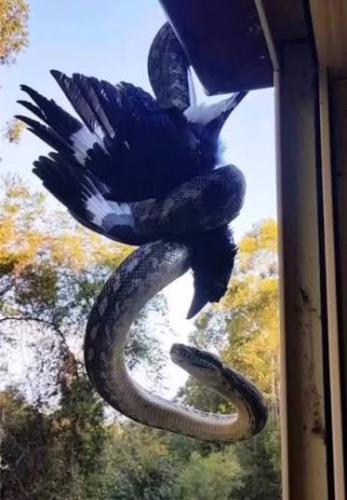
In my nest of twigs and hope
There once cried my little babies
Cracked to life from what were
Pearly white eggs, incubated
From the warmth in my love
Untill a snake eyed our little home
Trouble in paradise, gobbling them all
One by one, alas, my little heart
Wasn't enough to feed its appetite
I wish it had taken me instead
It left a token though, in consolation
Its own egg left for me to care for
A broken mother grasps at hope
It was also abandoned, I think
This child is pure, like any other
It looks nothing like me, why am I
Disappointed when I knew it
Why did I still wish otherwise?
Blindfolded eyes, but I can't
Turn away from reality
Do I love it? I ask myself again
And I do not know the answer to it
Because what does it mean if I do
For all the loss that I face
And could I ever, really?
The snake I nurture, as my own
It keeps all my enemies at bay
But I'm not immune, I fear
To the poison that flows
In its icy cold veins
Now that its all grown up
I see its mother image in it
A snake is a snake, afterall
I may have raised a beast
For it'll kill, just the same
Will my dead kids ever forgive me?
For seeking them in their killer's kin
The guilt hangs heavy, eats away at me
I'm bound to die at the fangs of
The snake I nurture
It's a befitting end
To this mess I got in
I didn't spill any blood
But there are many more
A sin, than that
To be a snake is being
What nature asked it to be
But I was to be careful and
Survive as birds so, fleeing them
Snakes bite, and I should've known it
Points:
Time spent:
IP address:
Canary word: Present
Possible AI signals:
Original Text:
Are you sure you want to delete this comment? This cannot be undone.
Mark this comment as a review? Points will be awarded to the poster.
Your comment was posted, but it wasn’t long enough to count as a review. Reviews need about four complete sentences (at least 250 characters). Try writing another review that explains your thoughts in more detail — the author will appreciate it, and you’ll earn points for it.
142,052 Literary Works • 676,473 Reviews



Hi there! I got really fascinated by this poem so I decided to write my first review on this.
It was rather interesting, the concept. One thing that caught my attention was how you used "Pearly white" to describe the eggs and the line
really captured how the mother loved her eggs, her sorrow,
and the lines
also show her distress and GOSH I could feel it through the screen.
It seems to me, the way the mother wasn't sure whether she loved the young snake, she may have loved it, though I'm not sure, during earlier times. And as the snake grew older, the mother may, ah, feel less affection? (sry! not really sure how to phrase it) I believe that it might be because of the fact that the young snake looks like its mother, who is also the killer of the mother's eggs.
I really felt the emotions here, great work! Overall, the chosen words and phrases, metaphors and rhythms all worked really well, except for the line
in my opinion, the rhythm is a tad bit off.
I really like this poem and feel free to ask any questions about my review!
Well then another one from the bookmark. The dice do favour you =D
While I think something’s wrong with the rhythm here, I want to say, I really like this sentiment. Broken mother, grasping at straws and that the snake kinda just dumped the egg without any consideration. Well done!So, the summary… *squints to see if there are any metaphors to find there* there… have been reports of animals taking care of the young of a different species. I have to think of the goose raised by alligators…
But knowing you, this is probably about eventually being consumed by what you sink your time and effort into…
I have to think of the cuckoo when you describe the bird in her nest, and how cuckoos kill all the competition they find in a nest that isn’t theirs. Could also be the snake. (I want to protect the snake from you idk why xd)
Ohh!! (Well first: Oh ☹ the poor mother bird, lost everything. I feel the “I wish it had taken me instead” no matter how irrational. How would the eggs survive without her?) but now: Ohhhh! I have to think of the story here on YWS where a chicken decides to take care of a snake’s egg (bc the farmer was abt to murder it and its eggs) and so she does take the snake egg in (her name is Henrietta) but bc now a chicken has hatched a snake she’s accused of being a devil’s spawn. Good times XD
See this is why this is not a review, I can ramble off topic as much as I want xp
I dunno. From all the things I gathered abt animals, they don’t usually care all that much if the child looks like them or not (see I am still defending the snake XD)
Ah I suddenly have to think that my own child will also look nothing like me. She’s still very cute tho (when she’s not screaming)
Classssiccc misunderstanding. I do like that the bird thinks that this is how snakes operate. (What do you mean I’m doing only a surface reading of the poem. This is a comment, I’m gonna do whatever I feel like hahahaha nothing can stop me from stopping at the most base-level!!)
(Besides a deeper reading is probably very depressing and I wanna have a cool animal friendship where the snake protects but is also feared by its mother xp)
maybe instead of dead kids you could have written children. The way you phrased it makes it sound unwittingly funny….
There we have it. I knew it D=
Hmm I wonder if this is a metaphor for sunk-cost fallacy now.
Feel free to enlighten me into the depressing nature of this poem that I willfully ignored (But also understand)
Geez, I'm not as dark as you give me credit for XD
Cuckoos are a very repeatedly used metaphor culture and could've even worked better here! A pity I missed it. Wait, let me try out something.. So actually I'm a very great poet & the snake is a exaggerated metaphor for a cuckoo bird, which the momma crow now has to raise (let's hope no one knows any better >.>)
You be fighting on the wrong team here lol.
I was told being a mother is abandoning all logic and they'd go to any lengths to protect their children, hoping that I didn't overdo that here.
YWS has this masterpiece concept? Insane!
[Quote[See this is why this is not a review, I can ramble off topic as much as I want xp[/quote]
Well at least for non GR works, you're free to mark these as reviews anyways (you tryna reach max points at once right? Help yourself, I don't mind).
There's none, whatsoever, in the whole poem. Glad you caught that xD
Well she's being poetic + has a bird brain so what'd you expect?
How about kin? I don't want the slightest chance that any reader confuse the snake being referred as a child, though the tense should be telling enough.
On point! But even more than that, it's a warning on trust. A snake's tendency is to kill, and can't be tamed. Nature made it this way, it's not their fault. But a bird must not pity it, and put it's own safety first. To trust the worthy is the responsibility of the bird, not the snake. God placed head over the heart for a reason. It's kinda like a children's story tbh.
This was a pleasure to read, thank you again!
Hello!
Wow this is great, I love it! I love the literacy of it, and how it sounds almost like music, if you know what I mean? A few parts I really liked (literacy-wise)
I like how you wrote "In a nest of twigs and hope, because it shows how the nest is made from materials, small and brittle twigs, but held together by hope, a strong emotion, spiritual. For "There once cried my little babies", this did not make a big impression at first, but then I reread your work and it almost made me want to cry...
This part is very intersting: she loves the snake (she thinks?) but she hasn't evolved to physically have all the properties of a mother snake, and isn't immune to its poison. This is kind of foreshadowing/first mention of her later reflexion ("A snake is a snake afterall" and "Snakes bite, and I should've known it") which is also great. Another thing, I like how you phrased "the poison that flows in its icy cold veins"
Oooh this is really great, I think it's my favorite part. It's at the same time very well put and very deep in meaning, with good literacy and a lot of afterthought. I love it!
Here are a few suggestions I have, which you don't have to follow, but which can help you in future works maybe I guess? I don't know, do what you want with them.
At the part: "Now that its all grown up", wouldn't "its" be written "it's" since "it's" is shortened for "it is", and you could replace "Now that it's all grown up" by "Now that it is all grown up"? Just a quick grammar suggestion. In the next line you also wrote "its", but that would be correct since it is meant as "the 'it' from_".
Also, for "A snake is a snake, afterall" I wasn't sure if the spelling was "after all" or "afterall", so I looked it up and the answer was: "The correct spelling is 'after all' (two separate words). The term 'afterall' is a common misspelling and is not recognized as correct in English. Use 'after all' to emphasize something previously mentioned or to introduce a reason or explanation"
Other than that, some parts were maybe a bit weaker literacy-wise than others, but that was only apparent since the others were so good =D I don't think it's worth changing them, since they were very good too.
On a theme of 'morals and philosophy', there is so much to talk about that I don't know where to start! I love how the mother bird reflects throughout the poem, and each paragraph gives more to think about to the reader. I'm not very good at putting my own reflections about morals in words in my reviews, but I can say that I really enjoyed all the deep meanings in this. Great job!
Overall, I want to say again that this poem is really great, so please keep writing (and have fun because writing is fun) thank you so much for sharing this, share more and have a wonderful day!
-HMMHhehe the potato
Thank you for the kind words, you've been most helpful! <3
Hi, hello!
"Twigs and hope" is a lovely opening image. It gives the nest physical and emotional meanings, so I understand that the narrator has built her whole life around these children. "There once cried my little babies" sounds a little awkward, though. I understand what you're going for with that sort of phrasing, but the inverted word order pulled me out of the poem.
I like "trouble in paradise," though it has a casual sound compared with the mourning language around it. That could work if the narrator is bitter and understating the horror, but at the moment it feels a little disconnected from the rest of the tone.
Also, "until."
The idea that her heart wasn’t enough to satisfy the snake is strong to me because it can be read both literally and emotionally. She would have offered herself to protect the babies, but even all her love couldn’t stop what happened.
"Alas" feels a bit overly formal to me here. The rest of the grief is direct and personal, so this one word makes it sound as though the narrator is narrating an old fable rather than living through the loss. That may be intentional, especially given the ending, but I’d consider whether you need it.
I’m not sure "blindfolded eyes" works because being blindfolded already means the eyes are covered, while the narrator immediately says she can’t turn away. It creates two conflicting images: someone unable to see and someone forced to look. You could perhaps focus on her choosing to ignore what she knows, then being unable to maintain that illusion. The idea is good, but the image needs to be a little more precise.
I like the change here because the snake has become both the narrator's child and her protector. It shows that raising it has brought her some safety, even while she remains afraid of it.
The comma after "nurture" isn’t needed.
I’d also be cautious with "icy cold veins." It’s a familiar phrase and feels less specific than the imagery elsewhere. Snakes are cold-blooded, so I can see why you’ve chosen it, but "poison" is also technically different from venom. A snake injects venom through its fangs rather than carrying poison in its veins. The poem doesn’t need to be completely scientifically accurate, but "venom" would connect more naturally with the later image of its bite.
I’m interested in whether she has a real reason to believe the snake will kill her. If there have been warning signs, I’d include one before this. Perhaps it has started watching her like prey or struck at her once. At the moment, she appears to condemn it simply for growing into a snake, which may be intentional but makes her conclusion feel premature.
The last two lines don’t make grammatical sense. I think you mean that spilling blood isn’t the only kind of sin, but the wording needs rearranging. It could be something like: I didn’t spill the blood myself, / But there are other kinds of sin.
I’m also not completely sure what the narrator believes her sin is. Is it raising the offspring of her children’s killer, failing to flee, using the snake for protection or judging the snake for its nature? There are several possibilities, and your poem could be stronger if this stanza identified the guilt more clearly.
***
This has a really strong theme. A grieving bird raising the child of the creature that killed her babies is immediately tragic, and it creates a lot of interesting questions about love, grief, nature and inherited guilt. The narrator wants to believe that every child begins innocent, but she can’t stop seeing the mother in the creature she has raised. That conflict gives the poem much more depth than a simple story about a dangerous snake, and I wasn't expecting to see something so deep tagged as satire.
The most interesting part for me is that we don’t know whether the snake has actually betrayed her. It keeps her enemies away and appears to have grown under her care, but the narrator becomes convinced that it will eventually kill her because "a snake is a snake." That could mean she has correctly recognised an unavoidable danger, but it could also mean that her fear and grief prevent her from loving the child as an individual. I am interested in how that can be broadly applied to society as a whole, as well.
I’d think carefully about which reading you want. If the poem is about the impossibility of overcoming nature, you need to show the snake becoming dangerous rather than only telling that it will. If it’s about prejudice and the fear that children inherit their parents’ sins, then the lack of an actual attack is important and the narrator's assumptions should be made to feel more questionable. You could also keep both interpretations, but the ambiguity needs to feel deliberate. I feel that satire needs to have more certainty.
Thanks for sharing, cheers!
Lipton
Hey there, vulpesvelox! Thank you for taking out the time to review this, I really appreciate it. You're right about a lot of things- this isn't great and needs a lot of work. I wrote this as a frenzy and this helped me calm myself through it. This wasn't an endeavor of skill, but a cope to deal with overwhelming emotions or process life. I might heavily edit this, as this in no way reflects the level of poetic writing I've reached till now. Still, I'll answer some of the things you asked, to the best of my capabilities.
I can see and agree with you here, definitely something I'll be fixing somewhere down the line.
Oops, thanks!
Hmm, would 'oh' work then?
This was actually a very valid concern, I'll certain try to come up with something better.
Lol I just didn't heed that while writing, almost embarrassing for a biology major. Thank you for pointing it out!
They certainly do to me, but I can't deny that your version is much clearer.
Your intentions are correct, but secondary. But her sin is something else entirely- it's putting her heart over her brain. She knows nature doesn't bend it's ways, and still in a moment of weakness, it harbours a predator. Forgiving is good, but for someone who killer her own kids and is a danger to her own life, it's foolishness. She pities the snakelet for having to live in it's skin, not realising it fully embodies the life it's given. You can't save a cub from the lion, he is the future lion. Nature is cruel and she went against the survival instinct that's in every creature to keep them safe - she ignored that and that's her sin. She should've known better than to trust a snake, people are wary of them in reason.
I wanted it to be a metaphor for humans, that trusting the people is a fault of our own. In s pursuit to be kind, we override caution and safety- something that we should always look after. No matter what trauma life puts you through and how much you want to help the other, put yourself first.
I meant the satire for it's sarcasm and not humor, but you could take it that way. A bord raising a snake- was she even thinking? The idea is clearly bad from outside perspective, but the bird living through has a hard time seeing it.
It hasn't yet, but is bound to. I wanted this ambiguity so that the reader juggles between if it's just the bird overthinking or a lesson of a snake doesn't shed it's skin so easy. At the end of the day though, I don't want to limit the lesson one takes from it. People hear what they need at a moment, when messages are made unclear. I can cater a larger audience with that, and offer versatility. It's about inevitable nature, prejudice but correctly placed and a lack of action despite knowledge- an intricate combination of the three.
Hey! Thank you for such a thoughtful response, and please don't feel like you need to dismiss the poem as "not great." I'm still getting the hang of reviewing, so I'm sorry if my review felt overly critical. I really did enjoy the narrative and what it says about humanity!
Your explanation of the sin makes the intention much clearer, as well. I'm glad I can look at this through a different lens now!