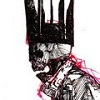
all the world is blind
This time, he is going to die.
He can’t remember how to breathe, how to take full deep inhaling gulps of oxygen to shoot his veins with blood and energy and fire. He can only try, in thin shuddering gasps that spasm his frail fingers. He can feel the world bleeding away in his dreams, in his head, in his heart. This time is the last time.
Behind the grey triangles of shadow that are his prison cell, the guards mutter and shift. They are uneasy. The eclipse is coming, or so they say. He cannot tell; there are no windows in the cell, no cracks in the stone. No light in the darkness. The sun is already in shadow for him.
He dreams of Kasturba in a white sari, a memory of his youth. She lowers her eyelashes bashfully and he is won, as any young man is won by the slightest motions of a beautiful girl. He dreams of the last time they made love, the sweat beading on her forehead, cheekbones in shadow, eyes lidded with pleasure.
He dreams of her corpse. Cold to the touch, lips bluing even as he weeps over her. Wrapped in a white sari, or what was once a white sari, now grey and tattered and worn thin. How does the world matter when he will never see her smile again? All he has now is memories, pockets of things that were once beautiful.
In his cot, the wire frame hard against his knotting limbs, he tosses and turns and calls for the dead.
The eclipse is coming. The guards shift their feet and whisper. The cell stinks of sweat and sickness. He dreams of a snake that is a man that is a dragon that is a planet. The swallower of suns and moons. Rahu.
The snake-dragon-planet-man says, “It doesn’t have to be over.”
And he says: “What other choice is there?”
Rahu reaches into his own mouth and down his throat and into his stomach and withdraws a vial. A small glass cylinder glittering with gold. He holds it out. “You have this.”
The man recoils, shaking his head. “No. Not that. That is not a choice.”
Rahu smiles. He puts the vial in his mouth and gulps it back down.
“We’ll see what you think tomorrow,” he says.
In his prison cot, the man writhes and weeps.
*
Mornings are a panic.
There is a car bearing straight for him.
Mohandas swerves the taxi out of the way. Wrenched to one side, the passenger in the backseat mutters a sharp oath beneath his breath.
“Sorry,” says Mohandas. The seatbelt bites into his chest as he twists the car through a dense tangle of traffic. He swipes the coffee balanced precariously in a holder, taking a quick gulp of the dark bitter liquid. The thin cardboard of the cup burns his fingers.
“Can you go faster?” The man in the back checks his watch and grimaces.
Not without killing us both, Mohandas thinks.
“Of course,” he says.
They pull up at the building ten minutes later. The man, with a mumble of, “No change, thanks,” thrusts a wad of bills into his hands and slams the door behind him. Mohandas counts the bills out. Barely two dollars of tip.
“I have to eat, too,” he says to the empty cab. A car honks behind him.
He guides the cab away from the curb and drives into the packed street ahead.
*
A lifetime ago, he plays a game of faith.
The girl comes to him in the night, the woman who is not his wife. She hesitates at the foot of the bed and he says, “Come here.”
She does. Her features are blurred in the darkness.
“What’s your name?” he asks.
The girl lowers her head. “Nanti,” she whispers.
“Look at me,” he says. She does. He extends his hand and she clasps it.
They lie in bed together, a hand span apart. Her breathing is shallow and jagged. She is preparing herself for something that will not come. Her breasts rise and fall as she inhales and exhales. He can smell the sweat on her skin, that fragrance of woman and summer and rain. She is only silhouette and skin but he thinks that she must be beautiful in ways that he can only imagine now.
He has a momentary spasm of desire but he stops himself. He is stronger than this.
Mohandas curls his fingers into the cotton bed sheets and measures the length of his breaths. He closes his eyes and empties his mind and leads himself away from temptation.
He is better than this.
She lies beside him all night, through the dark hours, through the first glimmer of colour and sunrise. In the morning, they still lie a hand span apart.
*
Sitting on the stoop of the taxicab company, facing a dingy alley that is wet with the stink of garbage, he unscrews the little silver flask. His hands shake.
“I thought you were a man of faith.”
He almost drops the flask.
“I am.” Mohandas turns to look at the man who spoke. “You surprised me.”
Harun emerges from the doorway and seats himself on the stoop. His bones creak as he bends his knees. He is getting older.
“What’s that?” He gestures to the flask.
Mohandas hesitates. “It’s honey.”
Harun grins. “In a flask? Isn’t that melodramatic?”
He shrugs. “It’s convenient.” He tilts the flask over his cup. A glittering bead of gold poises on the edge of his flask, falls into the coffee. He measures out four drops.
“Do you mind?” Harun peels open a plastic Tupperware box. From the crack in the plastic wafts the scent of spice and meat. Mohandas shakes his head. No, he does not mind. It reminds him of Gujarat, of the town on the edge of the ocean, his first memories of the world.
Harun is not from his little coastal birthplace; he is from a university. He once had a doctorate in theoretical physics in a world across thousands of miles of ocean. Now they sit together, the orator and the scholar, the two cabbies with broken English, and eat lunch in this wet dank corner of the city. Two men in the land of opportunity.
*
An eclipse is coming.
He parks the taxi by the edge of the ocean and walks to the pier as the sky begins to grey. Sometimes he forgets this place, the salt tang of the air, the whip of the wind, the soft thunder of the water. He closes his eyes, shutting out the darkening sky, and remembers another pier on the ocean. Kasturba at his side. When was the last time he thought of Kasturba? The set of her brow, the long high angles of her face. The warmth of her body against his, entwined in sleep. When she was serious, she would frown, lips upturned, nostrils flared. She was often serious.
His memory is blurring along the edges, fading in some places. But not her. She is sharp with focus even now, even after sixty years. Maybe more.
He inhales the salt tang of the air. The taste of home.
“Mahatma.”
His eyes flicker open. The world shifts again and he is back on the pier with the taxi behind him and the weight of a silver flask pressing against his chest. The sky is black.
He exhales.
“Don’t call me that,” he mutters, turning.
Rahu smiles. It is not so much a smile as a contortion of features. The thing that is his face distorts into three faces, seven. “They used to call you that. Everyone.”
“No one remembers,” Mohandas says. Not even me.
His smile widens a notch. “Don’t tell me you regret this.”
Mohandas doesn’t respond.
“Don’t pretend you do.” Rahu’s hand snakes out.
Mohandas stumbles back but he has already yanked the flask out.
Rahu’s eyes glitter. “Still have it.” He unscrews the cap. The contents of the flask burn pure warm sunlight into the darkness. “So much for regret.”
Mohandas looks away.
“You can always pour it into the ocean, you know,” Rahu says. “Or maybe I could. Do you want me to do it for you?”
No answer. Mohandas clenches his teeth.
“Do you?”
“No,” he snaps, turning. “Stop.”
Rahu regards him for a long moment, his eyes bright and laughing.
“That’s what I thought,” he says at last, and pushes the flask back into his hands. “Don’t play the righteous card. You lost that one a long time ago.”
With that, he disappears into the black.
Mohandas stumbles to the edge of the pier, the cold weight of the flask in his hands. He puts it back into his coat and begins to cry.
*
He plays the game of faith again.
This time there are no disciples. There is a number in the phonebook and a wad of cash on the night table. Her name is Wanda. She is aged, ragged. There are smudges of shadow under her eyes and hard lines forming around her mouth.
“It’s not what you think,” he says.
She doesn’t bat an eyelash. “Sure thing.”
He lowers his head. “The money is on the night stand. I just – I need you to lie down.”
They lie in the bed together, a hand span apart. He has forgotten that faint musk of another body, the sensation of warmth beside him. He struggles to control his breathing, to fight the thoughts in his mind.
He is stronger than this. He knows he is.
A wave of hunger washes over him. He can’t breathe.
His penis stiffens.
“I’m sorry,” he whispers, face flushing.
“There’s nothing to be sorry about,” she says, less than a foot away.
But there is. How can she know? He can’t do this. He is a man of faith, a man of discipline. There is nothing but shame in this for him.
He succumbs.
*
He almost rear-ends the car. Horns blare.
“Jesus Christ,” mutters the woman in the backseat as she clutches her bag. “Watch where you’re going.”
“Sorry,” he mumbles.
She doesn’t leave him a tip.
Mohandas drives through the city until he finds a temple. He sits outside, hands on the steering wheel, and wills himself to go inside, for his body to unbuckle the seatbelt and open the door and climb the steps and find light.
He can’t do it.
*
“Here. Take this.” He flings the flask at Harun.
His friend looks at it, bewildered. “What’s this? What’s wrong?”
Mohandas shakes his head. “I don’t want it. Keep it. Even if I ask for it. Don’t give it back.”
“I can’t take this,” Harun says.
“I don’t want it,” Mohandas repeats.
Harun holds it out. “I’m sorry, Mohandas. I don’t even know what it is.”
“It’s my life,” he says, backing away from it.
“You’re not well.” Harun takes a step forward. “Come home and my wife will make you dinner. We can talk.”
“No.” His voice is harsh. “Just don’t give it to me.”
Harun sighs and puts the flask down on the ground.
“Whatever’s in this thing,” he says, “I’m not your conscience.”
He starts to walk away. Mohandas stares at the little silver flask on the ground before him.
“Harun,” he says, “are you afraid of death?”
Harun stops. “Sure. Isn’t everyone?”
“Yes, but.” He tries to find the words. He used to be an orator. Why is it so hard now? “How afraid?”
“As afraid as anyone else,” Harun says. His brow knits in confusion.
“I think I’m more afraid,” Mohandas murmurs. “It’s – I can’t do it. I’m weak.”
Harun almost smiles. “Everyone’s weak. Welcome to the world.” He turns and walks towards the building. “If you change your mind about dinner, I’m here.”
He disappears through the door. Leaving Mohandas in the alley that reeks of rotting fruit, just him and the flask again.
*
In the night, he dreams of his bride. Kasturba, a vision in red and gold. His first memory of desire. She smiles shyly at him and he is filled with want.
He dreams of the last time he saw her, on a long table wrapped in a fading white sari. Her lips darkening even as he rocks back and forth and weeps for all that he has lost. Her body is cold and empty. There is nothing left here.
Nothing.
*
The city is whispering to life at dawn, the sky is streaked with citrus shades of lemon and orange. The sharp sting of the ocean whips at his coat. He gropes around in his coat and finds the cold metal weight.
He takes it out. The sound of the cap unscrewing is the only sound in the world.
Mohandas holds up the flask. It glitters in the sunlight.
He empties it into the water. Drops of gold, years of his life falling into the ocean.
Winding his arm back, he flings the flask as far as he can throw it. It arcs through the sky, limned in white light, and splashes into the depths of the water.
He takes a long deep gulp of salt air and lets go.
It is over.
Mohandas lowers himself onto the pier, facing the rising sun. He smiles, tears burning bright in his eyes.
And he waits to die.




 (Because thoughts are generally awesome.)