
Points:
Time spent:
IP address:
Canary word: Present
Possible AI signals:
Original Text:
Are you sure you want to delete this comment? This cannot be undone.
Mark this comment as a review? Points will be awarded to the poster.
Your comment was posted, but it wasn’t long enough to count as a review. Reviews need about four complete sentences (at least 250 characters). Try writing another review that explains your thoughts in more detail — the author will appreciate it, and you’ll earn points for it.
141,247 Literary Works • 674,329 Reviews


hi there! :]
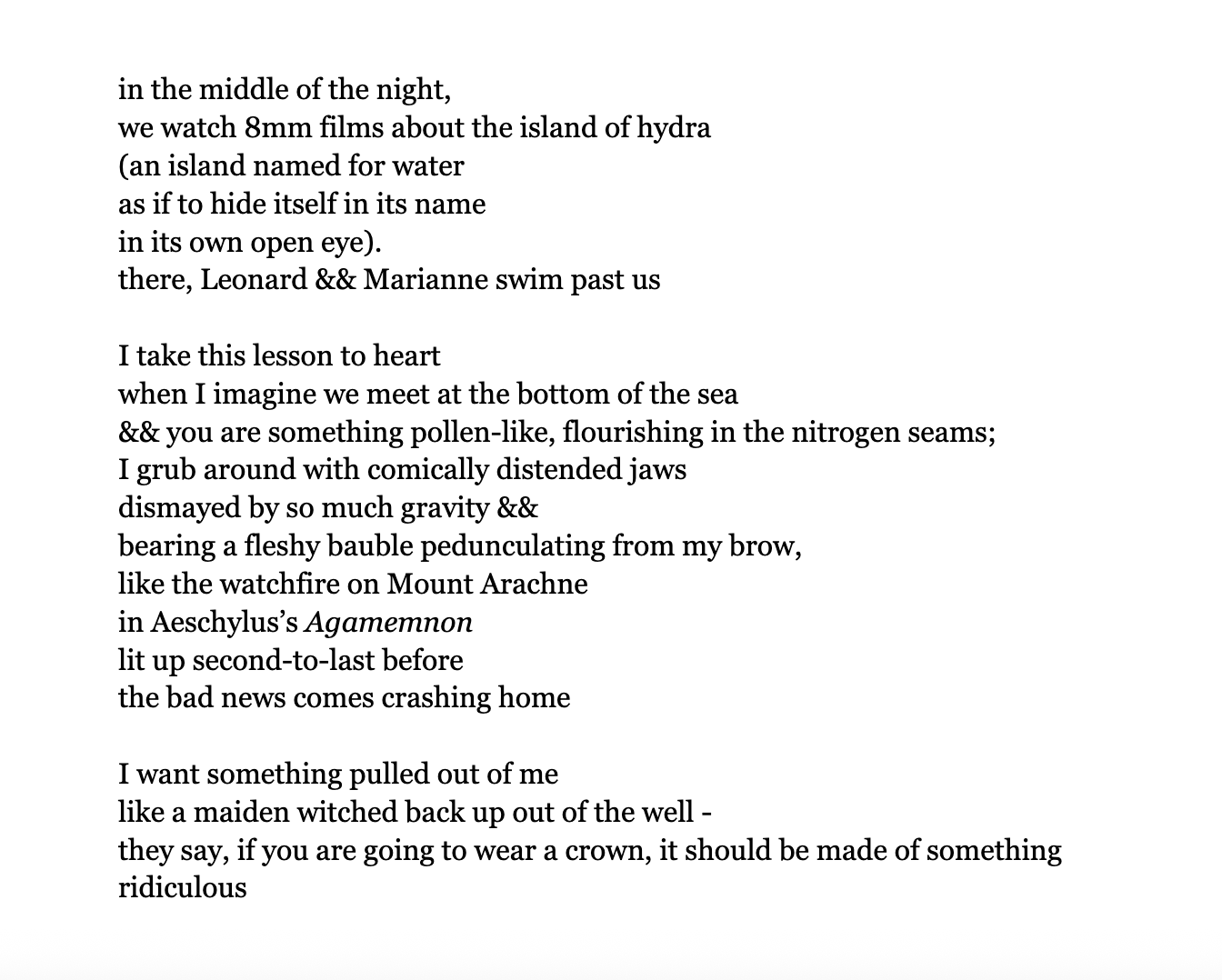
This poem feels very much circular, and I think that is what caught my eye first. The world of the poem feels self-contained, like a reel looping endlessly, but it isn't something closed-off; to me, it felt like, as a reader, I was there. I first felt this with the music reference of Leonard and Marianne swimming past. I thought their presence acted as a mirror for the poem’s emotional theme--and I imagine it is meant to be universal in a way--of romantic idealism drowned by time / circumstances.
The middle stanza deepens the poem’s surreal logic of that. The imagery at the bottom of the sea, e.g. the nitrogen seams, the "fleshy bauble pedunculating from my brow," etc. walks this fascinating line between grotesque and devotional. I imagine it is purposefully uncomfortable.The body mutates under pressure; love itself seems to deform under gravity, which is fitting for the relationship idea that floats around. What I find especially compelling is the undercurrent of yearning for transformation. It isn't inherently *scientific* to me, but the speaker wants something "pulled out of me," not unlike rebirth / resurrection. I could see there being an underlying allusion to something else, outside of the clear literary allusions already here.
I was fascinated by the structural choices like the lack of capitalization and the cascading "&&"s too, and I feel that creates an interesting visual rhythm of hesitation and continuation. I think each line folds into the next in a way that mirrors the narrative progression. It could be something to consider, though, to see one moment of sharper sensory grounding. I'd say to think about a texture or a sound that contrasts with the poem’s fluid imagery. Right now, everything exists underwater / in filmic distance, so one small earthly detail could humanize it further. I don't *know* anything about the narrator--and I don't know if there even is a real, concrete narrator figure who is reliable--so this could help develop that side of things as well.
To go into that deeper, my suggestion would be to lean a bit more into the emotional side beneath the mythic imagery. The poem is gorgeous in texture, but the narrator's emotional position gets blurred by all the rich allusion. Who are they outside of that? For instance, what does the act of “watching 8mm films” feel like in their body? Is it warmth, ache, nostalgia, or dread? Film is universally understood, as most art is, but I don't have any point of reference for *why* it is being focused on instead of other art forms.
I hope this helps!
lina
For starters, I think this is very ambitious.
I have always adored abstract/surreal poetry, and this is a contender - I mean, this poem is absurd. There is no working around that. It feels Camusian in a sense: the world reflects our desire for meaning only by mirroring it back nonsensically. The poem’s syntax enacts this as well, as it keeps folding on itself, building equivalences that don’t resolve ("as if to hide itself/in its own open eye" - this doesn't pragmatically mean anything, but it means everything). The whole poem has this occur with all of the literalization of psychic states/feelings into grotesque anatomy OR pop culture literacy that couldn't stand alone (or even, really, across stanzas).
I like that. I also really like the first paragraph's "retro" establishment with the 8mm films and and the nocturne, almost childish focus on minuscule details ("in the middle of the night... X happened" is roundabout by definition and obfuscates the linearity of time; that isn't to DIMINISH the time framing, but to say it could possibly make this dense/denser) - retro goes well with the "Leonard && Marianne" reference, which almost certainly nods to Leonard Cohen and Marianne Ihlen. Are the narrators (implicit you and "you" referentially) doomed lovers? or just a vehicle for your Hydra (Greek myth vs. Greek reality) image to "succeed," as you clearly are culturally literate enough to ENACT pop culture instead of simply using it?
Though, it seems the Greek play allusion falters. Mount Arachnaeus is where the fire took place (to signal/omen that Troy has fallen - Clytemnestra sees the beacon before Agamemnon returns home). Arachne, on the other hand, is the weaver that Athena punished for being prideful. I can't figure out if this was an intentional usage of Arachne to symbolize something, perhaps like communication woven from the fires, or if it was simply a mistake/a mistranslation from Greek. Easy fix if unintentional.
Besides that, I do have some smaller nitpicks:
You have a LOT of registers happening here, and you often switch between them. More "highbrow" (Aeschylus) meets technical (pedunculating, nitrogen) meets colloquial (bad news, ridiculous). On a level, it's brilliant, but it is also deeply obscure. This plays a part in what makes this "absurd" - not to take that as meaning BAD absurd, but absurdism as a deeper genre - and while that works for someone who can critically understand absurdism, it isn't a reach to believe the average poetry reader wants clarity. In fact, I don't think clarity is "needed" in poetry, BUT (and there always is one...) it makes the poem digestible. Unless someone is operating at a level where they ENJOY classical Greek tragedies, music, and articulate adjectives, this just sounds like words. Unfamiliarity breeds misunderstanding. And poetry is just words, but why? Because humans crave meaning. Meaning comes from understanding. (See? Roundabout.)
The references are more clever than vulnerable as well; do you want intellectual distance, or do you want a vulnerable poem? You can have both, but typically, it subverts the whole concept of vulnerability in the narrative (love, within intellectual distance, is connotationally negative since distance is negative). The narrative self-awareness ("island named for water," "as if to hide itself in its name," etc.) isn't necessarily smug, but it is certainly "cheeky" considering the various images. Is that the goal, or rather, a byproduct?
I do enjoy this poem though. A LOT. I love irony in poetry, especially "gimmicky" (for lack of a better word) irony. You handle the seriousness with care, yet maintain a sense of playfulness with the later stanzas (such as the concluding "ridiculous crown" in question). Lexically? Impressive. You have control over your language. Poetically? Also rather impressive, but there could be some more clarity at times as I've gone over. The main gist I gathered was "can a self be seen without becoming spectacle?" and that is a strong, capable theme that will get (and has gotten) this poem quite far.
Great work getting me back into the swing of reviewing as well; that is no small feat!
Best,
floodlights