

Points:
Time spent:
Canary word: Present
Possible AI signals:
Original Text:
Are you sure you want to delete this comment? This cannot be undone.
Mark this comment as a review? Points will be awarded to the poster.
Your comment was posted, but it wasn’t long enough to count as a review. Reviews need about four complete sentences (at least 250 characters). Try writing another review that explains your thoughts in more detail — the author will appreciate it, and you’ll earn points for it.
125,008 Literary Works • 672,832 Reviews



Transcript:
Spoiler
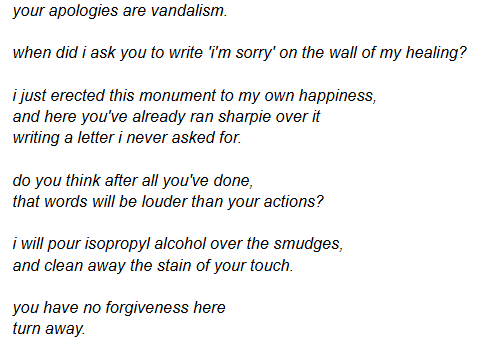
your apologies are vandalism.
when did i ask you to write 'i'm sorry' on the wall of my healing?
i just erected this monument to my own happiness,
and here you've already ran sharpie over it
writing a letter i never asked for.
do you think after all you've done,
that words will be louder than your actions?
i will pour isopropyl alcohol over the smudges,
and clean away the stain of your touch.
you have no forgiveness here
turn away.
Hai :3
Firstly, I love how this poem treats apology as an intrusion instead of the traditional idea of healing. That is SUCH a strong central idea!! It's a simple idea, but I love how you've transformed its meaning. The whole piece feels like someone protecting the sacredness of their recovery from a person who wants to rewrite the damage they caused. It’s bitter, clean, controlled, and honestly really satisfying in the way it refuses to soften itself. So good!!
!!!! What an opening.
This line is so direct and so memorable. I love that you don’t ease us into the metaphor. You just state it plainly, and it immediately reframes apology as destruction. Usually, apologies are presented as repair, but here they’re defacement. That reversal is so good!! It tells us right away that the speaker has done the work to build something after pain, and now the other person’s “sorry” is not a gift ~~ In a way, it’s graffiti, something seen as "unwanted" by society yet an art form.
LOVE this. "The wall of my healing” is such an interesting image because it makes healing feel architectural, like something built slowly and intentionally. A wall can protect, divide, display, or preserve, and I love that complexity!! The other person writing on it feels invasive, like they are trying to make the speaker’s recovery about themselves. That’s such a real thing, too: when someone apologizes not to help you, but to relieve their own guilt.
This is probably my favorite section!! The monument image expands the wall so beautifully. Healing becomes something grand, something earned, something worthy of being honored. Then the Sharpie comes in, and it’s so jarringly casual. I love that contrast!! A monument is permanent, sacred, public in a way, while Sharpie is childish and impulsive and ugly. It makes the apology feel not just unwanted, but sort of disrespectful.
^^^ Tiny grammar thing: “you’ve already ran” should be “you’ve already run.” Also, I wonder if “Sharpie” being capitalized could make the image pop even more, since it’s a brand and also feels so visually specific. Small detail, though!!.
UGH this is so good.
The isopropyl alcohol is such a cold, sterile, a little surgical image. It makes the speaker’s refusal feel like disinfecting a wound, but also like cleaning a surface after vandalism ~~ That double meaning is amazing!! The “stain of your touch” is especially powerful because it implies that the harm was not only emotional but lingering, residue-like. Something touched the speaker and left evidence behind, and now they’re reclaiming the right to remove it.
^^^ I’d maybe think about whether “smudges” and “stain” are doing slightly similar work. They both fit the cleaning/vandalism metaphor, but maybe one could become more specific? Like ink bleeding, black streaks, residue, fingerprints, something like that. You already have such a strong visual world here, and adding one more concrete detail could make this part even more visceral... Why vandalism? Lean into your metaphors more!!
WHAT an ending!! I love how final this is. There’s no negotiation, no “maybe one day," no forced moral high ground. The line “you have no forgiveness here” feels mythic in its scope, like the speaker is guarding a place that means a lot to them. Like, it's become something of a home for them. And then “turn away” is so clean and brutal. It doesn’t beg the other person to understand because the speaker learned over the course of the narrative that they don't want to understand. I like that finality!!
Overall, this is such a powerful poem!! I adore how controlled it is. It doesn’t spiral, even though the emotion underneath is clearly intense. The speaker has already chosen themselves, and the whole poem becomes an act of protecting that choice. Great work!! <33
- Payton
thank you!
You're very good at expressing the feeling of betrayal and the overcoming, congratulations. "That your words will be louder than your actions?" It's a good quote because it's already well known when we want to point out someone hypocritical or, as the it says by it self, say more than actually act.
there is something i genuinely appreciate in how this poem commentates on the topic of apologies. like how verbal apologies can't lessen the pain that *you* had to take the steps to move on & cope from. how verbal apologies can be more beneficial for that person apologizing than you. there is something raw in that commentary and i love that!!
I really like the concept of someone's unwanted and unneeded apologies taking form as a sharpie scrawl on a monument to the person's hapiness :O
This is so good.
Love this so much <3