
I.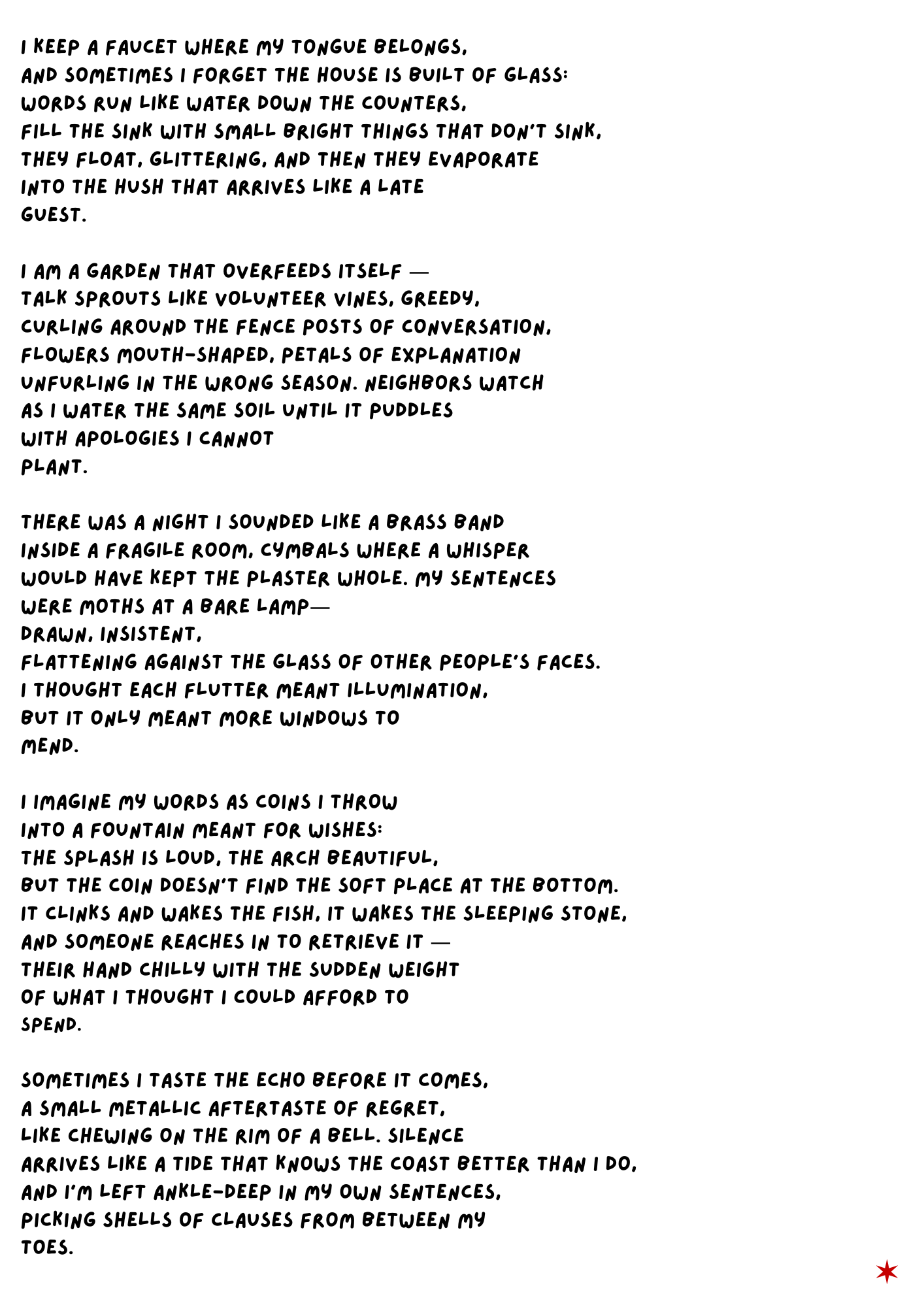
─────────────────────────────────────────────────────────
II.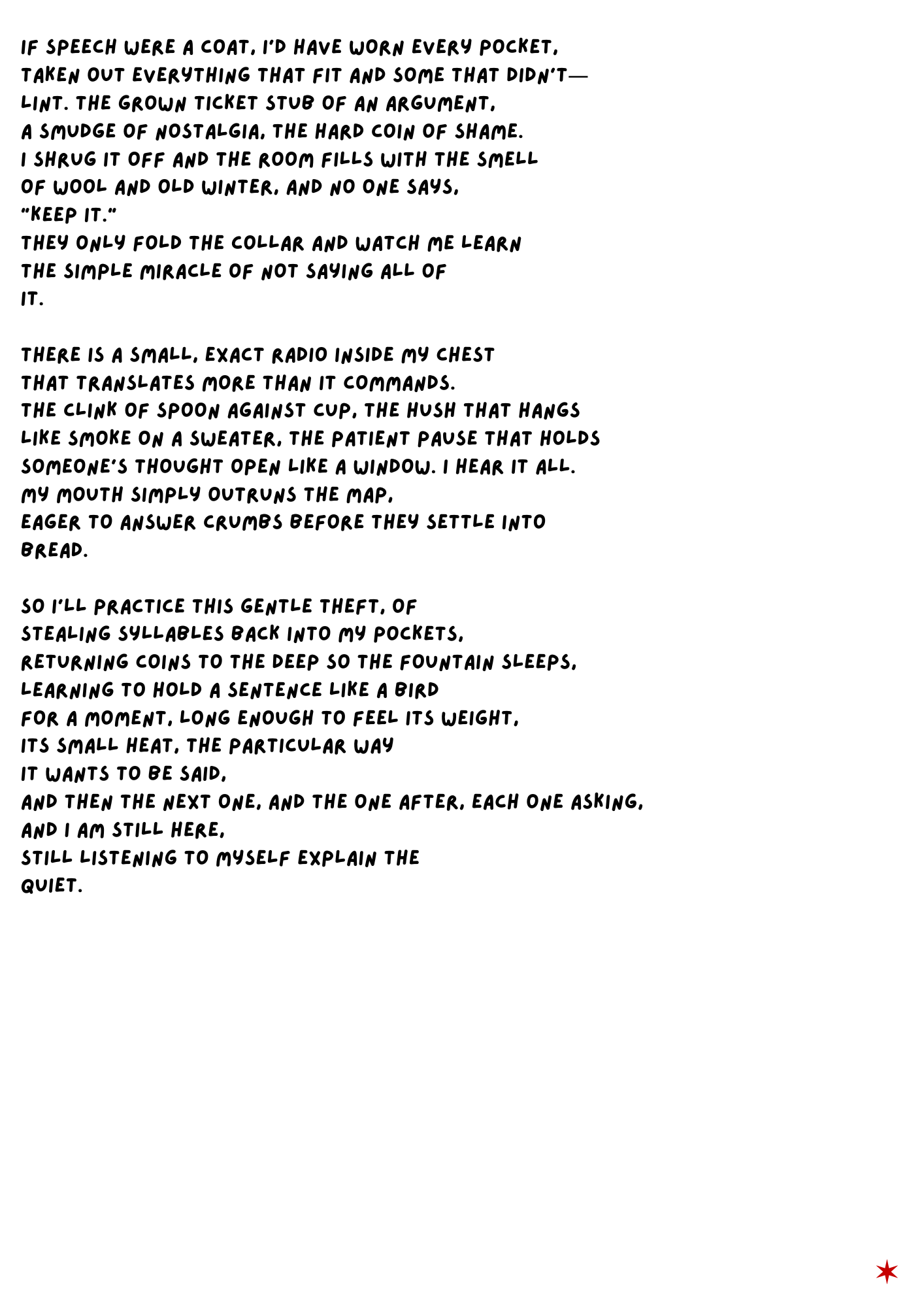
──────────────────────────────────────────────────────────
Points:
Time spent:
IP address:
Canary word: Present
Possible AI signals:
Original Text:
Are you sure you want to delete this comment? This cannot be undone.
Mark this comment as a review? Points will be awarded to the poster.
Your comment was posted, but it wasn’t long enough to count as a review. Reviews need about four complete sentences (at least 250 characters). Try writing another review that explains your thoughts in more detail — the author will appreciate it, and you’ll earn points for it.
142,082 Literary Works • 676,571 Reviews




TEXT VERSION
-----------------
I keep a faucet where my tongue belongs,
and sometimes I forget the house is built of glass:
words run like water down the counters,
fill the sink with small bright things that don't sink,
they float, glittering, and then they evaporate
into the hush that arrives like a late
guest.
I am a garden that overfeeds itself —
talk sprouts like volunteer vines, greedy,
curling around the fence posts of conversation,
flowers mouth-shaped, petals of explanation
unfurling in the wrong season. Neighbors watch
as I water the same soil until it puddles
with apologies I cannot
plant.
There was a night I sounded like a brass band
inside a fragile room, cymbals where a whisper
would have kept the plaster whole. My sentences
were moths at a bare lamp—
drawn, insistent,
flattening against the glass of other people's faces.
I thought each flutter meant illumination,
but it only meant more windows to
mend.
I imagine my words as coins I throw
into a fountain meant for wishes:
the splash is loud, the arch beautiful,
but the coin doesn't find the soft place at the bottom.
it clinks and wakes the fish, it wakes the sleeping stone,
And someone reaches in to retrieve it —
their hand chilly with the sudden weight
of what I thought I could afford to
spend.
Sometimes I taste the echo before it comes,
a small metallic aftertaste of regret,
like chewing on the rim of a bell. Silence
arrives like a tide that knows the coast better than I do,
and I'm left ankle-deep in my own sentences,
picking shells of clauses from between my
toes.
-------------------------------------------------------------
If speech were a coat, I'd have worn every pocket,
taken out everything that fit and some that didn't—
lint. the grown ticket stub of an argument,
a smudge of nostalgia, the hard coin of shame.
I shrug it off and the room fills with the smell
of wool and old winter, and no one says,
"Keep it."
They only fold the collar and watch me learn
the simple miracle of not saying all of
it.
There is a small, exact radio inside my chest
that translates more than it commands.
the clink of spoon against cup, the hush that hangs
like smoke on a sweater, the patient pause that holds
someone's thought open like a window. I hear it all.
my mouth simply outruns the map,
eager to answer crumbs before they settle into
bread.
So I'll practice this gentle theft, of
stealing syllables back into my pockets,
returning coins to the deep so the fountain sleeps,
learning to hold a sentence like a bird
for a moment, long enough to feel its weight,
its small heat, the particular way
it wants to be said,
and then the next one, and the one after, each one asking,
and I am still here,
still listening to myself explain the
quiet.
Hello there, human! I'm reviewing using the YWS S'more Method today!
Shalt we commence with the possessed S’more?
Top Graham Cracker - This is a poem about being overwhelmed by many things and also sort of feeling like when you speak it’s not quite understood.
Slightly Burnt Marshmallow - I have no recommendations to make as of right now, but if you would like to edit this, then you may.
Chocolate Bar - I love how it feels like wishes are drowning away in the water of the sink that feels like an ocean. My favorite lines were about the coins in the fountain being lost, kind of like how growing up brings lost hopes and the ending where the speaker is still trying to explain the depth of what they feel, the loneliness that cannot so easily be defined.
Closing Graham Cracker - Overall, a lovely poem about being overwhelmed. I have enjoyed reading this and I might check out some of your other works sometime. And so now…
I wish you an awesome day/night! ^v^
Hey centizore, Lim here with a review c:
Firstly - this is very cool! Even with all the different kinds of imagery, from coins to gardens, there is a continuity of voice and form and meaning that makes this poem very cohesive. I'll start with what I understood from the poem.
The speaker/ narrator has a certain relationship with words: they feel the need to say a lot and say it fast. Sometimes this overflowing hurts people, or gets them into trouble in some way (like with the plants being overwatered or the windows breaking). The speaker finds it hard to stop themself from saying things they may regret ("taste the echo before it comes / a small metallic aftertaste of regret"). They are able to listen but their speech is portrayed as this overpowering force that can "outrun the map". In the last stanza, the speaker seems to determine to be more patient, but the ending lines have this melancholy to them.
I find myself in awe at a lot of the imagery. I think it's very vibrant and dynamic, filled with motion like the words running down like water, then becoming "small bright things" that float upwards again. The personifications of the plants in stanza 2 similarly make the speaker's words seem fiercely eager to get out. Emotionally there's also this sense of otherness or alienation that comes through: for example, in stanza 1, the words "evaporate into the hush" without being received. In stanza 2, "the neighbors" feel separate and distant from the speaker. I think what makes the ending melancholy is it implies despite the speaker's efforts there is no one to listen to their words, so they are "still listening to myself explain the/ quiet".
These lines are intriguing. The intent of this "someone" feels kind of ambiguous. Are they a kind stranger trying to listen (since "retrieve" seems positive) but it makes the speaker feel too exposed? Or is it an act of theft or misappropriating the words? It sort of feels like it could be a lot of things!
I wonder what's the significance of saying "Keep it" or of folding the collar? It kind of feels like the speaker might wish for people to let them say all those words but also comes to an acceptance of the "they" maintaining a kind of boundary? I'm not sure though - like the last part I quoted there's an interesting ambiguity to these lines that stood out.
In terms of themes, I feel like this poem suggests the difficulties of connection and communication. I think it conveys the ways in which people struggle to make themselves understood and how that doesn't always look like silence or being withdrawn - sometimes that looks like rambling and saying more than one means. At the same time, because there are these tonal shifts within the poem, there also seems to be the idea that being more patient with speech can be beautiful and beneficial. The images in the ending convey a sense of peace: "so the fountain sleeps", "learning to hold a sentence like a bird". Both of these messages co-existing adds nuance to the poem.
Overall, I really enjoyed the journey this poem brought me on! Each stanza feels like its own little world, but joined together with the rest by this concept of the speaker's strong desire to communicate. I really like how you've captured the experience of listening as a "small, exact radio" in contrast to the big, restless movements of talking (at least in the first few stanzas).
Hope this helps, and keep writing!
-Lim
HIYA LIM!!! thank you so much 4 this review - genuinely among the most thoughtful i've received and i'm super grateful you took the time!!
your reading of the poem is remarkably close 2 what i intended - the speaker does have this painful self-awareness where they can hear themselves, taste the regret before it arrives, and still not stop. the ending isn't resolution so much as exhaustion - the determination 2 be more patient is real and sincere and probably temporary, and i think you caught that melancholy exactly right.
something you touched on that i wanna expand a little - the alienation and otherness. the speaker in this poem is something like a fly on the wall of their own life, strange as that may sound. they have the small exact radio, they receive everything in the room shifting, the pause they filled 2 quickly, the moment someone's expression changes. they are watching themselves in real time and still cannot intervene. that's the specific horror of it i suppose. it isn't obliviousness, not really, but full awareness running alongside the inability 2 prevent it. the first- and second-hand embarrassment exist simultaneously.
and the people in the poem are worth looking at closely aswell, because they aren't entirely cruel even if slightly discriminatory. the neighbours don't confront the speaker, they just watch. the room doesn't react with anger, it just absorbs, perhaps cringes a little, then moves on. nobody says keep it because they've already adjusted, already folded the collar and redirected. the people in this poem respond 2 the speaker the way rooms respond 2 a lot of noise - they wait 4 it 2 pass. and that quiet, patient non-response is its own particular kind of hurt, because there's no dramatic fallout, and the speaker never really becomes a punchline, it's just the slight cooling of the air and the speaker left understanding, again, what they've done.
regarding the person reaching into the fountain - i'll say that the intent isn't entirely kind. the some1 retrieving the coin is the other person in the conversation bearing the brunt of what the speaker threw in without thinking - their hand is chilly because it's an uncomfortable retrieval, not a generous 1. the speaker thought the words were free 2 spend, that the splash being loud and the arch being beautiful was enough, and it wasn't, and somebody else paid the cost.
on the coat stanza - the folding of the collar is that same aforementioned quiet, slightly cold tidying. the room isn't cruel, it again simply moves on and adjusts. nobody says keep it because..nobody particularly wanted it in the first place, really, and the speaker has 2 watch that happen and learn from it. it's less acceptance and more the particular humiliation of understanding that the boundary was never theirs to set, if that makes sense. and there is defo something else in that "keep it"; you weren't wrong 2 sense a wish there. the speaker DOES want 2 be told 2 keep it. some part of them is always waiting 4 the room 2 say 'yes, actually, we want all of it, say everything, we're listening.' i tried 2 layer that quiet grief in the stanza, because it truly isn't just that nobody says it, but that the speaker is still hoping someone will, every time, even after all the times nobody has. the coat comes off and they wait. and the room just, again, folds the collar. and the speaker learns again, until the next time.
the small exact radio is among my favourites in the piece so i'm really glad it resonated with you, as with the rest of the imagery - the contrast between how much the speaker receives and how little they manage 2 hold back is kind of the whole tragedy of it. they have never been unaware. they're still there though, still trying 2 practice the gentle theft of stealing the syllables back into their pockets.
thank you again lim, truly - you asked exactly the right questions and landed in exactly the right places, and i appreciate how you delved into it because reviews like this 1 make the writing feel worth it. stay safe, take care, and keep writing as well!!1
What a wonderful piece and wonderful use of imagery (and consonants)! The descriptive imagery in this poem is so lovely.
hello, thank you so much!!!

this 1 is a pretty significant piece 4 me personally so knowing the imagery landed the way i intended is really wonderful 2 hear. i'm glad you caught the consonants - that was very much intentional.
thank you once again 4 reading
Love the font you chose for this. Also the title! They both feel very fitting.
thankyou corvid!!! all deliberate choices, im glad you noticed them
I like the font! It works well with the poem.
thank you!!!