
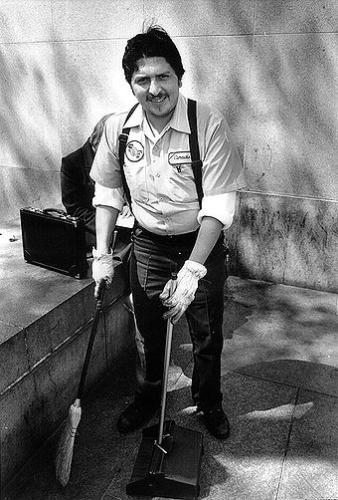
DURING ONE LATE summer night in 1992, Francisco Manuel Herrera—or “Don Manuel” as his friends called him—pulled out several bottles from a large yellow trash can while the others were posted as lookouts. They had warned him to be quick (“Don’t take your sweet time again, cabrón!”), and so Don Manuel was arms-deep rummaging while he thought about how he hated the feel of a sweaty T-shirt sticking to his back. He could hardly see in the darkness and therefore had to grope for the bottles, sifting through cans, piles of scrap metal, and broken glass. Every now and then he would find what he was looking for, but more often than not the bottles were empty and of no use to him, so he had to toss them aside, sometimes mumbling underneath his breath. When, however, he had eventually stuffed his rucksack with bottles that contained smidgens of liquid, and when it was threatening to burst at the seams, he dashed to his friends and with a grin presented them the loot. They nodded approvingly and together Don Manuel and his friends scuttled away from the parking lot of MicroTech, where they had clocked out of the office just hours before.
MicroTech was one of those companies that seemed to have appeared out of nowhere in the shortest possible of times. Stewarded by self-made whiz kids, the company produced semiconductors and these had recently helped the US military to bomb Kuwait, which had repelled Saddam Hussein’s army and intimidated the Soviets. People thought it was a true American success story, and so it had left the nation giddy with promise and possibility. MicroTech was based in East San Jose, in the Santa Clara Valley in Northern California. Its offices boasted polished glass planks through which squinting outsiders, despite the bright Californian sun, could make out the silhouettes and sometimes faces of MicroTech’s engineers. These engineers drove convertibles—for these were a new breed of engineers who during the pursuit of science found the seduction of riches—and their cars, which accelerated fast and roared loud, were sacraments intended to announce proudly to the world their new-found faith. MicroTech engineers had discarded their white lab coats for flannel trousers and white shirts, which were pressed to perfection, with the cuffs neatly folded back two turns. Their Reaganite haircuts were impeccable, and their golden wristwatches oozed opulence.
Don Manuel was not an employee of MicroTech; he was, however, an employee of NextGen Cleaners. Don Manuel’s uniform consisted of black trousers, white sneakers, and a blue T-shirt. His employer’s logo was sewn on the left shoulder of this T-shirt, and on the right shoulder there was a small hole, which started to give his attire a shabby look, but since it was a hand-me-down from a previous employee whom Don Manuel heard had been fired, and since his employer did not provide more than one uniform, Don Manuel took pains to preserve what he had as best he could. On this day, Don Manuel was in a good mood. Around 3 P.M., one of his five roommates had cooked a caldereta, a traditional Michoacán dish consisting of ground beans and rice. The roommates ate fast, some showered, and at 4 P.M., Don Manuel was outside warming the sputtering car engine until the others joined him for their commute to work. At 4.30 P.M., Don Manuel and his roommates arrived on the parking lot of MicroTech along with a swarm of shuffling Latino workers wearing blue. The third of eight children, Don Manuel was born in the rural town of El Espańol in the state of Guanajuato in 1969. His father was a labourer on his ejido parcel (agricultural land owned communally), but when he fell sick, Don Manuel abandoned school aged fifteen and became a domestic servant. In 1990, exasperated with his poor prospects, he decided to cross through the mountains of Tijuana in the San Diego border region at the age of twenty-one, and since he had the good fortune to go undetected, he worked as a labourer in a sawmill in Ferndale in Northern California for two years, a job his older brother had procured for him, until the sawmill closed, forcing Don Manuel to join an exodus of Mexicans to San Jose where he eventually became a janitor at NextGen Cleaners. At first, Don Manuel was glad of his new employment. He had worked his way up to the position of a “utility worker”, one level above an entry-level janitor, and he was now responsible for the cleaning of windows, shampooing of carpets, as well as the waxing, stripping, and buffing of floors. He much preferred this over the emptying of trash cans and cleaning of restrooms, which rank-and-file janitors are in charge of, and his new tasks along with a pay increase of $.55 an hour had raised some hopes of prospect.
Recently, however, these hopes faltered. MicroTech had subcontracted NextGen Cleaners to clean its building. Outsourcing was an easy choice due to the flexibility of service, its low cost, and certain beneficial labour arrangements (“We prefer working with small janitorial companies whose managers are on site and supervise their own staff.”). In an effort to boost the bottom line, NextGen Cleaners had begun to initiate a series of cost-cutting measures this summer that affected the janitors. NextGen Cleaners went through several rounds of culls, and every time the remaining janitors had to complete more work with fewer hands. Don Manuel’s employer rationed cleaning supplies such as regular paper towels, encouraging janitors to filch napkins from the MicroTech cafeteria even though security would every now and then seize offenders, which was especially frightful to the many undocumented. When his friends could take it no more, they urged Don Manuel to make their complaints heard. On account of his reading, which gave him an adroitness of language the others did not possess, he had earned the title “Don”, and others had therefore elected him to the position of a broker between the Mexican janitors and the Korean managers, which he acquiesced to. Don Manuel’s heart was thumping as he placed his hand on the doorknob to Mr. Kim’s office. He let the hand hesitate there for a while. Then he took a deep breath, swung the door open, and walked in. Mr Kim, hunched over paperwork, did not look up.
The conversation had gone as expected. After the exchange of some forced pleasantries, Don Manuel explained the problem while Mr. Kim stared blankly at him. Promises were made to look into the matter, and Don Manuel was eventually waved out of the office (“I am sure you can appreciate how busy I am.”). Outside Mr. Kim’s office, Don Manuel sighed. He thought it was best to avoid the other janitors for a while. He hated the sagging of their hopeful faces which by now should be accustomed to a lack of tangible progress, and he therefore thought it best to find one of the remote janitor closets where he could be alone and open his calculus textbook, for Don Manuel was studying for his high school diploma. He did not attend any formal classes but had found a school that offered tuition via mail, and his greatest difficulty was to find time for his reading and assignments. Between his job as a janitor and his other odd jobs here in there, he thought his best chance was to sneak away on the labyrinthine premises of MicroTech and to make off with a few minutes of furtive privacy. Yet he had to be wary. Management would issue a formal warning or even fire him if caught, and even some of the other janitors did not approve (“You think you are better? If you are so smart, you’d know that you can’t go to college without a social security number.”). The disapproval, the risks, and perhaps the futility, however, did not matter to him: he was imbued with a sense that life should be more.
When ten minutes had passed, the closet door sprang open. Don Manuel gulped but then realised it was one of his roommates. “Always reading, “ said the roommate. “You need to be careful with those eyes, cabrón, or they will get weak.” There was some sort of emergency or other, his roommate had told him. A quarrel had broken out between some of the Mexican and Latino janitors, and Don Manuel who said that he would be on his way soon was to mediate. Then the roommate left, but not without reminding Don Manuel that they were moonlighting tonight and that he should remember to bring the detergents with him, which they had found last night. As he convalesced in his momentary solitude, Don Manuel thought about the path he had hitherto trodden—the ones that he had left behind and the ones he missed. He knew his mother felt uncomfortable staying with her oldest married son and that she wanted to live alone in El Espańol with her remaining unmarried children. The remittances Don Manuel had promised had hardly transpired, and in the vast frontier of Silicon Valley he had only found the paradoxes of prosperity. On his way out of the closet, his T-shirt got caught in the doorknob and snagged a little. He then thought of those swanky white shirts they were wearing at MicroTech.
Points:
Time spent:
IP address:
Canary word: Present
Possible AI signals:
Original Text:
Are you sure you want to delete this comment? This cannot be undone.
Mark this comment as a review? Points will be awarded to the poster.
Your comment was posted, but it wasn’t long enough to count as a review. Reviews need about four complete sentences (at least 250 characters). Try writing another review that explains your thoughts in more detail — the author will appreciate it, and you’ll earn points for it.
141,687 Literary Works • 675,565 Reviews



Wow, I like how much cultural information you put in this! Clearly, you either did significant research or are familiar with your topic. Your descriptions of poverty are supreme and give a good feel for what kind of place you are describing. The title of the work really grabbed my attention and sent me to this post. So good job with that, too!

As I mentioned before, I like how much cultural information you provided here, but a little explanation as to what the italicized words mean. (ie, cabrón) Maybe you could include a little list of words that you use and their definitions at the top? Just a suggestion.
As another suggestion...In the beginning you start with a narrative form with no dialogue, and you write in a rather formal story-telling style. That seems to abruptly change when you start the communications between the characters. I suggest using normal dialogue (and omitting the parenthesis) but again, it's just a suggestion. Aside from that, good work! I enjoyed reading your realistic descriptions!
Happy writing,
KJ
Hello darling~
This was a very interesting, stirring piece. I'm from San Francisco and I was born in '99, so I had a front-row seat to watch the decline of the Bay Area over the last couple of decades, as the tech industry gentrified it beyond recognition. As you can imagine, I'm bitter. Especially since I consider social media to be one of the most evil things man has ever created, so to see the billionaires who are responsible for companies like FaceBook, Twitter, Instagram, et al take over a once-vibrant, artistic area and render it into this soulless, unaffordable husk of its former self... it's awful. (If you ever want to feel depressed, just look at the rent prices for studio apartments in San Francisco. Ugh.)
Anyway, all of this is a long way of saying that I understood this piece on a personal level, although my story is quite different from Don Manuel's, because I know just how horrible these mega tech companies are and how badly they treat low-level workers/laborers whom they view as disposable and replaceable. The wealth/class disparity of this area is shocking and upsetting, and I think you captured that quite well. There was, in particular, one line you wrote that really stuck out to me: you called it the "paradoxes of prosperity." I love that. It's a great way to describe what this piece is about, and a very succinct, memorable summation of these issues. You've given a name to something which is difficult to describe. Well done. That phrase is going to stick with me.
So, I like the themes and topic of this piece. I think you did a good job of illustrating the injustice and inequality of it all. I know this story is set in '92, but these problems have persisted and worsened in the years since, so the tale that's told—and the critique that you give—is, sadly, as relevant now as ever. It was an emotional piece for me to read, though it's hard to tell if that's because the writing itself was effective in conveying emotion or just because I'm familiar with so much of the content. Either way, it definitely made me feel things: fury, despair, and a deep hatred for Big Tech (although I always feel a deep hatred for Big Tech).
Admittedly, I'm not that familiar with the experiences of Mexican immigrants in Silicon Valley during the early 90s, but the story felt true to life. It had an air of authenticity. I know you said you read a book on the topic, and I think that helped build credibility, because it felt well-researched. It also, very importantly, felt like you cared about the topic and the story you were telling. It was kind of a gut-wrenching, heartbreaking read—something that leaves you feeling uneasy and unhappy about the state of the world—but that's a good thing. That's how the reader should feel, after a story like this.
Your writing was polished. There weren't many mistakes, though I do have some critiques.
First of all, I think the way it was written was a bit on the passive side. I also would've liked it if you'd relied less on narration and more on action/dialogue. I wanted to have a better sense of Don Manuel as a person, and I didn't really get that. If you'd written some scenes of him interacting with others or moving through his everyday life—and actually written those scenes, rather than skipping over them/summarizing them in your narration—I think that would've provided us with a far better grasp of his character, and made him feel much more real.
Also, I found the beginning of the story a bit confusing—and troubling. Later, toward the end of the piece, you imply that it was bottles of detergent they were looking for with the line "to bring the detergents with him, which they had found last night." But you didn't properly establish that in the opening scene, leading me to wonder what it was they were looking for. I don't know if this was an intentional misdirection or not, but the vibe of that first paragraph sorta seemed like they were looking for leftover booze? And I really, really don't like that, for a number of reasons. I think it's a terrible choice to open your story with a Mexican character digging through the trash. The optics are ugly, because it feeds into certain stereotypes. To begin this piece with a Mexican character scrounging around the garbage to find leftover bottles of booze is especially awful, but even having him searching the trash to find cleaning products is still problematic and kinda icky. And of all the different ways you could've started this piece, why that? Why not start with something that's completely unexpected and subverts our expectations of poor, blue-color Mexican immigrants? For example, you could've opened on him studying and then segued into a discussion about the uphill battle for him to get his degree. That would've been a much better, more meaningful introduction to his character.
(Also: wouldn't the company he works for provide him with cleaning supplies? Does he really need to hunt through the trash for them? Or when you say that he's "moonlighting," are you implying he's working on the side in some freelance capacity, hence the need for the detergents? Again, further clarity was necessary. The whole thing left me confused.)
Now it's time for some nitpicks...
Periods and commas always go inside quotation marks. No exceptions.
It's not a huge faux pas to end a sentence with a preposition (Lord knows people do it all the time), but it would be more grammatically correct (and sound better) if you wrote this as, "to which he acquiesced."
Should be: "The conversation went as expected."
Should be: "odd jobs here and there."
This sentence is in desperate need of punctuation. Put a comma after "Don Manuel" and another comma after "on his way soon."
Ooh boy, this is overwrought and pretentious. Make that extremely overwrought.
Okay, that's it for my critiques and nitpicks! All in all, I think this is a moving piece that addresses an ongoing, real-world problem, and mostly does so with compassion and a sense of authenticity. We definitely need more stories centered on characters like Don Manuel, and we also need more works that critique the horrors of the tech industry and the income inequality of the Bay Area. I'm really glad you wrote this. I think you managed to hit a lot of important points, and to critique these systems without sermonizing.
Well done!
This is my first short story, and I started to write to learn how to communicate better. I read a book about Mexican immigrants in Silicon Valley by Christian Zlolniski, and wanted to help tell the stories of the characters in the book. Looking forward to learning from your comments!