
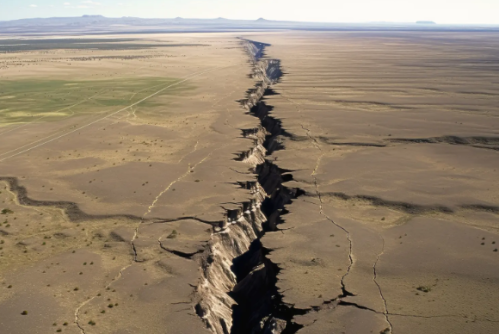
There was a small fold in the landscape near Burrenholde, where an ancient earthquake had cracked a crevasse in the earth - but time had sealed the gaping hole, and all that was left was the said fold: two parallel mountainous areas, filled with creases and with a thin valley through the center. It was small for its type, but didn't escape the other norms for that kind of natural phenomenon, the worst of it being the constant shaking and moving of the earth. The earthquakes were small ones, so they didn't cause any damages to Burrenholde, the nearby village. The villagers could barely even feel the stronger ones. But the fold was always moving, so if anyone were to wander in that direction twice - not that anyone did, since it was said to be haunted and cursed - each time a year appart, they wouldn't be able to recognise anything. Every recognizable landmark would be changed. Every rock would have a new position. Every road destroyed or deplaced. The Fold of Burrenholde was marked number one-point-one most unlivable place in the land, second only to the Great Fire Mouth; an active, very explosive volcano, which was marked number one-point-zero.
There were eighteen people living in that fold.
Eighteen was an average. There was always someone dieing, someone arriving. There was no community, there were no families. Each individual lived alone, retreating to their own shadowy corner of the fold, tucked away under their own, unstable boulder. They lived in small crevasses, gaps in the rock, behind stones or in temporary caves. But earthquakes were almost constant in the fold. Their homes were deadly to them.
These people were like so many glints of life, finding refuge inside the crushing jaws of a cruel stone monster. Flickering out, one by one.
There were as many differing causes for death as the deaths themselves in the Fold of Burrenholde: the deadly, moving stone; suddenly appearing holes; hunger; thirst; madness - and so much more.
The people usually started by doing everything they could to surrive, when they first arrived in that place: they ate whatever they found, shrubs and insects if they were lucky, sand and dirt otherwise. They tried collecting rain in bowl-like stones, in their trembling palms, in their thirsty mouths. They tried shielding themselves from avalanches, hiding under giant boulders, staying awake as long as they could. They tried sleeping through the scorching days, building huts from stone and sand, singing themselves awake, singing themselves asleep, growing seeds between the rocks, running from dangerous animals. They tried sweating away dirtiness, memorizing dangerous areas, keeping their clothes from ripping, sharpening stones for weapons. They tried killing time by reciting poems, throwing pebbles at marked spots, singing, dancing, counting. But eventually, they started reciting the verses wrong, missing every throw, singing notes too high or too croaked, ending every dance by punching something, skipping numbers or saying one dozens of times before they noticed. Eventually, if nothing else killed them first, they died of madness. Rolled up in a ball of misery, mumbling nonsence. Wishing for death. Crying. Screaming. Begging. But no one heard them. For the inhabitants of the village of Burrenholde, the fold was haunted and cursed. And the others in the fold were too fixated on surviving and their own misery and mistrust to reach out a hand to the other.
But why were these lives tossed into this infinite well of darkness and dispair, condemed to finish their existences in misery and madness? Why did these people not try to escape?
The cause was their names: they were called Invisibles.
Invisible: means ignored, not noticed, or not considered. Litteraly, unseen.
In that land, the name of which has to this day been lost, there was a king, the name of which has also been lost. He ruled grandly and richly, with pride and self-esteem. But in the shadows, behind the stage, he punished every servant who disappointed him much, every peasant with a too great debt, every poor who dared to not show enough respect, with the cruelest of punishments: branding them an Invisible. It meant the confiscation of all their belongings. It meant branding them with a large, capital I in the face using a white-hot, iron bar. It meant throwing them into the said fold for life, with the promise of worse if they tried to escape.
Not that much worse was really possible. Some really had tried to escape - but villagors fled from their branding, their dirtiness and ripped clothes, and guards would arrest them and give them a beating before throwing them back in. After that, the Invisible never tried again: they usually died within the week.
These horrors were not widely known. The only few who knew where the king, the queen and one or two highly trusted guards in charge of the affair - and a couple of other guards in every city and region knew naught but this piece of information: "Criminals branded with a capital I in the face are highly dangerous escaped prisonners that should be brought to the king himself immediatly."
***
If one were a bird, and one were to fly low through the rocky creases of earth that make up the fold of Burrenholde, on a certain day in which this story begins - and if one were to parcour through balancing stones, over high bumps and down in narrow valleys, if one were to follow the rough path made by the center of the fold until the little clay houses of Burrenholde village's inhabitants were naught but specks of grey near the horizon - then, if one were lucky, one might find a small camp spot tucked in the entrails of the ever-changing land; and, if one were even luckier, one might catch a glimpse of a frail little girl, wrapped in a large cloth that wasn't really a cloth, but animal hide; one would have been able to wonder at how her skeleton-like arms worked tirelessly at gathering grass, sharpening stones, stitching further hides; and if one were to stay there, watching, not daring to stretch one's wings to not disturb the child - if one were to stay until that time where noon and evening seem to mix together, noon not willing to depart yet but evening already arrived, so that one cannot tell which is true - one might see the way in which the girl, as the ground began to tremble, stood up suddenly, carried everything fragile under a strange sort of object that ressembled a table but didn't seem to be of wood, and tucked her own little body under with them. Then, one would have had to fly away, for the place would have been too dangerous for a resting bird.
This girl was called Nellie - and she was just about thirteen. She had tanned, scraped skin that stuck to her bones, rosy cheeks, long, messy black hair and a pair of amber-green eyes. Her lips were thin and bleached from the sun, her small nose curved upwards at the end and her eyebrows were rather thick. She would have been cute if she hadn't been pitiful.
Nellie had a mother, whom she liked to call "Mama", and knew no father. She didn't even know what a "father" meant. Her mother had been branded an Invisible and sent to the fold while Nellie was still unborn - raising a child had kept the woman from madness, and both mother and daughter from death: they had supported each other in that way. Nellie keeping her mother's sanity whole. Her mother saving Nellie from an unescapable death. They had found a way to survive in the fold.
All of this resulted in three things for Nellie: She wasn't dead, and had a healthy sanity, if not a very healthy body - she had no I, the marking of an Invisible, on her young face; being a fold-born child, no one had ever branded her - and she was now so used to the fold that, no matter how strong the earthquake, how dreadful the weather conditions or how painful hunger and thirst, she always found a way to survive. At least - until this point. One might add, also, that she had a mother. It is always a good thing when one is trying to survive in the middle of a deadly natural phenomenon.
"Mama! You're back!" Nellie squealed, running towards the woman like a six year-old would. Having never been around other people, Nellie had kept her childhood instincts, letting her act in this way: surprisingly for a girl raised in the Fold of Burrenholde, she had never been forced to act tough, grown-up or mature in any way - to her, the fold was a normal place to live and her mother was like her shadow: she beleived that both of them would stay together forever.
How very wrong she was.
Her mother hugged Nellie, setting a basket made from dried shrubs and the occasional wind-blown twigs onto the floor. The earthquake had stopped a while ago, and Nellie had stopped hiding. It was now definitly evening, slowly turning into night as the sun started to disappear behind a nearby boulder. Soon, it would set for the inhabitants of Burrenholde, the nearest village - but whoever lived in the fold could only every see the sun setting behind the closest rock. Nellie had only once seen the horizon: she and her mother had climbed the highest crease, risking that an earthquake would send them tumbling down; but Nellie had been scared of the gigantic space, of all the green that was as if giant, lush shrubs coated the earth forever around them. She'd asked her mom: "Mama! Why did the sky fall on the earth over there? What if it falls on us? I'm scared!"
"Bimbly-berries!" Nellie squealed again. It was how she called the rare Bilberry that sometimes grew through cracks in the rocks. Common heatwaves made it hard for anything to grow in the fold, so the small blue berries were some of Nellie's favorites. The child stared in awe at the berry-filled basket.
"You know what this means?" her mother asked her.
Nellie hesitated a second. Then she remembered: "Bimbly-stew!" she squealed even louder, dancing and jumping and moving her frail little arms around as she chanted: "Bimbly-stew, Bimbly-stew, Bimbly-stew!"
Her mother smiled saddly. It was lovely to see her child so happy after a hard day of searching and gathering. She only wished she didn't have to force Nellie to grow up in that horrible place. It is so selfish, she thought. But she tried to push the guilt away: Nellie had nowhere else to go. If she left to a better life outside the fold too early, the poor girl would die alone on the streets. They had to wait until Nellie was ready, so she could leave with a good chance of living a happy life - even if it hurt her to see her daughter so little fed.
Nellie made loud slurping sounds as she gulped down her bowl of cooked Bimbly-berries, later that evening. Her mother had given them both small portions of the stew, and not only because they needed to keep some for later; if they ate too much so suddenly after eating so little, the consequences could range from a bad stomach ache to death. The woman was very careful about this kind of thing.
"Quit the disgusting noises!" Nellie's mother laughed.
"But why?" Nellie groaned. "What's the point?"
"It's incredibly annoying for me." her mother told her. She didn't add, and it will be for others when you join society.
Nellie made an unintelligible sound that sounded like a grunt, and resumed slurping.
Her mother sighed, but didn't press.
Late that night, on beds of dried grass, Nellie fell asleep immediatly. Her mother didn't: she couldn't stop thinking. When should she send Nellie into the world? Thirteen seemed definitly too young. She couldn't remember well, but her vague memories told her that children still lived with their parents at that age. But Nellie was already a teenager. How many more years before she left? Three? Five? Ten? How many more years before she, her mother, had to stay in this fold alone, forever, with only mad criminals here and there - she blocked the thought before she could fully finish it. This shouldn't be about her. Nellie was the young, innocent girl who hadn't yet had a chance to see how life really was. But then the inner debate started again: when send Nellie into the world? Too early would leave her alone to fend for herself - but too late would eat up her time to live in the real world, might make her pass a chance that she would otherwise have had. And it would keep her inside the cruel jaws of the Fold of Burrenholde for longer...
The woman stayed up most of the night, tossing and turning both on her bed and in her head - but never coming to a decision.
Points:
Time spent:
IP address:
Canary word: Present
Possible AI signals:
Original Text:
Are you sure you want to delete this comment? This cannot be undone.
Mark this comment as a review? Points will be awarded to the poster.
Your comment was posted, but it wasn’t long enough to count as a review. Reviews need about four complete sentences (at least 250 characters). Try writing another review that explains your thoughts in more detail — the author will appreciate it, and you’ll earn points for it.
141,185 Literary Works • 674,242 Reviews




I enjoyed this prose. The premise of the Fold of Burrenholde is immediately interesting, and I especially liked the contrast between the whimsical, storybook narration and the reality of the Invisibles’ lives. There are quite a few spelling and grammatical errors that interrupt the flow. Proofreading would make the chapter substantially more polished. There are some awkward constructions and comma splices; reading the prose aloud may help identify some of these uncomfortable areas.
The greatest mechanical issue is sentence structure. Several sentences, particularly in the opening paragraph and the section beginning “If one were a bird,” contain so many clauses that they become difficult to follow. Breaking some of these into shorter sentences would make the prose smoother. There are also a few dialogue-punctuation errors, such as “ 'It’s incredibly annoying for me.' her mother told her." Because “her mother told her” is a dialogue tag, the quotation should end with a comma rather than a period. I’d consider trimming some of the repeated exposition about the Fold’s dangers, since the survival section already communicates its brutality very effectively.
Thank you for this read.