
Hey guys. If any of you remember me at all, I'm still working on the same pile of garbage (in technical terms, a novel) that I was months ago, and it's going quite well. Here's the prologue and part of the first chapter, in case you're interested. I would appreciate any comments, positive or negative. Thanks!
PROLOGUE
It is autumn in Garathen. The old and regal city, nestled between rolling hills and fast forests, sits quiet below the overcast sky, its towers and steeples rising from the cobblestone streets into the gloomy air. It is a large city, and a magnificent one—but by the standards of the world, it is by no means the largest. Even though the great trading cities of the Myroa Sea or the industrial rail-hubs of Calthorn are richer, more massive, more politically power, there is something about the old city by the river that it makes it different, that makes it somehow more powerful, more beautiful—and more terrifying.
It is age. It is history, and the memory that goes along with it.
The city is old, innumerably so—and every street corner and building seethes with the memory of bygone ages, ugly times and beautiful times and bloody and treacherous times. All around Garathen, there are signs and remnants of terrible and beautiful events, but for the most part they go unnoticed. The city has moved on, grown, prospered, and is usually bustling well into the midafternoon.
But the city is quiet now, unusually so.
There is a stillness and closeness in the air; below the clouds and sky and steeples there is very little sound or movement. The laugher of children, the whinny of horses, the cries and shouts of life all seem to be muffled under some phantom weight, one that bears down on the city like a gauntlet that crushes a skull.
To those open to it, there is a gloom, a desperation in the air—a feeling as if there will never be any great sound from the city again, that the sun will never emerge behind its fortress of clouds, that the trees will never again bud. The emotion scratches at the hearts and minds of Garathen’s people, but only a few notice it fully and completely—and to these few, there is nothing more frightening in all the world. It is not only desperation and gloom— it borders on mind-numbing terror. Even the happiest notice a hint of it whenever their eyelids drop. For that split second, that moment of darkness, the horror seething off the city burns its way into their minds—it is a moment bordering on madness, a moment when the mind is convinced that all is utterly lost, and that to perish would surely be better than to open one’s eyes again.
And then, through the quiet, bells begin ringing.
They start slowly at first, a slight tingling and clanging that gradually increases to a booming song, which cries out through the autumn air. In their towers, the great iron beasts swing from left to right and back again as the shadowy men who grasp their ropes hurl them. The passion of the bellmen is unusual today, for the rank desperation in the air is strongest in the old cathedrals and towers of the city, and so they channel this unstated power into their sinewy arms with every swing. And as the bells ring over and over again, the air grows colder and the gloom grows tighter.
Some can sense the truth in the air: It is not the men who ring the bells—it is the city. It is not the men’s hearts which cry out in desperation, it is Garathen, old and scarred and screaming out through the sky.
For Garathen is a living thing, an entity, and now its collective memory seethes and rises like a twisted beast through the air, writhing and screaming out through the great iron bells. A current is growing, deep in the sewers and old, dark places of the city—and it wants to be heard.
The cold October wind picks up, and howls through the cobblestone alleys and avenues. Men and beast shiver alike, and as they watch the wind tear down leaf after leaf from the trees, sweeping the dead and cracked things around their feet, they can sense the morbidity entering the air—and they shiver all the more.
The wind bears the dead to the ground, and the train bears the dead to Garathen.
The ground shakes ever so slightly, and from the rolling mountains to Garathen’s north comes the sad, tattered sight. Its machinery still hums, and its engines still cough black smoke, but its wheels are slowing, their undaunted desire and energy forgotten. The torn iron beast wheezes into Garathen along the old railway that cuts through the fine architecture, passing under the disapproving glare of cathedrals and towers and over the sad, glimmering waters of the river Concord.
The angels on the cathedrals seem to weep, and the gargoyles grin sickeningly.
The cruel iron of the train stands in stark contrast to the beautiful city, but they are not all that different—under the surface, they are both dead. With its last, dying breath, the train pulls itself into the heart of the city, and finally comes to a halt in the gaping mouth of Garathen’s rail station.
The train takes its finally breath, and exhales.
One of the iron hatches swings slowly open, and from the shadowy door a great wash of blood and smoke pour out. A single boot comes from the darkness, and then a solitary man emerges from the billowing smoke, nonchalant as blood washes out from behind him and onto the red brick of the station. He stands there for a moment as the smoke curls around him, his eyes gleaming with a tint that looks almost crimson, a bloody red that intensifies but for a moment and then subsides. Dressed in shabby, torn traveling clothes, his body is gaunt, and sickeningly thin. Gracing his head is an old black top hat, and from under it grow the weeds of his hair, thin and straggly strands that fall, in places, even to his sallow cheekbones. Wrapped around the lower half of his face, obscuring it, is a black, threadbare scarf.
As the torrent of blood and smoke begin to subside, he walks away and slips quietly into the city, descending the steps from the station onto the sidewalk across the street into an old and quiet park.
The trees sway uneasily above, and the children in the park flee from his presence. At length, he moves deeper into the park, crossing under the swaying trees and melding into the shadows cast by their branches.
Walking in small, controlled strides, he moves deeper and deeper into the trees until he reaches a pond circled by benches—where he perceives a man sitting on a bench near the still waters. His face seems to contort into something that could be a smile, though it is hard to tell under the scarf. It is a hideous look; his cheekbones and scarf rising upward is more of a sick caricature of smile than a real one.
The wind howls with terror.
The man on the bench is sitting there as though dead, looking blankly over the water. His arms clench his old black coat as though he is deathly and desperately cold, and the black hair that falls to his shoulders is caught and lightly swayed by the cruel wind. There is a kinship in the eyes of the rueful man on the bench and the man with the scarf—but the eyes of the sitting man are filled with a different sort of emotion.
They are the eyes of one who is long since dead, and in spirit is already far away, howling and rattling its chains in Tartars. They are the eyes of a man beaten and whipped and left in the dirt to die—of a man who should be dead, and in many ways already is. They are the eyes of a man bereft of his humanity—the eyes of a beaten animal.
But the eyes of the grinning man with the scarf—the orbs that pierce through the soul of the man on the bench—are different. Under the red irises, there is the same emotion as the man on the bench, the same horror and desperation. But shining through, ugly and far more hideous than even the twisted tangle of flesh below his scarf, there is bestial rage, and a morbid sort of glee. They are the eyes of a man who has been left in the dirt to die, crawled halfway around the world trying to find his own humanity again, and who has accepted his fate, and now merely laughs at it. They are the eyes of a giggling madman—the eyes of a rabid beast.
The children have fled, and now the park is utterly silent save for the whistling of the wind in the trees. The air grows closer, darker—and gloomier—as the sun draws down. Yet more leaves give their final breathe and succumb to death, drifting downward to the ground at the man’s feet.
An annoyed expression comes into his face, one that seems to chastise the leaves for dying and leaving him there alone. Still siting, he kicks at the leaves with the toe of his boot, crushing the dead things underfoot in a way that seems methodical, almost surgical. They crunch under the weight of the leather soles, creating little cracking sounds that tear through the grim, cold silence. He raises his head and casts his gaze upward at the sky, watching as the clouds slowly tinge with orange fire and hints of crimson blood. He closes his eyes, and seems to feel the spirits of the leaves leaving their bodies and rising to the sky, leaving only his dead soul behind to languish on the earth.
Or, as it were, two dead souls.
Beneath the scarf comes another smile, and a scratchy, hoarse voice issues forth from the frightening stranger; it is little more than a whisper.
“Gavin Isolde”
The man on the bench whips his head around, wide-eyed, but sees nothing.
There is only a scarred and weather-beaten crow, perched on a dead tree, gazing at him.
CHAPTER ONE
By the side of the river Concord, looming over the twisting avenue which curved past it and out of sight into the finer estates of the city, stood a large, lonely manor house, its curtains drawn and its door and windows shuttered. The black-red stone, covered with ivy, was ancient, but a seal was still vaguely visible on one wall—that of House Penbrook, a noble family whose ancestral seat was miles to the north in Hollow Crane. It was the business estate for Lord Penbrook for occasions in Garathen of business or leisure, but Penbrook was an aging bachelor, with only a sick, sallow foster child as his heir—the young man whose mind presently coiled and slipped into madness in the dark.
The manor was utter darkness save for the few spots of light that broke through the curtained windows; not even a single candle was lit and not a single window was not covered with a veil or shutter. The rooms, with their high, arched ceilings and fine furniture, were solitary, empty—and felt it. The very atmosphere was that of immense gloom. The winding corridors seemed to go on forever—the long, looming passageways twisted through the house to chambers and closets and parlors and places that seethed with the same dark energy that was pulsing through the city.
The statues and busts in the manor grinned hideous smiles, as the gargoyles on the cathedrals had at the death-train’s passing, and things rattled and fell and spoke in the dark.
The sound, the very air was maddening—and the worse was yet to come.
Locked in his chamber, wrapped in a night-black cloak, Gavin Isolde knelt prostrate on the ground, arms wrapped desperately around himself and staring, eyes bulging, at the wood floor. Sweat poured off his body, and his nerves and muscles twisted. It was as if he was seized by two forces, two natures—one of a man with severe epilepsy, and the other of a man ready to drive a blade through his own heart.
Around him, the statues grinned and the paintings warped.
Cold. Endless cold. Biting, freezing, despicable cold…
Gavin gripped himself tightly and writhed on the floor, trying not to scream out in terror. The room felt as if it was closing in on him—the walls were moving back and forth, the ceiling fell and rose again, the statues were giggling madly and the portraits on the wall glared at him with rage and shrieked at him with glee.
The air twisted around him, choking him—a phantom weight gripped his throat and throttled it, and he finally managed a scream, a hideous yell of fear and despair mixed with a growing madness—a glee, a pleasure. The twisted beast of rage and pain that rose from the soul of Garathen gripped Gavin tightly in its ethereal, terrible grasp, and giggling it beat him against the floor again and again and again.
As the statues and paintings screamed around him and his body tore itself on the floor, the thin rope of his sanity—his humanity—snapped . His eyes rolled to the back of his head. The twitching stopped. One hand released its grip around his body and gripped the floor, and slowly—ever slowly—he slid across the hard wood, trying to get up. Weakly, he dragged himself over to the giant painting easel set up against the wall.
As the paintings around him laughed and conversed, he staggered to his feet, and his eyes—filled with a terrible emotion screaming with rage but rooted in deep despair—focused on the oils and paints on the table next to the easel. He grabbed them, and as he did so the part of himself that was still himself knew that it had lost—and in that instant, it was gone.
The madness gripped him fully, now.
The dark energy pulsing through the city and his heart brought with it a wave of twisted creativity—it spiraled through his head, and pulled vast and wondrous impossibilities out of the deepest corners of his mind. His brush dipped in and out of the paints—mixing gruesome colors—and struck the paper again and again. The force acting through him moved with certainty, with precision—and not once did Gavin’s hand hesitate.
What might have taken a master artisan weeks of planning and frustration and despair to conceive and execute was performed within minutes, and when the awful task was done, the darkness returned some shred of Gavin’s sanity to him.
Although still gripped with terror, his mind comprehended clearly with the rush of adrenaline. He did not pay attention to the statues and paintings that jeered and hissed around him, nor to the shadows dancing inexplicably across the wall—he stood rapt and in awe of what he had created. It was succinctly, sickly magnificent. A strange mixture of wonder and terror fired every cell and pore of his body merely looking at it.
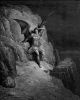
In the foreground knelt a dark, unclear figure of a man—a man who seemed to be wrapped in night, with twisted wings folded under the shape which Gavin assumed to be a cloak. He stood upon the rooftop of a monolithically huge tower and gazed across the fiery sky to another tower, one which seemed to be a twisted caricature of the former. Hanging in the sky was a burning orange sunset, casting a fiery glow upon everything in the portrait save the man wrapped in night. It pulled at Gavin’s mind, somehow—like a far-off memory or a distant dream, a distant nightmare.
The laugh and wail of the statues around him suddenly stopped, and the air seemed to hold its breath. Gavin felt a chill that was half exultation and half terror, and in front of him, the picture seemed to move.
Slowly, deliberately, the night-clad man turned.
Exultation filled his body—exultation in terror. As the dark figure began to turn, Gavin somehow knew what was to come: he knew that the sight would drive him mad, shatter his mind—but all the same he wanted to see it, to embrace it.
To embrace ultimate insanity.
As the night-clad man neared the completion of his rotation, the world seemed to come apart in pieces around him, and Gavin’s mind imploded.
He fell before he could see the face.


 This is not a pile of garbage. I thoroughly enjoyed this; your style is very beautiful, but in a very haunting way. Nicely done here.