

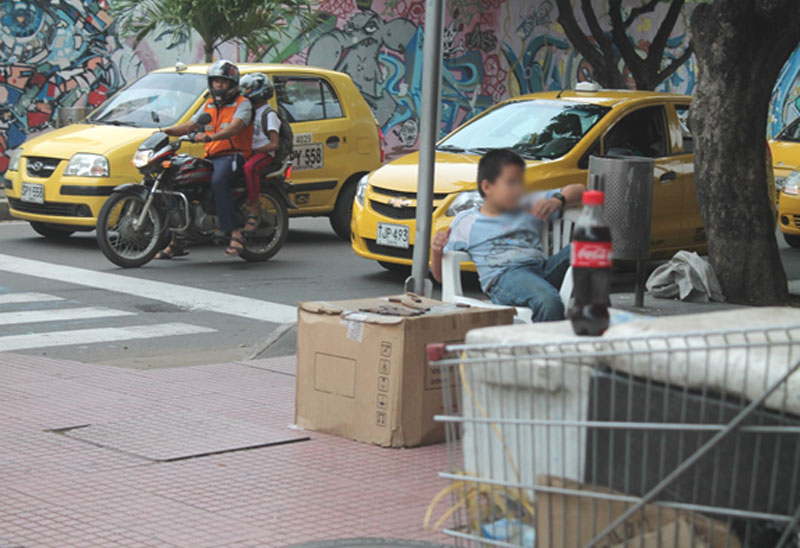
Child labour, photo by Natalia Meza, in San josé de Cúcuta, Colombia.
Once, the well-known Argentinian singer Mercedes Sosa said in one of her songs “At exactly this time, there is a child on the street…” And she was not wrong when she described this reality in her lyrics, along with Calle 13, a rock band from Puerto Rico; there are currently approximately 150 million children on the street.
“It´s the honour of man to protect what grows,
To make sure that there is no childhood spent on the streets,
To prevent their heart ships from sinking…”
In the same way, René Pérez Joglas, composer, resident rapper of Calle 13, described the reality of many children:
Everything toxic in my country enters my nose,
I wash cars, I clean shoes,
I smell of glue and I smell of crack…”
Humanium, international child sponsorship NGO, reveals that there are approximately 250 million children working worldwide.
Child labour, according to ILO (International Labour Organisation) is defined as that which deprives children of their childhood, potential and dignity, and is detrimental to their physical and psychological development.
So, why are there more and more children working?
The main cause is the economic situation of their family, which forces the children to work to survive, deprives them of their rights, of studying, enjoying their childhood and playing.
However, jobs such as helping their parents at home and working in a family business are not considered dangerous. Provided that they do not interfere with their studies, these are considered beneficial for their development.
The ILO´s report “Measuring the progress in the fight against child labour, estimations and world tendencies between 2000 and 2012” highlighted that minors that carry out dangerous jobs that put their health, safety and morality at risk, represent almost half of all working children, which in absolute terms amounts to 85 million.
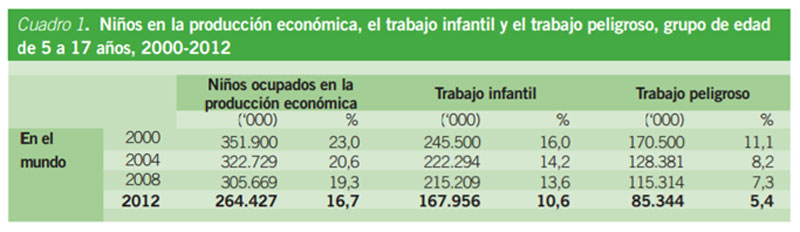 Chart taken from ILO report “Measuring the progress in the fight against
child labour, estimations and world tendencies between 2000 and 2012”
Chart taken from ILO report “Measuring the progress in the fight against
child labour, estimations and world tendencies between 2000 and 2012”
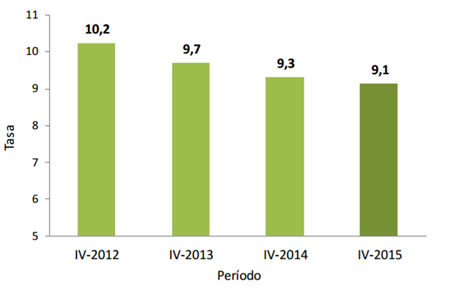
Graph taken from DANE (National Administrative Department of Statistics) Technical Bulletin, 2016
Now, the outlook in Colombia. The DANE Technical Bulletin, 2016, shows that 9.1% of minors are affected by child labour.
This also depends on age, it was recorded that children between 15 and 17 years old are affected more, with a rate of 24.4%, compared to the rate for 5 to 14 year olds of 4.6%.
In 2009 DANE ranked the capital of the department of Norte de Santander in sixth place in terms of child labour, with a rate of 6.5%, above Medellin (6.3%) and Pasto (5.3%).
What jobs are most common among minors?
Agriculture, one of the most physically demanding jobs for any human being, sadly is the most common among underage workers (37.3% of all child labour), followed by retail (30.5%); industry (13.6%); services (7.8%); transport, storage, communication (6.9%); construction (2.1%); real estate (1.2%) and mining (0.5%).
In general, these statistics are necessary to demonstrate the reality that children have to face. Even so, percentages don’t show the severity of the problem, for example 0.5% of children work in mines, meaning that 5,250 Colombian children risk their lives on a daily basis.
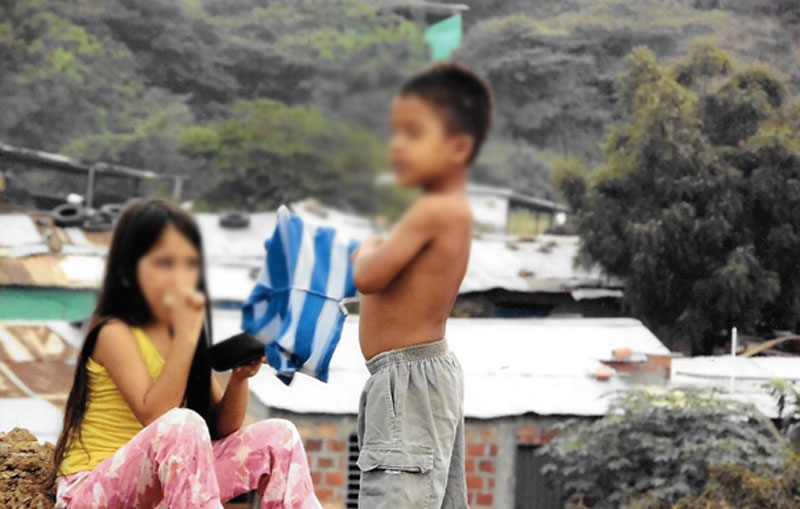
Child labour, photo by Natalia Meza, in San josé de Cúcuta, Colombia.
Ana Karina Álvarez, Simon Bolivar University psychology student, agrees that child labour affects cognitive and emotional development, given that children are forced to abandon activities appropriate for their age, such as playing with their peers and learning, furthermore it’s possible that they will have problems when it comes to establishing interpersonal relationships.
In the long term, this implies an increase in the levels of poverty and violence, as well as mental and physical illnesses, all of which cause negative effects at the socioeconomic and cultural level.
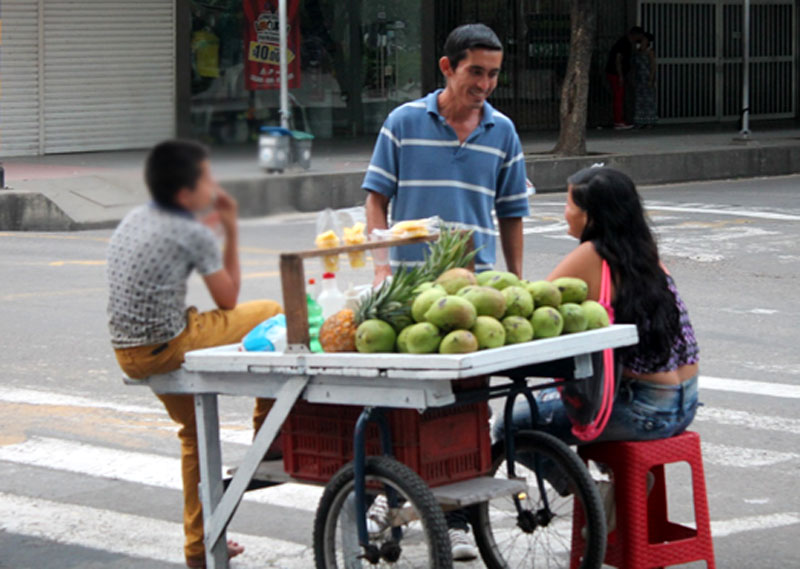
Child labour, photo by Natalia Meza, in San josé de Cúcuta, Colombia.
What about cases of adolescents between 15 and 17 years old that work willingly and with the permission of their parents?
The Code of Infancy and Adolescence establishes that their working week cannot exceed 14 hours, and they can count on legal authorisation and the protection of labour laws (Article 35 of The Code of Infancy and Adolescence) World Vision, Code of Infancy 2011.
Moreover, the ICBF (Colombian Institute of Family Wellbeing) developed the application “I am here” so that people can help to combat child labour from their mobile phones.
Do you often see children working in your neighbourhood or on the streets? At times that they should be in school? You can report this, just download the app and enter your details and the location of the child. For more information go to www.yodigoaquiestoy.com.
The Colombian folk pop band Morat, in one of their songs, talk about child labour:
“To learn to love you
I’m going to study how to make your dreams come true…
Give you a life with more pluses than minuses
If you let me there will be no questions, only answers”
It’s for this reason that I invite you to study the dreams of children, and give them more pluses than minuses in their lives, so that they can spend more time in education than on the street.
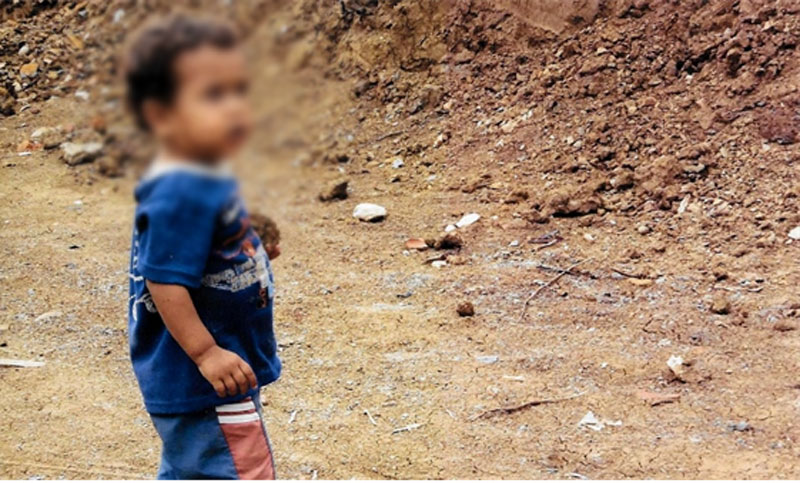 Child labour, photo by Natalia Meza, in San josé de Cúcuta, Colombia.
Points:
Time spent:
Canary word: Present
Possible AI signals:
Original Text:
Are you sure you want to delete this comment? This cannot be undone.
Mark this comment as a review? Points will be awarded to the poster.
Your comment was posted, but it wasn’t long enough to count as a review. Reviews need about four complete sentences (at least 250 characters). Try writing another review that explains your thoughts in more detail — the author will appreciate it, and you’ll earn points for it.
125,018 Literary Works • 672,857 Reviews


Hi there!
Okay, so you've got a lot of good statistics here about child labor. I like that you also point out that the stats don't necessarily show the extent and danger of child labor. Like how "0.5% of child workers work in mines" doesn't pack the same punch as "5,250 Colombian children risk their lives on a daily basis."
However! Two points.
1. I think you need to up the ante a bit. Yes, there are lots of child workers, and that's bad. But you keep mentioning that it's bad because of mental/physical health issues and an inability for children to develop as they should. That's fine and well, but you don't give specific examples of these things or how this will affect the children as they age/society. Show readers the cycle of poverty and violence! Paint a picture of a future full of adults who have labored hard since they were children. Perhaps there are some statistics you could tie in that predict future poverty rates?
2. I also think you need to provide more information about what someone reading this article could do to help, assuming that's sort of your purpose - to inform people of this problem in the hopes we can end child labor. But so far we have "you can contact child services using this app." That's only one potential solution and, I'm afraid, neither one that's far-reaching nor one that addresses the issues at the core of child labor. Earlier in the article, you tell us that child labor is often the result of the child's family needing more money than the parents can make. In that case, poverty is a major player in child labor. Rather than simply plucking these children from the work force and putting them into school when their family can't afford that, we need to address the root causes of child labor! What are they, and how can we start doing that?
Hey there. Aleta here for a brief review. The article was in depth and informative, and it made me feel bad about the luxury we have here in comparison to working children somewhere else. The images definitely provoke more emotion besides the facts and statistics. However, you don't need the pictures that don't show the children working. Some of them don't even clearly show that the child is working, but just show a sad picture of a child and it's pushing an appeal to pity. Only one or two pictures will be enough to emphasize that these children aren't happy about this and it is a pressing issue.
Overall, you have plenty of statistics and proof for the prevalence of child labor, which was well researched. The one thing that your essay is msising is an explanation for how these statistics help your point. Your essay should be built off of these statistics. You've laid the foundation for your essay, but you're missing any sort of structure and then the finishing touches. Looking forward to seeing when that building is raised, because your house is in an interesting location (interesting topic) and the foundation is solid. Definitely will check out an edited version of this essay. Keep writing!
Hey there natalia,
So when you say children, are you referring to children all over the world or just children from Columbia? I would recommend clarifying that.I gotta say, I felt a little guilty while reading this essay. Here I am, listening to my music and sitting in a comfortable swivel chair while browsing the Internet and reading an essay, while there are millions of kids my age or younger who are out risking their lives. But it was a very well-argued case, with just a few things I wanted to point out.
1) You don't need that many quotes from famous singers. One will be plenty to demosntrate that celebrities are aware of the problem and are working to combat it, and the main point of your essay is not to prove that celebrities are or are not aware of this problem.
2)What argument are you making? Here, we see that you clearly point to statistics that show that child labor is a real problem. But we never see your proposed solution, and we don't see what you're arguing for. Are you saying that child labor is awful, that child labor is increasing, that child labor is common, what? You need to clearly state what you're arguing for in an essay.
3) Follow up question: You need a thesis. Right now we just have a list of statistics that prove that child labor is, sadly, very common. But you never have a sentence near the beginning that says "Although child labor is very common, you can do xyz to help prevent it." or something like that. That is something necessary in a good argumentative essay.
4)
5) If you're going to mention this, I would explain this more. I still don't fully understand how this helps. That needs to be further established to be a point that you make.
6) On a more general note, this so far is just a list of statistics. You don't have enough writing where you explain why these statistics help you to argue your point. You've clearly emphasized that child labor is prevalent and a real problem, but you never explain how to solve that problem.
6) You don't need all those pictures. Some of them don't even clearly show that the child is working, but just show a sad picture of a child and it's pushing an appeal to pity. Only one or two pictures will be enough to emphasize that these children aren't happy about this and it is a pressing issue.
Overall, you have plenty of statistics and proof for the prevalence of child labor, which was well researched. The one thing that your essay is msising is an explanation for how these statistics help your point. Your essay should be built off of these statistics. You've laid the foundation for your essay, but you're missing any sort of structure and then the finishing touches. Looking forward to seeing when that building is raised, because your house is in an interesting location (interesting topic) and the foundation is solid. Definitely will check out an edited version of this essay. Keep writing!
Best wishes,
MJ