
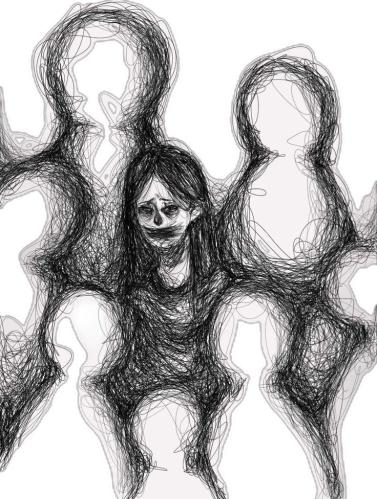
I used to look in the mirror
and see a person
now i see something else
The eyes are the same
but there's something behind them,
something darker,
something I don’t want to name.
The mouth is the same
,but the words that come out
don’t sound like mine anymore.
The hands are the same
,but they’ve done things
I can’t take back.
I stare at myself
until the edges blur,
until I can’t tell where I end
and the monster begins.
They called me a monster,
and I thought they were wrong.
But now,
I’m not so sure.
The mirror doesn’t lie.
And it’s been telling me the same story
for years.
Points:
Time spent:
IP address:
Canary word: Present
Possible AI signals:
Original Text:
Are you sure you want to delete this comment? This cannot be undone.
Mark this comment as a review? Points will be awarded to the poster.
Your comment was posted, but it wasn’t long enough to count as a review. Reviews need about four complete sentences (at least 250 characters). Try writing another review that explains your thoughts in more detail — the author will appreciate it, and you’ll earn points for it.
142,058 Literary Works • 676,507 Reviews



hey! i love this poem so much it reminds me of like, Frankenstein in a weird way.
  I wanna see more of your writing!
i really like the imagery in this poem, "until I can’t tell where I end and the monster begins" is such a cool sentence. i wonder what the narrator has done to view themself as a monster, I think a part 2 would be really cool to go into that backstory. overall, this is a really neat poem. keep up the good work
Hey! I like this poem. It reminds me of something my brother and I did once. We had heard from some talk show that if you stare at somebody's face for a while in a dimly lit room, and don't blink, you can actually see their face morph and their features shift. We each watched each other 'turn into a monster,' so to speak. It was actually quite alarming.
I don't recommend trying that. But the memory made me chuckle as I read your poem.
One thing I thought was interesting was the lines:
"They called me a monster,
and I thought they were wrong.
But now,
I'm not so sure."
This highlights an issue with identity. The subject claims that the mirror has "been telling me the same story for years." And yet their perception has just now changed, due to what others think? That makes this a sad poem to me. And yet so true for so many people.
As for grammar, I won't be exhaustive. The previous commented did a good job on that. But I will agree that exploring additional punctuation could prove to be effective to your writing, and I noticed your second "I" was not capitalized!
Thanks for sharing. Keep writing!
Hi there - Lim here with a review!
This poem seems to depict the speaker’s change in their view of themselves. I read it as having a slow methodical pace, with each line revealing a part of a story that has been going on for “years”, as the last line emphasises. So it comes across as a slow realisation rather than a quick one. It seems to me that the speaker may not have been a “monster” initially, but did things over time that made that description seem more fitting.
I thought these lines were interesting in the wider context of the poem because the speaker seems to struggle between seeing themself AS the monster or seeing themself as separate from the monster but having been replaced by it, if that makes sense.
The cover image definitely spooked me. It’s very striking to see all these human-shaped figures surrounding the one figure drawn in with detail. It seems to suggest that this monster-like quality makes the speaker different from ‘everyone else’. This, together with reading the poem, seems to portray bad deeds within the context of an individual person and what choices they have made, as opposed to, for example, discussing them as the product of a society or social ills. Was this what you were going for when you chose this cover image?
Something I like about your writing here is how you position line breaks. It feels like each line adds something to the story of the poem,and the points at which you choose to start a new line emphasise those elements, such as in:
The first line emphasises that it’s not a physical change, then the second line focuses on actions the speaker did, followed by the third line that foregrounds the regret - which implies those were bad, morally wrong actions.
Similarly I like how end/begins is the last word in each of these lines. I tend to pay attention to the last word of a line, so to me this really ties together the idea conveyed that the speaker and the “monster” are blurring together.
Something you might want to think about is how you use punctuation. I found that I could get the idea of the rhythm/ poem shape you were going for but felt a bit distracted when the punctuation didn’t match up to that, for example when there was no period/ full stop to end the first stanza (even though the next line then began with a capital letter). Speaking of stanzas, it might also be helpful to have a space between them, for example:
You can do that more easily in the Publishing Center if you enable Classic editor when uploading poetry c: Sometimes having no space between stanzas can be a stylistic choice, maybe to convey that the speaker’s headspace is really cluttered, but it’s good to know you have options on that.
Something I find striking about the poem is that the speaker initially “thought they were wrong” about the speaker being a monster but gradually came to agree. I feel like that’s kind of an unusual story to tell - I haven’t seen it in other poems, at least, so it feels original and interesting to me.
Overall, I enjoyed reading this poem. While the idea of seeing a “monster in the mirror” is a popular trope, I think you gave a unique take by focusing on the speaker’s self-refection (no pun intended) and their introspection on who they have become as a person, and their realisation that they don’t like the new them. Something you might want to think about in future writing is whether the punctuation is adding to the meaning of the poem or otherwise helping to organise it the way you want (the same way your line breaks in the poem do).
Let me know if you have any questions about this review - and keep writing!
-Lim