
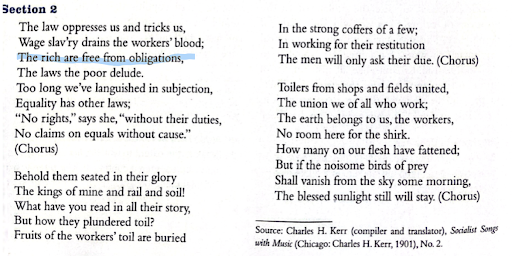
The socialists in the 19th and 20th century challenged the industrial capitalism by providing critical analyses and critiques about the problems that were present due to the industrial capitalism. One way the socialists presented the problem with the industrial capitalism was through paintings. In the painting “A Pyramid of Capitalist Society,” the working class is shown at the bottom, they are holding up all the weight of the upper class symbolizing the hard work they do for the upper class. They present this problem by making the working class the biggest layer that sits on the bottom of the pyramid that holds all the weight of the others. No matter how much they work, it exemplifies how the working class will always be at the bottom. Another way that the socialists challenged the industrial capitalism was by making songs that they sung while going on strikes. In the “Socialists Song with Music,” the writer uses phrases describing the bad condition of the working class. They do this to have their voices heard by more people. The problem that they have with the industrial capitalism is how “the rich are free from obligation,” and how the “law oppresses us and tricks us” (Kerr 1-3). The working class is represented through the voices of the writer of the songs and is presented to a wide variety of people. The criticism on the law and the rich getting richer show how the industrial capitalism was challenged through the socialists in the 19th and 20th century. The songs and the paintings created by the socialists were how they critiqued the industrial capitalism.
Points:
Time spent:
IP address:
Canary word: Present
Possible AI signals:
Original Text:
Are you sure you want to delete this comment? This cannot be undone.
Mark this comment as a review? Points will be awarded to the poster.
Your comment was posted, but it wasn’t long enough to count as a review. Reviews need about four complete sentences (at least 250 characters). Try writing another review that explains your thoughts in more detail — the author will appreciate it, and you’ll earn points for it.
141,457 Literary Works • 674,477 Reviews



I don't want to be sharp, perhaps this is just an informative essay, but what's the point? There does not appear to be any conclusion to this piece, and I think it may serve you very well if you have a purpose for this piece. If it is in fact just an informative essay than it's fine, leave it how it is. I had drilled into me the persuasive essay when I was younger, and so I look for the point in any piece. Thank you for the information, it is interesting the use of popular media to communicate political ideologies.
Hi hi!
I've taken a few classes where we talked about this! I'm not at all an expert, but I'd like to think I know what I'm talking about! But still, I had to preface...
This is a solid foundation! There are many ways to critique industrial capitalism, and you covered that here! Painting and music for example, as you mentioned. I wish you had went in depth though. Art was a huge medium for socialists back in the day, but you barely elaborated on why and how! That's the whole point!
I also think that you could improve the transition between examples. Each example should smoothly lead to the next! You write very well, but it doesn't feel concise. It feels like you're making a list instead of an article. There's a central theme, but I can barely put my finger on it, without previous knowledge!
The other reviewer is correct about explaining what socialism is, too. I would also like to see a definition of capitalism. If you are going to use a word, describe its meaning!
But overall, this felt like a good start! :> I think there's room for improvement with clarity and consistency, but you know what you're writing about! If you added just a little more content, this would be gold. The argument right now isn't the most compelling, but it can be. Again, it's a great foundation!
~ Seoyoung
Short but pretty good.
As an essay, it checks most of the boxes in the 'fundaments' category, which is really all you need and I appreciate that. It gets straight to the point, defines its goals and contention, gives the information in a very digestable way, then concludes. Its simple yet informative, which is great. My only issue is with the title, which is such an incredibly broad topic, yet the essay only touches on how the socialists criticized the capitalist functions of society during the 19th and 20th century. What could have included and what I would love to know is: how did the capitalist side of the debate respond? and what was the discussion like during that time period? Some inclusion of certain large events would have been excellent, such as any important legal decision or changes that provoked the socialists, perhaps. Some dates included could have also been nice.
Aside from that, the topic could also be expanded upon, maybe in future essays or extentions to this one, that could discussion aspects of socialism that were outside of the goal of this piece. Maybe you could have other paragraphs talking about things like how socialism evolved over this time period; the different perspectives of socialism; how capitalism responded to the socialist opposition; and the different countries that took on socialism and the ones that rejected it. These are just examples, and so many more could been included.
Another thing to address is the introduction; what on earth is socialism about? I know its in opposition to capitalism, but how? and what does the ideal socialist society look like and function? and who thought of it and when? A clearer definition of what socialism is and its relationship to capitalism would've been very helpful, as, after all, not everyone is going to know about it.
Thats the end of my criticisms, although the final nit-pick is a request for images of the capitalism-pyramid. Also watch out for confusing grammatical syntax in the sentence "No matter how much they work, it exemplifies how the working class will always be at the bottom." I love this sentence, and its super impactful with "no matter how hard they worked,", but it is a little confusing.
The 'they' is clearly the sentance's subject and 'work' is the object, yet the next clause begins with 'it', now referring to the painting, not the workers ('they'). To me atleast, the 'it' came across as referring to the 'work'. A clearer wording would be: 'No matter how hard they work, the working class will always be at the bottom, which is represented in the painting.' Or, what I think is more impactful, 'The painting demonstrated that the working class will always be at the bottom, no matter how hard they worked.'
Overall, its pretty good. It's straightforward and accessible information, which is an excellent quality that a lot of good expository writing should have.
Anyways, if none of this you care about, awesome; if you take something from this, awesome.