
Published October 13, 2026

What if an ancient legend didn't remain trapped in the pages of a book, but came alive every year under a thousand glowing lights?
In India, there is a time when the nights seem to hold stories of their own. Drums echo through the streets, lamps flicker in the darkness, and millions of people celebrate battles born from ancient mythology.
It is called Navaratri — “nine nights” in Sanskrit, an ancient Indian language. But why nine nights? And what makes the tenth day so special?
According to Hindu mythology, a powerful demon named Mahishasura had become so formidable that even the gods struggled to defeat him. From their combined divine powers emerged Goddess Durga, a fierce and radiant embodiment of feminine strength. Riding a lion, she fought Mahishasura in a legendary battle that came to symbolise the triumph of good over evil. Her victory is celebrated during Navaratri in many parts of India.
For nine nights, devotees honour the goddess through prayers, music, fasting, and dance. In Gujarat, colourful crowds perform Garba, a traditional dance in which people move in circles to rhythmic music. In other regions, magnificent displays honour Goddess Durga, while families gather to celebrate cherished traditions passed down through generations.
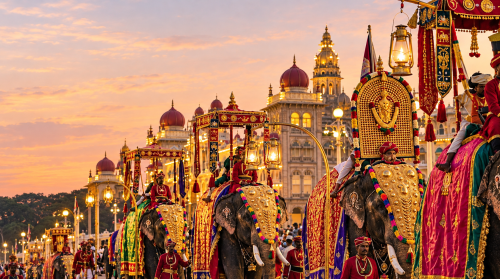
Then comes Dussehra, also known as Vijayadashami, meaning “the tenth day of victory.” In Mysuru, a historic city in southern India, the royal palace glows with thousands of lights as a grand procession winds through the streets. Elsewhere, towering effigies of Ravana, the ten-headed king from the ancient epic Ramayana, are set ablaze to celebrate his defeat by Prince Rama.
Two legendary battles. Different traditions. One enduring message.
Perhaps the most fascinating part of these celebrations is that the real battlefield is not found only in ancient legends. It exists within us, too — where courage must face fear, kindness must overcome cruelty, and truth must stand against deception.
And so, every year, when the drums begin to beat and the night sky glows, India does more than remember its ancient stories. It brings them to life.
Perhaps that is the mystery of these nine nights: the gods may belong to mythology, but the battle between good and evil is a story every human being knows.
And another beautiful tradition of India is .....
During this festive season, many people observe a tradition called Ayudha Puja, in which they honour the tools of their work — from books and musical instruments to farming equipment and machinery.
Imagine celebrating not only gods and ancient victories, but also the very tools that help you learn, create, and build your future.
Perhaps that is beauty of India even an ordinary object can become extraordinary when we learn to see the meaning behind it.
Points:
Time spent:
IP address:
Canary word: Present
Possible AI signals:
Original Text:
Are you sure you want to delete this comment? This cannot be undone.
Mark this comment as a review? Points will be awarded to the poster.
Your comment was posted, but it wasn’t long enough to count as a review. Reviews need about four complete sentences (at least 250 characters). Try writing another review that explains your thoughts in more detail — the author will appreciate it, and you’ll earn points for it.
142,003 Literary Works • 676,297 Reviews



A well written and laid out feature.
As a reader who enjoys history and non-fiction, this was very enjoyable to read and is clearly well researched. It does the brilliant job of also bringing the story to life, telling us not just what the festival is about but how it feels to be part of it.
Overall very good, I would love to see the writer do more of these covering more hindu festivals.