


Warning: This work has been rated 16+ for violence and mature content.
(The first chapter of my book, taking place in late 1940's Georgia. Arthur Collins, after suffering a life-altering injury just before the end of the war, is brought back home and is now a shell of what he once was; disabled and viciously depressed. His mother is overwhelmingly desperate for her boy to be happy again, and his father can't even face him. However, everything changes once a new family moves into the empty house across the street; a mother and father, with a beautiful daughter he couldn't stray his eyes from. Arthur's quiet solitude outside is now replaced with a picture perfect family across the street, haunting his every escape out of the home. And if his mother had anything to do with it...They wouldn't be strangers for very long.)
Chapter 1
Death could have been a better fate than this.
Those very words haunted his thoughts within every passing second. He could have died with honor, could have kept his dignity. But, God had decided it was not his time. So, instead, he found himself sitting on his bed, aimlessly flipping through channels on the television; a daily activity. The light that once filled those young, innocent eyes had long dimmed, and now adorned a chiseled, hardened face scarred by the terrible product of the war. He realized with a bitter twist of his gut that the last time he’d actually felt like a man—the last time he’d smiled—was in a dusty olive uniform three thousand miles away. Before the accident. What he considered the end of his life.
Now, what had remained, was only the shell of what he once had been.
Getting out of bed was a struggle. It felt like fire seared through his leg every time he tried to stand. It stung, it ached; a pain that tore through him with every attempt to move. When he had the energy, it was like going to battle with himself, destined to lose every single time.
That leg of his was nothing but a heavy sandbag filled with terribly sharp needles. It took all the strength he had left just to drag it across his room.
Click
Click
Click
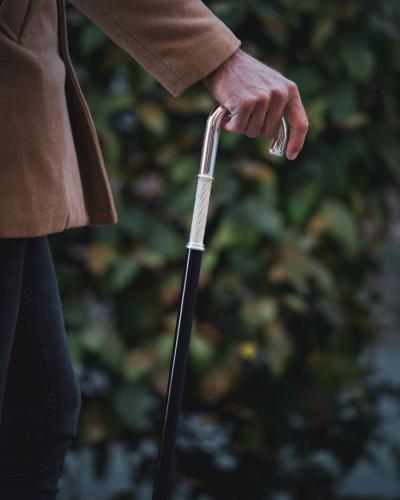
The soft sound of wood against a carpeted floor. He was 23 years old, and he could not walk without a cane. By his bed there remained a wheelchair, practically brand new, hardly ever used. It haunted him every time he’d gaze upon it, but he’d never dare to prove his own weakness by using it.
The mirror in his room was covered, although the bathroom mirror he was now approaching was the last man standing. The only thing worse than getting injured on the battlefield was looking at himself in the mirror.
He heaved, his weight leaned against his cane as those dark eyes of his finally faced himself in the mirror. He was disheveled. His hair was a mess, his face scarred and scruffy, eyes surrounded by dark circles. Despite hardly ever leaving his bed, he looked exhausted. The man he faced in the mirror was not one that he recognized. There once used to be a happy, athletic young man with all the promise and charm in the world in that mirror. Now all that was left was a body without a soul. And it tore him apart every time he faced it.
“Arthur Collins, is that you?” The voice of his mother echoed through the hallway, summoned by the clicking of his cane. She was utterly joyous every time he got out of bed, every attempt at normality giving her hope that her son was coming back to her even when he was always just upstairs.
There was no response, of course. Arthur did not talk, not a lot. Even using his voice was using energy he no longer had.
“Look at you! My darling boy.” Adaline Collins proudly looked upon him as if he had achieved an amazing feat just by getting out of bed. He hated it. “What’s gotten you all out and about this mornin’?”
Arthur clenched his jaw, straightening himself as he remained before his bathroom counter. “I’m dirty.” A deep, emotionless voice finally replied; scratchy and unused, enveloped by hints of Southern twang.
“How ‘bout I run you a bath, then–” Adaline already started walking over to the bath, excited that her beloved son was even just up and putting effort into himself.
“Ma.” Arthur quickly intervened, a hand raised. “I don’t need no help.” Slowly, he limped over to the bath.
Click
Click
“You don’t need to be putting so much weight on that leg of yours–”
“I said,” Just the mere mention of his leg made the ever-burning fire within him rage. “I don't need no help, Ma.” Arthur slowly lowered himself to reach the bathtub faucet, gritting his teeth.
Adaline bit her tongue, the frown beneath her happy facade slowly making itself known. Arthur absolutely refused any help from anybody. She could not help him, but that also didn’t mean that she would stop trying.
“Why don’t I set some clothes out for you?” She suggested warily, watching as he managed to turn the faucet, slumping over as he sat upon the side of the bath to catch his breath.
"I'm a grown man. I can get my own damn clothes.” He huffed. “Now, go on. Please. I’m filthy.” He would go days on without bathing, not getting out of that bed. Not taking care of himself. It was almost embarrassing to even think he was cleaner in the muddy trenches than he was now. Constantly laying in his own sweat and grime, marinating in his own filth while he melts his brain away, bitterly watching people on tv live the life he couldn’t.
Adaline sighed, a familiar look of worry washing over her features. He couldn’t understand why she was trying to be so positive all the time. He was nothing but a cripple who weighed her down every moment she dared to have hope for him in her eyes.
“Ma?” Arthur impatiently raised his eyebrows, his head motioning towards the door as he began to undo his belt.
“Well,” Adaline, defeated, brushed off her apron. “I’ll be downstairs. Got breakfast cookin’. Take your time, darling.” She gave one last smile before she quickly left the bathroom, the door closing behind her.
A sigh escaped his lips. He shook his head. Arthur knew better than to treat his beloved mother so coldly, though her worries for him made him feel weak. And Arthur Collins was no weak man.
As his clothes slowly dropped to the floor, his jaw clenched as he dared to face the mangled mess of scars that covered his right leg. Beneath the thin, translucent skin of his shin, there was a strange, bruised hue that never faded. It wasn't a natural color of the body; it was a dark, slate-grey tint—the dust of a German forest and the soot of a cold explosion—ground so deep into his tissue that it had become a permanent part of his American anatomy.
In the center of the largest craters, he could see the dark, blue-black specks of German steel. They looked like stubborn ink stains or heavy buckshot trapped under glass. Sometimes, when the weather turned cold, he could feel those tiny shards of metal hum with a different kind of ache, as if the iron was still trying to find its way back to the earth.
He ran a calloused thumb over a small, hard lump near his ankle. It was a jagged, blue-gray speck no bigger than a grain of rice, but it felt like a mountain under his skin. It was a souvenir he never asked for; a piece of the war that refused to be discharged.
The water, as it submerged him, brought temporary relief to the weight that his leg was, though he could never hold back the cringe on his face as the heat met with his sensitive skin. How pathetic he felt knowing that even bathing himself was a struggle, but he’d rather suffer than accept help. And he’d rather die than ask for it.
The steam that had masked the bathroom mirror began to thin, and the water, once a scalding sanctuary, was turning lukewarm. As the drain gurgled, the buoyancy vanished, and the sandbag returned with a vengeance. The weightlessness was a cruel lie.
Arthur’s knuckles turned white as he gripped the high porcelain rim, his left leg shaking under the strain of hoisting his mangled half into the air. It was a slow, mechanical victory. When he reached for his towel, he didn’t rub it over his right leg. He patted it, wary of the mountain beneath his skin. Every pass of the cloth was a reminder of the German steel that now called his body home.
Heavy, wet feet slapped against the porcelain tile of the floor followed by the heaving of his breaths as he sat on the edge of the tub. Getting out was only half the battle.
Click
Click
Click
Admittedly, soaking his mangled leg in the heat of the water relieved him from some of the pressure, but it was all too temporary. The cane that held him upright pressed hardly against the floor with each limp he made to get across his bedroom, his breath trembling with every effort.
Dressing himself was another exhausting victory. By the time he forced his stiffened limbs into a clean pair of trousers, he was already spent. When he reached into the back of the closet for a clean shirt, his hand brushed against something heavy and coarse. He paused, his fingers curling around thick wool and smooth leather. With a sharp tug that nearly cost him his balance, he pulled the object into the dim light of the bedroom.
It was his high school letterman jacket. The deep navy wool was pristine, the leather sleeves still supple, and the large, gold ‘C’ for Collins sat proudly over the heart. In 1941, this jacket had been his armor. He remembered the weight of it—not the dead weight of a useless, mangled limb, but the glorious weight of a boy who could run a forty-yard dash in four-point-five seconds; the local star who had the world at his feet before he’d ever set foot in a uniform.
Arthur held the jacket up against himself, leaning heavily on his cane with the other hand. The contrast was sickening. The jacket was built for a chest that didn't heave with exhaustion after a bath, and for shoulders that hadn't slumped under the invisible weight of a war.
As he shifted his weight, his right leg buckled slightly. He looked down at the jacket, then at his leg, realizing that the athletic young man who wore that special gold embroidery was more than just three years gone—he was a different species entirely. The jacket was a relic of a boy who had died in a forest in Germany, even if his heart was still beating in Georgia.
“Breakfast is ready!” The eager tone of his mothers voice echoing from downstairs broke him from his train of thought.
With a bitter grimace, he shoved the jacket back into the dark corner of the closet. It didn't belong in this room anymore. It was just more static, more noise from a life he no longer had.
He straightened his shirt with trembling fingers, and turned toward the door.
Click
Click
Click
The sound of his cane was a somber metronome against the hallway floorboards. Like the steel embedded within him, the clicking was inescapable; a part of him that haunted his every move. The familiar aroma of bacon grease and rich coffee brushed against him as he reached the top of the stairs. To anyone else, it was the smell of home; to Arthur Collins, it was the smell of a life he no longer knew.
He descended one step at a time, a jarring rhythm of wood and bone. When he reached the kitchen doorway, the steam from the stove swirled around his mother like a halo, a soft tune playing on the radio. Adaline turned, her face lighting up with that fragile, desperate joy he had come to dread.
“There he is! Clean as a whistle and just in time,” she chirped, her hands fluttering as she set a porcelain plate of eggs and fresh-sizzling bacon on the table. “Go on, sit down. I’ve got the coffee just the way you like it.”
Arthur slowly sank into the wooden chair, the movement sending a fresh spike of fire from his ankle to his hip. He forced his jaw to unclench. He could feel her eyes scanning him, searching for a glimmer of the boy who used to bolt down these stairs three at a time, an eager smile on his face.
“Smells good, Ma.” Arthur said once he caught his breath. His voice was a dry rasp, but he forced a small, tight nod.
He picked up the silver fork before him, hand steadying only through the sheer force of will. He chewed the eggs, but to him, they tasted like nothing. Across from him, Adaline was talking—something about neighbors, the heat wave, the price of milk—filling the heavy silence with a frantic tapestry of normalcy. Arthur nodded at the right intervals, a ghost of himself.
The effort of holding his back straight, of keeping the grimace off his face, and of pretending to listen was more exhausting than the climb down the stairs. By the time he pushed his half-finished plate away, a cold sweat had broken out across his brow. He had given her ten minutes of "Arthur Collins, the survivor." He didn't have an eleventh minute left in him.
“I’m gonna go sit on the porch,” He muttered, grabbing his cane.
“But you hardly ate a thing!” Adaline started to rise, the worry lines returning to her forehead like ink bleeding through paper.
“I’m full, Ma. Just need some air.” He didn't wait for her response, holding up a hand to halt her before he shakily arose from his chair and limped his way out the door.
Click
Click
Click.
When Arthur had the energy, he would almost always find himself sitting outside. In the lovely suburban southern home he lived within, there sat two rocking chairs on the front porch. He always sat on the one on the right. Something about that spot had the sun sitting his person just right with a perfect breeze that brushed against his abused skin so gently. In the distance, he heard the sounds of children playing in a yard a few houses down, the scent of freshly cut grass following. Just getting to sit back and breathe in the fresh air and feel that sunlight was more refreshing than any bath he could ever soak in.
Across their lovely suburban home was another. The elderly couple that once lived there during his youth had been long gone, their absence established with a ‘for sale’ sign that sat right in the front of the yard for several years. The sign always faced him when he sat in his chair; bringing him back to a time long lost, but today– it was gone. It was only yet another forgotten relic.
The suburban quiet was broken by the low, steady rumble of an engine turning onto their street. A moment later, his father’s car turned into the driveway, its black paint dusty from the commute and the chrome bumpers glinting dully in the morning sun. It was a sturdy, sensible machine, built with the rounded, heavy curves of the years just before the war—a reliable relic that had survived the gas rations and the rubber shortages right alongside the family.
As the ignition cut out, the car gave a final, shuddering vibration before falling silent. The heavy door opened with a metallic groan and closed with a solid, echoing thud that seemed to vibrate through the porch floorboards and into Arthur's good leg. He watched from his shadow on the porch as the familiar silhouette of his father emerged, pausing for a moment to straighten his hat and pull his briefcase from the bench seat, his movements slow and practiced in the humid Georgia heat.
Arthur straightened in his chair– as much as he could. His father’s presence made him stiffen as he slowly approached. The older man glanced over at his boy, standing on two functioning legs adorned by neatly-ironed dress pants, fit for the perfect office job. He had worked overnight so he could come home early. Exhaustion was visible in his eyes.
“Boy,” Eugene Collins spoke out to him, a nod of acknowledgement following. “You’re out of bed.”
Arthur was tense, hands unconsciously gripping at the sides of the rocking chair. His relationship with his father was wary. He no longer knew where they stood since he came back home, and hadn’t for quite some time. His father hardly could ever bring himself to look at him anymore. He didn’t know if he was disgusted, or simply trying to mask the pain he felt seeing his son in such a state. Honestly, Arthur could not blame him for either reason.
“I wanted some air.” Arthur replied, taking in a breath.
“Your mother cooked you somethin’?” Eugene asked. His tone was unreadable, and so was his face. It always was. But maybe somewhere in those words, he showed concern.
Arthur nodded, humming. “A breakfast for five.” Adaline was once the mother of a promising athlete, and she still cooked like she was too. She had a habit of doing that, just so there would be enough for her and her husband.
Eugene, showing a hint of a smile, gave another nod. “As I thought.” And finally, he went on to the door. “You don’t stay out here too long, now.” He’d say before the door quickly closed behind him, leaving Arthur once again by himself. His father, once his best friend and biggest fan– could not even stand to be in his presence for more than a few minutes, couldn’t even look him in the eye. It hurt him more than any warzone ever could.
He released a breath he didn’t realize he had been holding, a hand stressfully running back his untrimmed brunette waves from his face. Just as Arthur began to settle into the familiar, bitter comfort of his own thoughts, a new sound disrupted the neighborhood’s rhythm—a heavy, discordant grinding of gears that didn't belong to the smooth-running sedans of the block.
A large moving van, its sides caked with the dust of a long journey and its engine let out a protesting hiss of steam, lurched to a halt directly across the street. It parked squarely in front of the house where the 'For Sale' sign had once stood. And only moments after; another car followed in from behind.
Arthur watched, his hand tightening on the head of his cane as his body tensed once more. This was a violation of his sanctuary. For years, that empty house had been a mirror of his own life: silent, abandoned, and static. Now, the back doors of the van swung open with a violent clang of iron, revealing the stacked skeletons of a new life—wooden crates, rolled rugs, and the sharp corners of a dining table wrapped in burlap.
Then, he saw them; the silhouette of feet stepping out of the vehicle, hidden behind the doors. With a heavy mechanical slam or two, out walked what looked like a picture perfect family; a mother, a father, and– a daughter.
She didn't move with the practiced, heavy exhaustion of the people in Arthur’s world. She moved with a terrifying amount of energy, shielding her eyes from the Georgia sun with a gloved hand as she looked up at the peeling paint of her new home. Behind her, an older man in a flat cap hopped down from the driver's seat, wiping his brow before leaning back into the van to haul out a heavy trunk.
She was young—perhaps his age, or a year or two younger. The parents seemed as old as his own, never ending smiles of pure joy and excitement on their faces. They were the kind of people who looked like they still believed in the "post-war dream" the radio was always selling.
Arthur didn't move. He sat deep in the shadows of his porch, a ghost watching the living. He felt a sudden, sharp pang of nakedness, as if the covered mirrors in his house were no longer enough to hide him. If any of them turned their heads just a fraction to the left, they would see him: the broken soldier in the rocking chair, a grim monument on an otherwise perfect street.
The older woman said something to her husband, a bright, melodic laugh carried across the pavement by the breeze. It was the first time Arthur had heard a laugh that wasn't filtered through a television speaker in months. It tasted like ash in his mouth.
He clenched his jaw in an outrage, eyebrows kitting as his hand gripped at his cane. His peaceful outing had come to an end, and he refused to be seen. Fire struck through his leg as he slowly got up, wincing as he stumbled on his first try standing straight. Arthur limped as quickly as he could back to the front door that now faced unfamiliar faces.
Behind him, the violent clang of the moving van’s doors echoed like a mortar blast, the vibration shivering through the porch boards and straight up into Arthur’s person. The sound didn't just reach his ears; it impaled him. His heart kicked against his ribs, and for a moment, peaceful Georgia vanished, replaced by the gray smoke of the front. He nearly buckled, his hand raising to his chest as he fought to pull air into his lungs. Across the street, the young woman’s head began to pivot—a slow-motion turn that threatened to catch him mid-collapse. Panic, sharp and cold, overrode the fire in his leg; he pivoted and scrambled back toward the door, fleeing into the dark of the house before any pair eyes could find the wreck of the man he was.
Points:
Time spent:
Canary word: Present
Possible AI signals:
Original Text:
Are you sure you want to delete this comment? This cannot be undone.
Mark this comment as a review? Points will be awarded to the poster.
Your comment was posted, but it wasn’t long enough to count as a review. Reviews need about four complete sentences (at least 250 characters). Try writing another review that explains your thoughts in more detail — the author will appreciate it, and you’ll earn points for it.
125,021 Literary Works • 672,739 Reviews



Hey there, the Rebel here as your Review Valentine!
To start off, let's talk about...
First Impressions: I was a bit confused when I read the opening, which I later realised was a summary so that's just bad on my part but I guess you could add a 'Summary' or TL;DR tag at the top, it's okay. But now that I come back to the 'summary' or 'tagline', I am a bit intrigued by the last line:
It makes me think that the rest of the book is going to be a slow-burn romance about Arthur and the neighbour-girl with the pacing you have set in the this chapter, which brings me to my next point.
Pacing: The pacing in this chapter is deliberately slow and tinged with the gravitas of an ex-soldier trying to wrestle with the grim reality of post-WWII USA. It is a slightly exhaustive read, filled with minute details and flashbacks, but to be honest, it really adds to the tone of the book for a pilot episode -- if you are planning to take it the way I think you are. All in all, the pacing is slow but acceptable. The protagonists were fleshed out and a hook was set decently well, which brings me to...
Characters: The character of Arthur Collins and Mr & Mrs Collins were fleshed out remarkably well. It isn't just told that Arthur is dealing with post-war blues and PTSD, it is shown -- which is another thing that you do well. The little flashbacks, the jacket, the descriptions of the injury, the onomatopoeia of his crutch, his thoughts and the state of his mind -- were handled very well. It is a highly realistic description of one recovering from debilitating injuries (there is one thing I need talk about the injury itself, later) and I really like the description of the wat he flinched due to the loud noise of the van that partially triggered his PTSD. His parents are shown to be very caring and loving, as well as concerned about Arthur and his mental state. His father is a bit reserved, and his mother is jolly on the outside but very concerned in the inside. I am very attached to the characters now -- that's not a good thing for me, but definitely a good thing for you. But, on the other hand, speaking of bad things...
Criticism: I am no professional medic or surgeon but I am pretty sure that an injury like that should leave Arthur without a leg.
Unless I am misinterpreting it, it seems like his right leg -- though mangled and filled with soot, shells and scars -- is still intact. If lodged in the skin, soot and shells would cause infections that would 100% spread to the entire leg if the damaged tiasue is not cut out or replaced. For 1940s, every military hospital would probably cut off the leg below the knee if the main injuries are below the knee or the entire leg itself if it's above. So, well, that's the only 'unrealistic' part of the chapter and it's just a misunderstanding of injuries -- so I wouldn't pay heed to it if you just make it so that his leg is missing from below his knee and get him a wooden/metal replacement.
Final Score: A solid 8/10 for a first chapter, just check into the injury to confirm and change it if I am right and it will be a 9/10. Thanks for sharing this! :p
Haha hi!! Thank you so much for your review! And sorry about my little summary in the opening%u2014 probably should have made that more clear that it was NOT an actual part in the story!
You would be right! This is a romance! This first chapter really tones in on his character and how miserable he is%u2014 but things begin to change once the neighbors move in. His mother will invite them for dinner and force him to basically interact with his daughter%u2014 but that%u2019s all chapter two! The story really is about the impact of war on young minds, overcoming trauma, and finding yourself again. There will be a romance%u2014 eventually!
As for the injury!! I do not specifically state what happened as I want him to eventually explain it later on, so I hint to it through details!! He survived a Bouncing Betty%u2014a German mine that jumps three feet into the air before spraying steel balls everywhere. His was a "dud" in a way; the propellant was faulty, so it only hopped about a foot off the ground. It shredded his lower leg instead of killing him. Being a star athlete and a big, strong guy with a big ego, he absolutely refused to sign the amputation papers. He fought the surgeons to keep it, and by some miracle, the shrapnel missed his main artery.
It was a total hollow victory, though. The soot and steel balls are permanently tattooed into his skin from the blast, and the nerve damage turned the leg into a "dead weight" he just has to drag around. He won the fight to keep his leg, but he still lost the life he used it for. So, there IS a reason for him still having it!! But I do absolutely appreciate your concern! I really had to write it out and make sure it made sense before I decided it to be that way. He%u2019d basically rather suffer through constant pain than make himself a %u2018cripple%u2019. It%u2019s all part of his character and broken pride that he%u2019s too stubborn to get over!
Thank you so much for reading! I%u2019d love to see what you think about the next chapter when I post it soon! Best wishes!
Hello there, human! I'm reviewing using the YWS S'more Method today!
Shalt we commence with the wretched S’more?
Top Graham Cracker - Arthur Collins is a disabled war vet who can’t even look at himself. He’s ashamed that he’s even alive at all and he doesn’t want anyone else to see him in the state that he is in.
Slightly Burnt Marshmallow - I have no recommendations to make as of right now, but if you would like to edit this, then you may.
Chocolate Bar - I love how you describe Arthur! He seems like he’s so deep in all the terrible things that happened to him (and I don’t blame him) that he can’t seem to find joy anywhere. I think my favorite scenes in this chapter are when Arthur doesn’t finish eating because he doesn’t have the energy to and when he desperately runs back to the house when he sees the family move in, because he doesn’t want to show himself to other people.
Closing Graham Cracker - Overall, a very compelling first chapter! I enjoyed reading this and I’m going to read all the other chapters that you posted. Maybe Arthur will be able to find some joy in his life…
I wish you a lovely day/night! :>
Taking a break from the creeper stories to take a look at this :3 For Violet Victory!

Is the italics part what you would call the summary at the other side of the book?
Hmmm we are pretty deep in the MCs head so it feels a bit weird to hear him talk about his own eyes like “young and innocent”. I feel like this is more something an outside narrator would describe.
Why does he describe the last mirror as the last man standing?
So I think your writing is solid but I see you doing a few basic mistakes when it comes to how to properly format dialogue. Take a look at this resource Punctuation within Dialogue to gain clarity 😊 It is one of the things that I cannot unsee in stories so I will keep mentioning it @.@
I like the way you describe his injury. Taking the time to really highlight where it came from and what it means for him now. Poor guy.
“As the drain gurgled, the buoyancy vanished, and the sandbag returned with a vengeance” That’s a rly cool phrasing! And that too: “wary of the mountain beneath his skin. “ Less happy abt the emphasis of the German st4eel once more in the sentence right after. Is he going to make a point abt this being German, tying it always back to having the enemy material with him forever now?
I like this phrasing too: “With a sharp tug that nearly cost him his balance”
I also like how consistently you use the three “Click”s to show his movement. Very good!
Hm I feel like we spent a bit too much time being in his miserable mindset. I know this is his routine and you need to show it but …I feel like very little happens and I don’t know what to expect from the story atm. I don’t know how to say it without sounding insensitive but… it feels like things just …don’t move forward. Not in a “the character is stuck and I’m showing how he is stuck” but more in a “the story itself doesn’t really engage in this misery”?
I do like that even in his thoughts he sounds like an old man, because that is what he feels like to himself.
It feels like the moment his father steps out of the car that the story might finally be going somewhere. I hope it can keep this energy =D
“For years, that empty house had been a mirror of his own life: silent, abandoned, and static. “ Ohh I love this paralell! And now a family is moving in and he needs to start facing the fact that he might need to change himself. The story is labelled as romantic too so I wonder if the love interest is moving in across the street now XD
And at least the contrast between her and him is already apparent. I still think we spent too much time with him and his misery, it took… what feels like forever to get to this point in the story where we catch a glimpse at this new family XD
I already like that just the presence of them, of her(?), makes Arthur self-conscious. That he doesn’t quite like being seen like that.
Oh and he has ptsd triggers of course. Aww ☹ But I like that she noticed, even if he fled from her. That is compelling already ^^
Join the fight! Write more reviews!