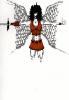

III. The Answer of Nix
Together Fee and Nix swam down the street of Kelpie City, passing all manners of sights, or at least those want to appear in such a place. Kelpies of note rode about in chariots made of grand, chromatic seashells, dressed in the sort of glossy refinery they found beautiful; often these were tiny beads or miniscule pearls, or sometimes the scales of more loudly colored fish. These scales, the reader may be assured, were appropriated by no violent means. To the contrary, where one finds kelpies one seldom finds violence, unless mischief could be considered a lowly form of that activity. But then, of course, all Faerie were inclined towards mischief, so it would be odd to hold that especially against the kelpie folk.
Merchants littered the streets, mustached shrimps weaving their appendages, clutching baubles and gadgets of every sort. Shrimp have ever been the salesmen of the sea, for being especially diminutive and exceptionally useless (except as food or fertilizer) to the intelligent society of the waters, it was necessary therefore that they ape stations of import, inventing needs where nothing was wanted and wants where nothing was sought. In this manner, shrimp avoided, whilst in the sea, the dangers of cocktail sauce when they were among fellow water-creatures, though as yet the only defense the cunning of these salesmen have artificed against humanfolk is the trail of fecal matter lining their bodies, a result no doubt of their trade among kelpies.
What are called by Faerie fishdragons and by men seahorses abounded in the city too. Some of these towed the carriages before mentioned, or sported sometimes single riders, kelpies either of youth and wealth or submitted to positions of civil service. The fishdragons had great wide eyes and beautiful gold, brown or green eyes, and their riders were often swathed in expensive trappings, scintillating rainbow fish scales, dollops of gold and trimmings of the finest red seaweed to make the most distinguished dress among kelpie fashion.
Fee found herself noticing the gills of Nix as they passed along together, their natural means for breathing water, which she herself lacked. Airbubbles and drifts of water flowed around the creasing, wavering strips as they opened and closed, revealing for brief moments the dark red flesh within the gills. Certainly partakers of this tale have asked to themselves how Fee breathed without this physical accoutrement; had one seen the little Faerie, or any little Faerie of her sort (which are called sprytes, as I have neglected to mention, by many, though they call themselves sylphs most usually), one would note a most beautiful, translucent glow about her body. This iridescent aura possessed by all sylphs is their Faerie magic, and its brightness indicates their health, and its hue their mood or sometimes their endeavors. Ordinarily, Fee’s glow was the greenish gold typical of her kind, but now it was a bluish white, mostly. This change allowed her to breathe in the depths of the ocean; how exactly this is so remains a mystery to most non-sylphan scholars on the matter, and so I would ask the reader not levy too harsh an opinion of my ignorance therein.
Nix, of course, was entirely aware of Fee observing him in this manner, but did not let on until suddenly he swung his gaze on her with an amused grin.
“It’s not polite to stare, princess,” he chided lightheartedly.
“Forsooth, and it is most improper to correct a princess, moreover,” Fee answered with a grin of equal ebullience. She was thinking of Sindri’s question, and for some reason she wondered if the answer was in those gills. “Nix, why does water not speak?”
He gave her a peculiar stare and did not answer, thinking for a few moments. “One of Sindri’s assignments, huh?”
She nodded, rolling her eyes. “You know him too well.”
“You’re in luck. I know precisely why the water does not speak.”
“You do?”
“Yes, I do.”
He was silent for some choice moments, until she burst out, exasperated, “Well, why, then?!”
“It’s very simple, really. The water does not speak, you see,” and here he paused very sagaciously, “because it does not have a mouth.”