


For the Agonstics out there... and the Atheists too, if they'd like to answer.
13 posts in this topic.
-
Soo! Recently I have experienced this twice, as someone firmly in the land of agnosticism, once from a Christian, and once from an atheist. Both of them told me that I really ought to decide one way or another what I believe. Like, saying that I wasn't sure, that I don't know one way or the other if there is or isn't a god, wasn't a good enough answer. My Christian friend was very serious, while the atheist friend said it more in jest than anything. I was wondering if anyone out there had experienced anything similar, like being on the fence was not an acceptable answer and you had to choose one or the other?
-
I don't think I have been in that situation. Religion is less common in my area. Although you don't have to pick one or the other tell them you are agnostic.

-
My reaction to such conversations with people like that is something like.
Me: hahahahahahha
Them: I'm serious you ne-
Me: hahahahahhahahha
Them: What the hell is-
Me: ahhahaahaha- oh man that was funny.
Them: You can't just fence sit on something like-
Me: ahahahahhahhahahha -
Brilliant XD
-
Actually, a lot of us atheists are really agnostic, but don't want to explain the term to everyone or conflate them as one and the same. I know I'm like that. Open to all experience in life.
-
Yes, I have been in a situation like that, and it is totally acceptable to be on the fence. It is up to you what you believe, not your friends. Politely tell them to back off and let yourself figure out what you believe.
-
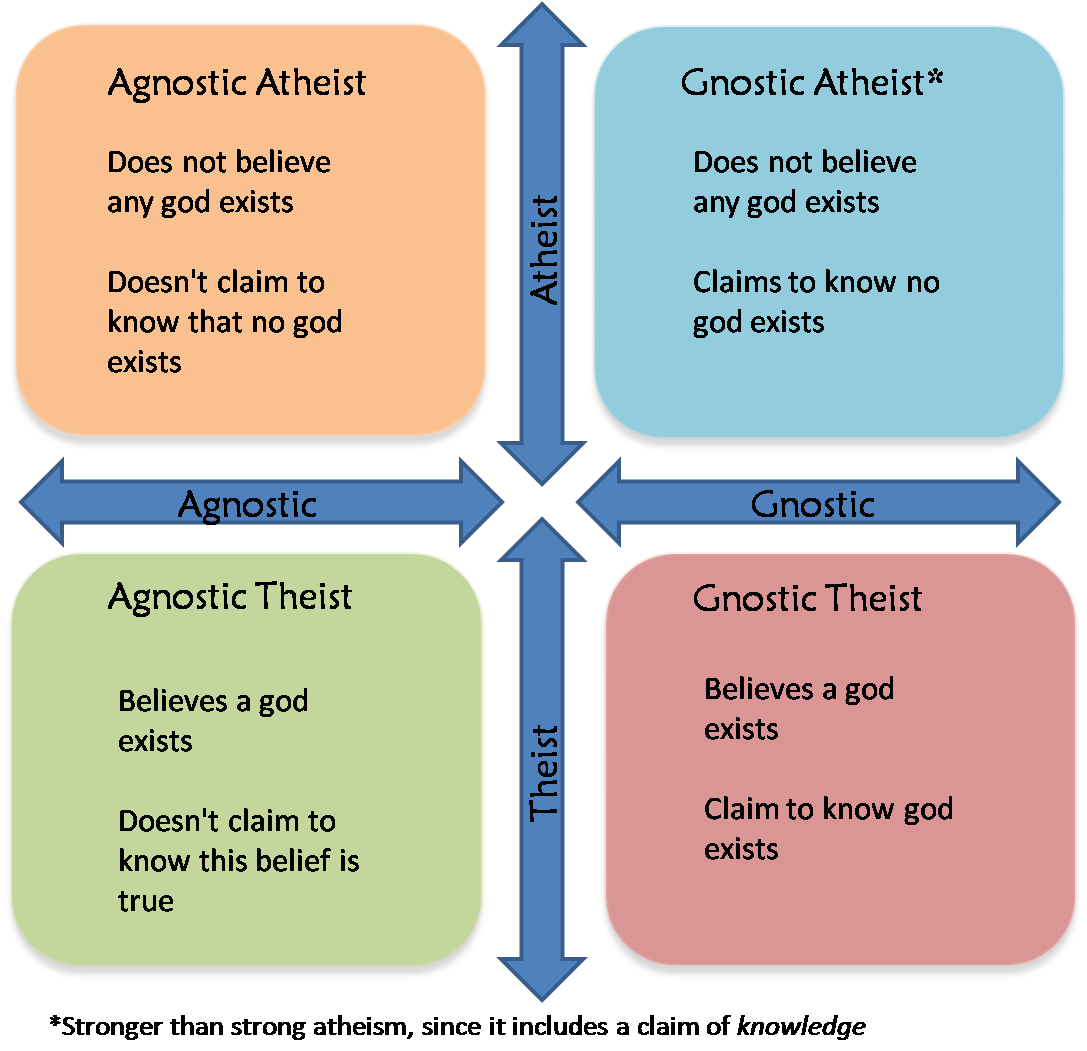
Not only acceptable, but necessary. It's impossible to know that gods do not exist, so being a gnostic atheist is as irrational as being a gnostic theist. Like Kay said, most atheists are agnostic; while we don't know that there are no gods, we know that the probability of gods is so low we might as well live our lives under the assumption that there are no gods. So it's more atheism in practice rather than atheism in principle. Also, keep in mind that agnosticism and atheism are NOT two point on the same scale; they're on different scales altogether. It's more like this.
-
I have. I really hate people who are like that.
Them: well, you have to choose-
Me: Is this your life? No. Are these your beliefs. No. Keep your nose in your own business, and stay out of mine.
Them:... No need to get snappy...
Me: You are the one who confronted me. So just SHUT UP and go sulk in the corner.
Them:... -
Go with being an Atheist then - obviously you do not actually believe in a God, which is what being religious means. In my opinion, of course.
-
Alternatively to what karzkin showed, agnostic ranges and temperaments more often then not, branch directly from one of these five I list bellow. The over all complexities based on each person are different as the concept as a whole is not very unified. But tend to play out like this:
Temporal agnosticism "I don't know whether any deities exist or not, but maybe one day, if there is evidence, we can find something out."
Permanent agnosticism "I cannot know whether a deity exists or not, and neither can you."
Pragmatic (apathetic) agnosticism "I do not see proof of any deity, in its existence and over all interest in any supposed creations, it may exist but I do not know. Thus the question is largely academic, and isn't worth spending time on." (What Zolen is.) (note that Temporal and Apathetic agnostics act very similarly, however are fundamentally different.)
Agnostic theism (usually the theism in question would be mixed with one or more religions) "I do not know that [deity] exist, but still believe [deity] might exist."
[/b]Agnostic atheism[/b] "I do not know for sure that any deity exist, but I believe, or at least am relatively confident there are not any." (Note that Permanent, and Atheist agnostics act pretty much the same, in how they handle religion...which is to say..vocally.) -
The issue is the varying definitions that people apply. I have a very narrow definition of the appropriate use of agnostic and so I'd rather not be misconstrued or unintentionally group myself with people expressing a view I don't agree with.
If agnostics are just people who don't abide by religious texts but refuse to rule out the possibility they might be accurate, if their opinion is simply "Well, I don't think it is, but the Bible might be right" then that's nothing I want to be associated with, it's a completely stupid distinction to make. It's a cowardly position, I think. What else can you say about someone who has looked at the Bible/Qu'ran/Torah/whatever and seen them for the implausible, rambling, primitive relics that they are, but who is too beholden to that sliver of irrationality in their minds that says, "But what if they're right?"
A question like, "How did the first single-celled organism develop from mere chemicals?" is truly wondrous to ponder but it doesn't inspire a spiritual sense of agnosticism: I think that one day human knowledge will be able to explain that question, but regardless, it is the presence of the inexplicable that I believe drives religious feeling. It's a need to have an answer, ideally a comforting one, for what we cannot comprehend. It was a great folly to invent epxlanations for these things, to bring a sense of order to the bewildering chaos that was life in the times most religious texts were written. In those days, religion had an immeasurably greater logical merit, what with all that was inexplicable for humans of the day to contend with. That plagues, diseases, storms, natural disasters, even death are not the result of moral failings; that the idea of a virgin birth is impossible; that it isn't possible to live to 157 (Abraham), that the world wasn't created it 7 days, nor was it 'created', and so on and so forth. Our collective library of knowledge almost utterly disproves everything in religious texts. It is solely because of their ancient history that they have acquired a sort of mystic legitimacy. If the Bible/Qu'ran was written today it would be dismissed as a dangerous, bizarre, ridiculous cult. Scientology and Mormonism are so hilarious only because of their relative modernity. So how on earth anyone can look at religion and feel agnostic is beyond me. -
Agnostics are not unified, the list above I gave is just a general coverage of it all, what people tend to more or less fit under, but at least for myself I can say I am agnostics because I do not assume to be all knowing, rather then dismissing things outright I have left them in the open, on the off chance SOMETHING in them is true. I am admitting at a lack of knowledge and thus a refusal to entirely block something off just because it makes sense to doubt it or question. Because while I do not know if any religion in question is wrong, I know that in the past humans have claimed many things were impossible or possible that are now true, and it would be stupid to close our minds to a possibility, even if its not a probability.
-
I'm an atheist, so I obviously think that's the right answer, but I would never dream of pressuring you or anyone else to chose what they believe. I think it's fine to be on the fence or religious or not. If you really want to decide, you can flip a coin (hear me out) and if you're disappointed by the outcome, go with the other option. This generally works for me, but sometimes I have to flip the coin more than once.










Sign in to reply to this topic.
Delete this post?
Are you sure you want to delete this post? This cannot be undone.