Movie Buffs

Movie Buffs

For all the movie lovers out there!

  • 32 forum topics
  • 300 wall posts
  • Created Mon Jul 29, 2013 4:35 pm

← Back to Forum

Faulkner's Movie Reviews

6 posts in this topic.

  1. So seeing as I'm planning to watch quite a few movies over the next few days, I decided to start a movie review thread of my own.

    Just a few hours ago, I suddenly got a craving to watch Whiplash, but my local blu-ray rental shop has closed. While waiting, I decided to watch another movie instead in hopes that I could maybe get back to my movie-viewing streak once more. Tonight, we have...

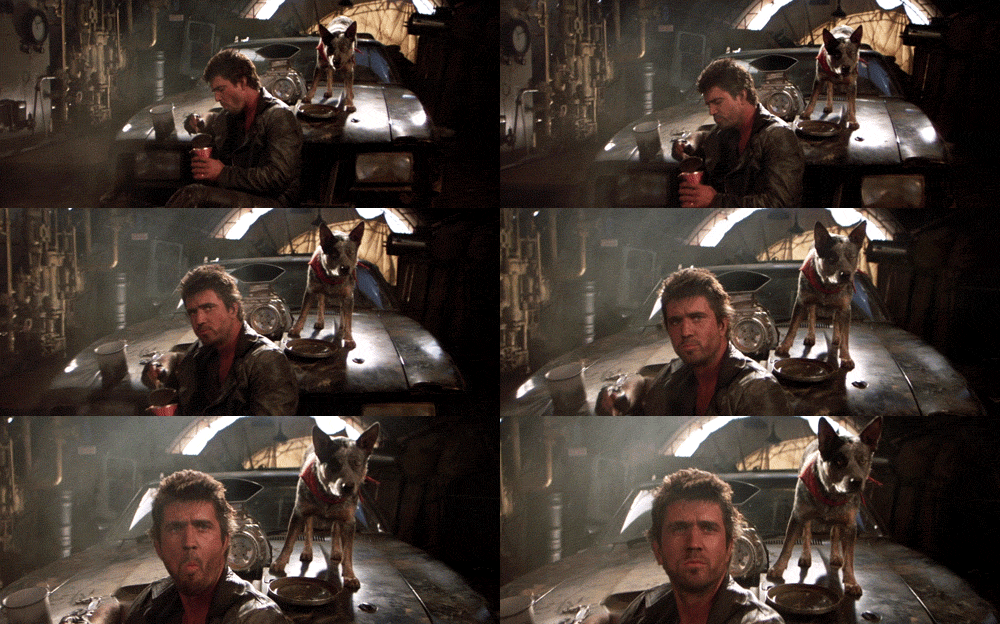
    Mad Max 2: The Road Warrior
    Image

    Mad Max 2 is certainly not the highly-praised sequel I have expected. Its plot was pretty average compared to the rich world and the multiple themes we were introduced to in the first movie. I kinda wish they had dived deeper into the deterioration of society as narrated in the opening prologue, but I was told that the third movie would continue such exploration of the Mad Max universe.

    That being said, I could definitely see why people consider it one of the most entertaining movies of the '80s. For a product of its time, it was a non-stop action film pumped with adrenaline. Throw in a character as badass as Max and you're guaranteed an explosive good time. The car stunts in particular were as great as the first movie.

    The characters who were not Max didn't impress me as much as those from the first movie. This goes back to the incorporation of multiple themes in the first Max. With those many themes, the movie had an opportunity to include interesting characters of various backgrounds, such as the homey housewife and Max's love, Jessie Rockatansky, as well as the dutiful officer with the sense of justice, Jim Goose. Moreover, I found The Toecutter's eccentricities much more interesting than The Humungus; the latter's bluff as a faux pacifist didn't impress me. And of course, there was the dog, who served up the usual comedic moments you'd find in movies with protective dogs... he was kinda forgettable too, to be honest.

    It's not all blend with the characters in Mad Max 2, however, as I'll admit that the Gyro Captain was somewhat interesting as a sidekick comic relief. He certainly didn't seem that original but managed to nonetheless serve a few nice laughs here and there.

    One thing I should note is that the lighting was really dark during the night scene where Max snuck away from the encampment with the four cans of gas on his shoulders. I almost couldn't tell where he was going. I was told that it's because they didn't use any lens to film the night scenes, which makes for a natural night, but it's not practical for filmmaking, IMO.

    Aside from the few moments of understandable awkward acting, some of the scenes were sped up to make the cars look like they go faster on film. I didn't notice this at all during my viewing, so it's clearly not a major problem. The raw and gritty filming style of this movie is largely acceptable by me. It fits with the world Mad Max is set in, and it didn't interfere too much with the storytelling.

    Overall, I enjoyed Mad Max 2. I probably seemed annoyed at its flaws, which cannot be further from the truth. George Miller's classic reminds us what real filmmaking is like - no CGI with raw acting. The fact that Max remains one of the most badass action heroes unmatched by modern mediocre action heroes such as Jason Statham says a lot. The whole 'Road Warrior' bit might seem campy at face value, but I feel that it really works here as the vengeful anti-hero goes on a soul-searching journey on a lost road.

    Unfortunately, Thunderdome doesn't seem that all promising... neither does Fury Road.
  2. 30th March
    Image


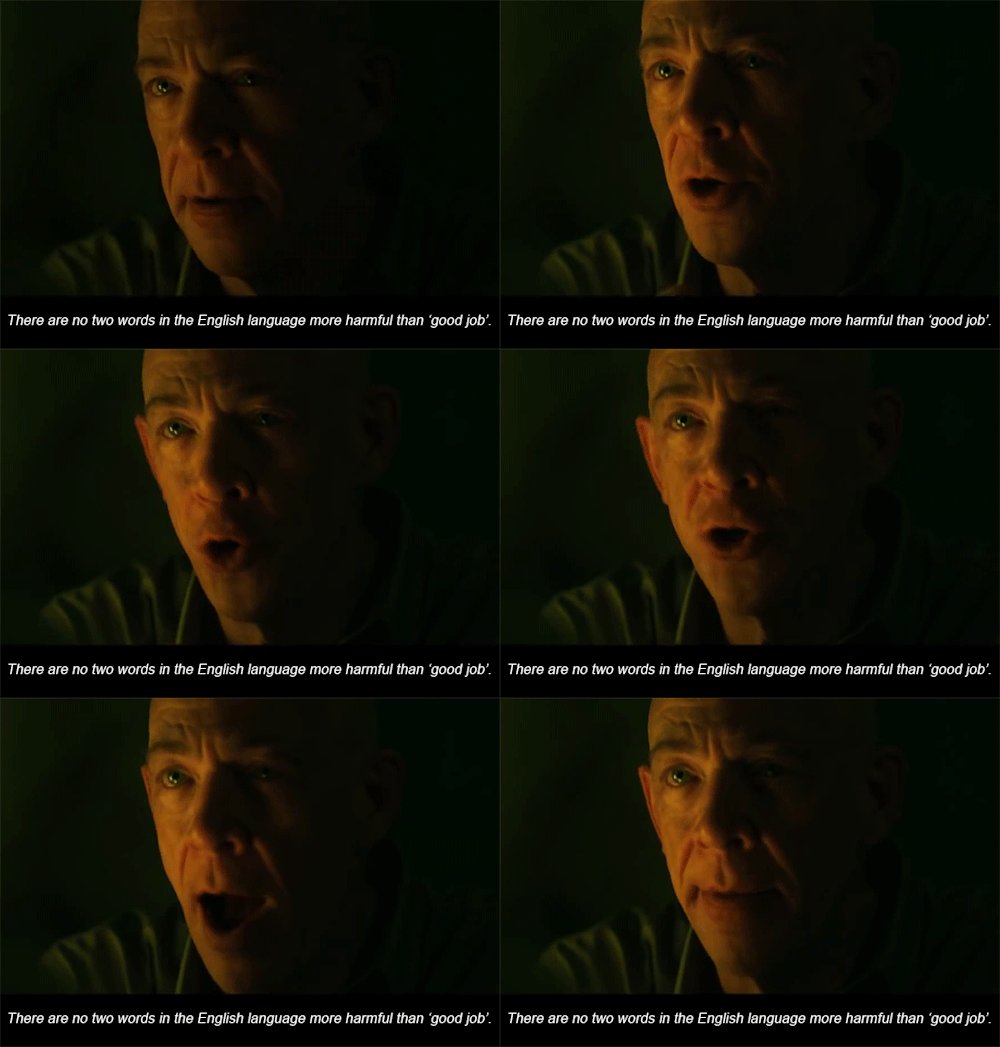
    Whiplash [rating]4[/rating]
    I have always been a bad student. Tough teachers? Oh sure, I've seen plenty. But there is a difference between a tough teacher and an unmotivated, uninspired student who doesn't put 100% into his studies.

    "Unreasonable" has become a platitude, particularly when referring to tough teachers.

    That being said, I could definitely relate to the kind of frustration untalented people have, the fear of incompetence that drives you to giving up. It takes a few good years of self-reflection for those kind of people to understand what the teacher's message: "Nobody is going to give a **** that you are incompetent. You think you are special, when everyone else has grovelled through the same mud and scum that you went through to get the success they have today?! Man the **** up!"

    Cheery. It's definitely not the kind of message our 'civilized' society could swallow today.

    At face value, Whiplash was good fun. It has a nice message about achieving greatness through hard work, and that greatness was beautifully exemplified by the crescendo that's the ending itself. I love fast-paced music, and as a kid, drum beats excited me. Whenever I hear slow-paced music hailed as "romantic", my response is this:

    phpBB [media]

    (Note: If the sound cuts off for you, you're probably using Chrome; it works fine on Firefox for me)

    When you dig deeper into the message? It's a melancholic message of PTSD. Or Stockholm Syndrome, depending on how you look at it.

    After all that intense berating, screaming, bleeding, chair-throwing action, it was such a wonderful feeling to see all that hard work paid off at the end. The drum beats at the end were, in a word, orgasmic. It was sex to the ears. So gratifying were the sight and sound of success that some might miss the grimmer consequences that come after the torture. Neyman had to strip himself of everything he was just to become 'one of the greats'. He lost his girlfriend because he was acting like an ***hole (not because he broke up with him; he didn't break up with her, she broke up with him and got herself a new boyfriend), he spat on the 'normal' ideals of the common people (such as his uncle Frank), and he adopted a twisted mentality of what it meant to be successful.

    Andrew Neyman: Charlie Parker didn't know anybody 'til Jo Jones threw a cymbal at his head.
    Uncle Frank: So that's your idea of success, huh?
    Andrew: I think being the greatest musician of the 20th century is anybody's idea of success.
    Jim Neyman: Dying broke and drunk and full of heroin at the age of 34 is not exactly my idea of success.
    Andrew: I'd rather die drunk, broke at 34 and have people at a dinner table talk about me than live to be rich and sober at 90 and nobody remembered who I was.

    Even the director himself said that his vision of what Andrew would become in the future is not something as naive or idealistic as people might think; after all, Charlie Parker died of heroine abuse at 34.

    But as controversial as Terence Fletcher's message might be, I agree with him. Or at least, I agree with his methods.

    "People wonder why jazz is dying."


    I have been beaten with a small cane by my parents when I was a kid. I was humiliated multiple times by my teachers when I was a teen. I was abused and pushed beyond my physical capabilities when I was in the army, conscription camp. And you know what all that has brought me? Success? No. More insecurities than ever. These things do stick with you. But you know what? I don't blame them. I know that it's due to my own mentality that I'm responsible for my own failure. It's not because I was pushed too hard by others, it's because I never pushed myself!

    It's all a matter of mentality. You could either treat your abuse as so-called "unreasonable punishment", or you could pick yourself up, shake it off, and push yourself beyond the limits your tough teacher has set for you. Be more tough on yourself than your teacher was to you. Charlie Parker didn't die because people were too hard on him - it's because he chose to be a heroine addict. That was all on him. Technically speaking, you can't die of clinical depression. Trust me - I've tried dying like that, it doesn't work. People died of hanging themselves, taking drugs, jumping off the roof, etc, etc. People don't die of depression. People die of their choice to commit suicide.

    Am I sounding familiar yet? Do I sound like I'm excusing the things my abusers have done unto me like a certain aspiring musician in a certain movie?

    Good movies like this make you question the daily things you have in life. It provokes, sometimes violently, but in the end, you will have a new outlook.

    The themes of the movie aside though, it was a bit dragged out near the end. Not my tempo.
  3. Oh yeah, I forgot to add the ratings to my two above posts. I keep forgetting I'm pasting these reviews to another site.

    Mad Max 2: 3.5/5
    Whiplash: 4/5
  4. The Departed
    I really expected this to be a four-star movie, really. I mean, it's Scorsese. Cape Fear was awesome. So was Goodfellas. But near the third and final act, some questions started popping up in my head:

    First off, why did Billy trust Sullivan so easily? Even I wouldn't be quick enough to suspect him had I not known he's Costello's rat considering that a) it's well-known that there's a rat in the police department, and b) someone just coincidentally calls me on the phone of my now dead informant. I would have suspected that this is the same rat who might have tailed Queenan somehow and murdered him.

    However, I didn't really mind that Billy began talking to Sullivan instead of just hanging up like he initially did, because think about it: Billy didn't know that Queenan was pegged as the rat, so for all he knew, it could either be Costello's rat on the other line, or it could just be some officer trying to reach him after being informed about the existence of an undercover cop.

    That being said, I still think Billy was too quick to trust Sullivan, but that's largely a subjective point (not to mention that Billy's portrayed as kinda dumb, to be honest), so let's move on.

    Why didn't anyone make a big fuss about the murder of a police captain? I'm sure the police department would love to use the murder of a captain as an excuse to haul Costello's entire band of hooligans downtown and do some hard questioning. Was it because they were two different departments? The FBI and the undercover department? If so, I still find it kinda weird that they couldn't do any crack-down at all, considering that it was an officer who's ranked "Captain".

    The next one's a big one: why didn't Billy just go out and yell, "FKING SULLIVAN IS THE RAT!" Yeah, because the possibility of him deleting your personal records didn't seem likely at all, no no. You have to go all secretive like a ninja and scheme a trap instead of telling any single officer in the police department you are in. Even if it's unbelievable that Sullivan might be the rat, at least show us Billy telling somebody, anybody. Even if his word against Sullivan might not have been taken seriously, at least show us something!

    There wasn't even any implication that this plan might not work! Billy's got the hard evidence at hand, I doubt that some explanation wouldn't allow the other officers to put two and two together. These are supposed to be detectives, right? You know, sleuths like Sherlock Holmes? Or has the title been sullied by too much donuts on their free time?

    And finally, it was kinda easy to spot Billy out as the rat, to be honest, especially after Sullivan had spoke to a young Bostonian in his twenties. I think that at least scratches off a few people in Costello's dirty dozen. And you know, it did seem like just a dozen people following Costello around, most of them old guys.

    Though to be fair, Sullivan did notice that little note about Costello being an FBI informant in the very next scene, so... eh.

    Now with the apparent plot-holes out of the way (or I might just really be mistaken, in which case feel free to correct me), there are a few other things I would like to address.

    For starters, the acting. I love Jack Nicholson (especially the rat-face that he made), but there were parts when I felt like Jack was playing the eccentric villain he seems to be often type-cast in. Leonardo was FABULOUS. I loved the chemistry he shared with Vera Farmiga. I mean, even though Sullivan is the love interest of Madolyn in this movie, Billy hits off with her much better, while the supposedly 'ongoing relationship' with Sullivan seems fake (which works in effect to implying how pretentious Sullivan is as a person, I suppose). And even though Matt Damon felt like he was type-cast as another Jason Bourne here, it works in his favor because the apparent innocence of his character really sells the parallels between the antagonist's baby-face and the protagonist's thug-face (Billy). The same goes for Wahlberg, who plays the mean ***hole kind of character that goes well with that face you just want to punch... not implying anything, ahem. Martin Sheen is playing Martin Sheen, so let's move on.

    The overall mafia theme of the movie, or just the mafia theme of any western gangster movies? I'm afraid I can't relate much, nor am I that knowledgeable about western gangsters to comment on that. Nevertheless, I love the parallels shared between Billy and Sullivan, "two sides of the same coin" as Leo so eloquently put it in an interview. Strangely enough, this is not the plot-centric convoluted movie many people have misconceived this movie to be, or rather, not strangely, this is a character-study, much like many of Scorsese's masterpieces. Though the plot is easy enough to understand, watching these two characters try and escape being made as the rat was pretty interesting to say the least, especially when you deal with the question of "Who is the bad cop here? The violent thug in undercover or the pretentious romantic?"

    Despite the thrilling moments when you try and figure out who's going to come out on top of the other, some of the abovementioned flaws just hold this film back from captivating me as a Scorsese film might have.

    3.5/5

    On a final note, Dignam's sudden appearance at the end isn't really a plot-hole. Dignam could have been informed anytime by either Madolyn through instructions given by Billy, or by Trooper Brown ("I told you to bring Dignam!") before he confronted Billy on the roof.

    Now to watch Infernal Affairs and see if it is just as good as the remake.
  5. Infernal Affairs (3/5)
    phpBB [media]


    Ho boy. Here we go. The bashing of the original.

    Just kidding. It wasn't that bad. But still, the practice of seeing the remake before the original can really switch up your ordinary "original is better than remake" perspective, because damn, Infernal Affairs sure made The Departed look like Citizen F-ing Kane. :P

    I'll admit, I've always had little respect for Chinese movies, despite being a Chinese and an Asian myself. Most of the ones I grew up with just didn't impress me with their low-concept plot, and a lot of them were mindless action films focusing on badass characters, their storyline as interesting as as Jackie Chan or even Steven Seagal movies. That's not to say all Chinese movies are like that (not that I've had the fortune to be blessed with the viewing of amazing Chinese movies), nor am I saying that Infernal Affairs is outright terrible... but damn, did it ever come close! xD

    Jokes aside (and I was really just joking; it's not that bad), there are a number of flaws that Scorsese brilliantly fixed in his remake. The tension of two cops hunting each other was fantastically done in The Departed, while in Internal Affairs, there seems to be an obsession to pace everything so slowly like it's supposed to be a character study... only that the characters aren't that interesting, especially Billy- oh, sorry, I mean Chan Wing-yan, the undercover cop.

    Chan was played as such a straight, average guy that it was rather boring to watch him. He's a mole in the mafia, but he keeps such a cool and calm demeanor with him the whole time that it absolutely makes no sense in contrast to Leo's portrayal, where a desperate man is fearing for his life. So by the end of the movie, when he desperately wanted his identity back - I don't give a s***! You didn't convince me that you were fearing for your life. Why the hell should I care now?

    Andy Lau. You know, Pretty-Face here definitely is more suited for singing than acting. Though it might be largely due to my lack of experience in Chinese movies, I've rarely seen Andy Lau in a good role! At least Matt Damon has a great reputation in acting, not to mention his performance in the Bourne franchise. Most of what I've heard Andy Lau from the Chinese community is his singing career. It helps that Lau Kin-ming (coincidentally sharing the last name of the actor, or should I say lazily) is supposed to be a blend character from the start, which was why Damon's type-casting works. But at least Matt was somewhat entertaining! Andy just acts like every music video I've seen him in - stone-faced and boring as f***!

    And no, I'm not done!

    Eric Tsang, great man, fun actor to watch. I've always had a personal bias for Eric, for he just has a kind of charm that wins me over. But here... I think that charm's a little underused. He's slightly less dead-eyed than the rest of the cast, and that's not saying much. And honestly, some aspects of his goofy persona outside of acting could be seen here in his character. Whereas Nicholson inadvertently brought his eccentricities to work, Eric brought his goofiness. Not that I could say I hate him for it - I love him, even if I can't bring myself to say that it's suitable for his character.

    Going back to the overall pacing of the script, this movie just feels awkward in many parts. The three different love interests being combined into one was one of the best ideas Scorsese ever had. The way it's played out here, it's so ridiculous. Not only Chan's love interest (Lee Sum-yi) spontaneously falling in love with him all of the sudden without prior foreshadowing or anything, we never got enough time to care about the other two love interests at all. Seriously, what's with Hong Kong movies with their spontaneous love interests? Is that how relationships work in Hong Kong? Because this is not the first time I've seen something like that.

    It's not all bad, of course, as the film did a few things much better than the remake, such as Superintendent Wong Chi-shing being the only one who knows of Chan's identity instead of having two separate cops. This work well because Chan and Wong are able to have a tighter relationship together in the story, their bond closer, without some Marky Schmuck injecting clever insults and interrupt the moment. That was... until the corny death music came around and spoil what could have been an emotional moment. Seriously, why do people have to insert stupid music in the background when someone dies? You underestimating our emotional capabilities, is that it? The scene worked so much better in The Departed with the silence. You could feel the shock from seeing Leo's surprised expression being reflected on your own face without some over-the-top Church hymn. If only they could combine that scene with the bond Chan and Wong had, because I didn't really feel the chemistry between Queenan and Billy.

    Also, the Morse Code was pretty clever, much more than whatever Scorsese tried to do with the same scene. The fact that the same Morse Code element was incorporated in a later scene instead of being a Chekhov's plot-device was even better. I have to admit though that I was a bit annoyed how Hon Sam, the triad boss, didn't pay more attention to Chan sending Morse Codes despite LAU TELLING HIM THAT THE MOLE USED FREAKING MORSE CODE! Oh my god. lol

    And really, I can't stress enough the point of The Departed being one adrenaline-pumping thriller whereas Infernal Affairs was a slower drama movie. Leo and Damon really brought the contrasting parallels in their characters, who could not be more different and yet are two sides of the same coin. It was fun to watch how their separate fates unfold. Having said that, the original actually has pretty intelligent themes amidst the drama. Yes, intelligent, much more than the more action-packed The Departed, I'm afraid. Sorry, Scorsese.

    While it is true that the exciting story of two cops hunting down one another was better executed in the remake, I can't dismiss the underlying philosophies brought about by the original movie. See, at the very beginning of the movie, the film goes on a textual narrative (what's with Hong Kong movies and asking the audience to read stuff like it's a book?) about the various layers of Hell, and how the worst one was called "Continuous Hell", where one suffers for all eternity the sins he have committed. Even the Mandarin title played on this theme, with "Wu Jian" meaning "Continuous" while the "Dao", the third Chinese character, meaning "Road". One thing that has always bothered fans of the original was how the remake had a clean-cut happy ending, and I couldn't agree more. Lau in the original is forced to walk the "Road of Continuous Hell", facing up to all the sins he has committed, and we are left with a depressing scene where Lau confesses that he would switch place with the now dead Chan. It is absolutely beautiful.

    Unfortunately, that only came at the end of what is a mess of a movie. Huh. So are the two sequels going to be any better? Or will I be treading on two 'continuous hell' of movie experiences? lol
  6. Infernal Affairs 2 (4/5)
    phpBB [media]


    Despite the romanticisation of its American counterpart, the Infernal Affairs trilogy is not a glamorous experience one would get excited about. If anything, it paints a very bleak picture of humanity, and that's probably why many fans of the original (particularly the Asians) didn't respect what the more cheapened experience, The Departed, has done. You don't walk out of the theater after watching an Infernal Affairs movie going, "Oh, that was such a fun thriller!" This is especially true with the sequels, which seem to tread a more pessimistic path with each sequel.

    Despite my earlier review, I don't really hate Infernal Affairs as much as you might think. In case you were wondering, I was aware that the first film was merely part of a trilogy that was compressed into a single movie by Scorsese. What I failed to mention in my recklessness was that I did get what the first movie was trying to say, and I really liked the concept. I even searched for the song that appeared at the end credits of the first movie because it had such a nice tune to it, and I was then won over by the lyrics conveying the overall theme of the franchise.

    The only real problem I had with the first movie was that the execution bothered me quite a bit. That said, in the second movie, even though it's not an amazing improvement, this is actually a much better movie than the first one. The execution still has a few rough spots, but the way the theme and philosophies are tightly knitted together that it impacts the audience so effectively more than makes up for its flaws.

    One of the best things about this prequel is an effective tool that many filmmakers failed to utilise properly in prequels - dramatic irony. The irony here is used as a means of continuing the themes addressed in the first movie as you begin to make sense of why the characters did what they would do in IA1, why they would become who they are in IA1, and how it all plays out in the big picture, how it contributes to the overall message of the story. I might need a few more rewatch or study other reviews to understand the exact message, but from what I could make out, the idea of 'fate' and 'destiny' are played with quite often throughout the two movies, something The Departed clearly neglected when Costello gave the same speech about "taking what you want" that Hon Sam gave in IA1. They are clearly two different messages with two different context due to the religious and spiritual undertone.

    The great thing IA2 did was push against the ideal of "take what you want" Hon Sam had back in the day. Sam learns some harsh lessons here about having to 'pay' when you're in the business of crime from the triad boss, Ngai Wing-hau. As his life in the triad starts to get a little more chaotic (as expected when you're in a mafia), the whole belief of being in control of your own destiny starts to fall apart. Even though the ending doesn't deliver as powerful a punchline as IA1's ending in regards to foreshadowing Sam's inevitable demise, there lies a great pathos by the end of IA2 that makes you pity the eventual fates of these characters, not just because you know what's coming for them, but also because these are genuinely likeable characters (save maybe Lau; he's Edward Cullen in this movie) who could have made better choices and be better people but were instead forced onto their tragic paths because of unforeseen circumstances. So much for being the master of your own fate. It's a depressing picture that tells you that sometimes, karma can be a real b****.

    One thing I must note is how incredible Eric Tsang is in this film compared to IA1. I love him. This is what I'm talking about! His charm is very well utilised in the story here. You see moments of badassery from Sam that makes you root for the guy because he's portrayed as this quirky and lively fellow who's just out there to make a living. The thing about Hong Kong gangster movies is that they are gangsters as glorified as the mafia you see in American movies, kinda like in The Godfather series. They are portrayed as anti-heroes instead of outright villains, and that fictionality works fine here in IA2 as it makes us like Sam a lot more.

    Another great acting I failed to address in my IA1 review is Chapman To's character, "Crazy" Keung, who is definitely a lot more notable to me than the American counterpart (though mostly attributed to the recognisability of Chapman's face...). I find the chemistry Chapman shared with both 'Chan' actors, particularly Tony Leung, very good and he made for an entertaining comic relief as opposed to whatshisname in The Departed.

    As for the pair of actors portraying the younger versions of Chan and Lau, I don't really have any complaints about them - they did a decent job - though Edison Chen's role is written into quite a few creepy moments, particularly those dealing with Sam's wife, Mary. It's not necessarily a bad thing, especially when it further reveals the vulnerability of Lau's character... but I am getting a bit of an Anakin Skywalker vibe here. Yeah, not the older Anakin either, naturally.

    I haven't talked a lot about Anthony Wong's character in either of my IA reviews, mostly because Wong Chi-shing's tough but sympathetic cop persona in IA1 and the corrupted cop persona in IA2 just didn't strike me as very interesting or original, neither of them did. He's a good actor, and yes, his character is definitely more fleshed out and better-written than Queenan the Forgettable, but it still isn't enough to make me sing cheers about him. He's kinda just 'there', though that can be said for most of The Departed side characters. I do admit though that what his character contributes to the overarching theme of the story is very effective as it shows us his own struggle with mastering his fate as a cop. The sudden death of his partner, I must say, was very well-timed and well paid off, especially with how much screentime there was devoted to bonding those two together. The little gimmick with deciding who gets to have the say using a rigged deck of poker cards is very appropriate as well.

    The music for the sequel didn't annoy me as much as the first one. Though the dramatic church hymns have returned, they aren't inserted in the scenes in an awkward fashion like in the first movie, and they work pretty well to heighten the emotions of the scenes.

    Although the movie did feel a little dragged out after half the movie was over, when the final part of the film appeared, I was at the edge of my seat because we got to see Eric Tsang in his most badass moment ever, one-upping Wing-hau with a set-up to counter Ngai's set-up. It was a little bit convenient, but I couldn't care less as I got to see Eric show off his terrific acting. Oh, it was such a joy to watch his performance that I didn't care that the movie was dragged out as long as it was at that point. And the final scene where Wong was forced to kill another person yet again (even though he didn't directly kill Kwun)! I was wondering how Sam and Wong's relationship got sour in IA1, and even though the explanation in IA2 feels a bit shoed in at the last moment, it makes sense and fits in with the overall context of the story. Two powerful figures who each have their own history of bloodshed they regretted over, and they finally duke it out in IA1 through the dishonourable usage of moles, despite having said regrets. You can't have a more epic setup than that.

    Overall, Infernal Affairs 2 impressed me more than I had initially anticipated. Its atmospheric character study proves much more intriguing than a Scorsese movie of all things, and I'm definitely looking to the final epic conclusion that's Infernal Affairs 3.


Kindness is the language the deaf can hear and the blind can see.
— Mark Twain