



Another helpful feature of Ido is compounding words. You can combine two nouns, with the first modifying the second. For example, skrib-tablo means "writing table". The second portion, tablo, forms the basis of the word, as it is still a table which is being referenced. The first portion is used to modify the second portion. This can be done freely, and dropping the o from the first noun is optional. It is recommended the o be kept when dropping it would make pronunciation difficult. Compounding words is required when you wish to use nouns as adjectives. In English, you can say "sea salt", but simply saying maro salo is forbidden. You must say mar-salo or maro-salo. It is also worth noting that the hyphen is optional but recommended, as it makes distinguishing the parts of the compound easier.
Elision is the process by which -a is dropped from some adjectives, or -as is dropped from present tense verbs. It is used primarily in poetry. Elision is, however, very common when using the word esas, as es is significantly easier to say in faster typing and speaking. Elision is also the reason why pronouns can be shortened from, say, elu to el.
Numbers can be counted in Ido as such. Un, du, tri, quar, kin, sis, sep, ok, non, dek; dek-e-un (eleven), dek-e-du (twelve), dek-e-tri (thirteen), dek-e-quar (fourteen) ... dek-e-non (nineteen); duadek (twenty), duadek-e-un (twenty-one), duadek-e-du (twenty-two) ...; triadek (thirty)... quaradek-e-kin (forty-five); ... cent (hundred), ... sepacent-e-duadek-e-sis (seven hundred and twenty-six); mil (thousand). Be aware of the use of the a when multiplying numbers, such that twenty (duadek) has an a to represent what is literally "two times ten". -e- is used to show addition, such as "ten plus one" being "eleven" (dek-e-un).
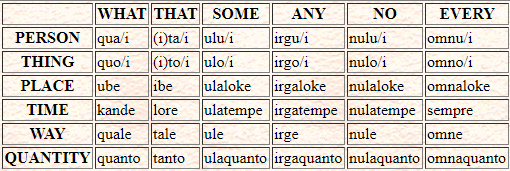
Ido question words are kande - when, quale - how, ube - where, and quo - what. Yes or no questions are formed by using ka, such as in a sentence like "is the train here?" To form any question, you don't change word order. Rather, you just add the above question word to the regular sentence. "La treno esis hike" "means the train was here", but "ka la treno esis hike" means "was the train here?".
This chart is a helpful reference for correlatives, which include question words and their responses.
Source - http://interlanguages.net/Grammar.html